
Search for a camping hammock tent and you get a wall of listicles.
Every one of them shows the same thing: a sealed pod hanging between two trees, bug net sewn in, rain fly built on, one bag, one purchase, problem solved.
That product exists. You can buy it today.
What none of those pages tell you is that it is the heaviest way to sleep in a hammock, and often heavier than the tent you were trying to replace.
I went through the actual published specs for the all-in-one hammock tents that dominate this category, then put them next to a matched component hammock setup and a matched ground shelter.
The numbers reorder the entire decision.
What You'll Learn
Quick Answer

A camping hammock tent is not one product. It is three different configurations that share a search term.
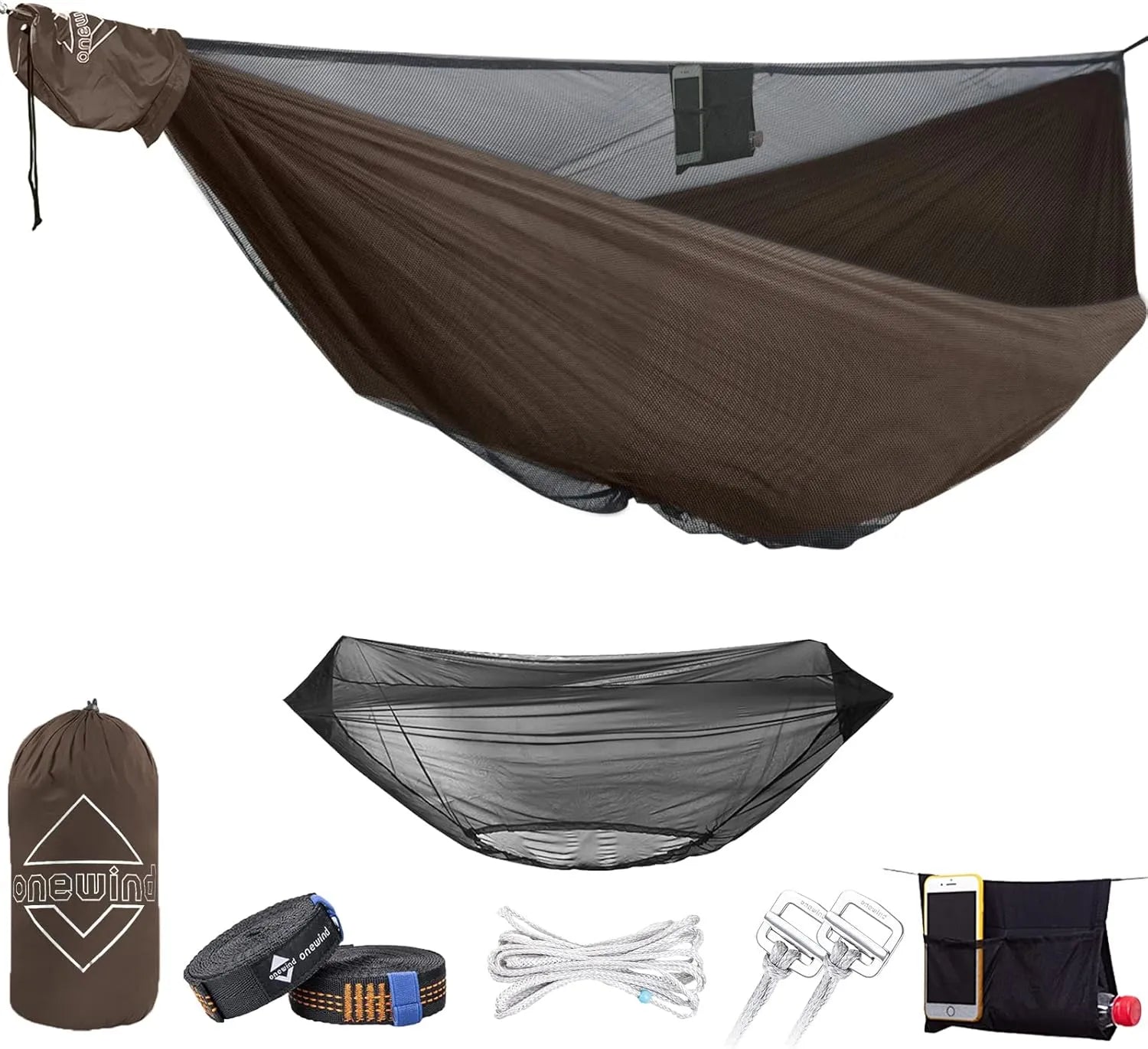
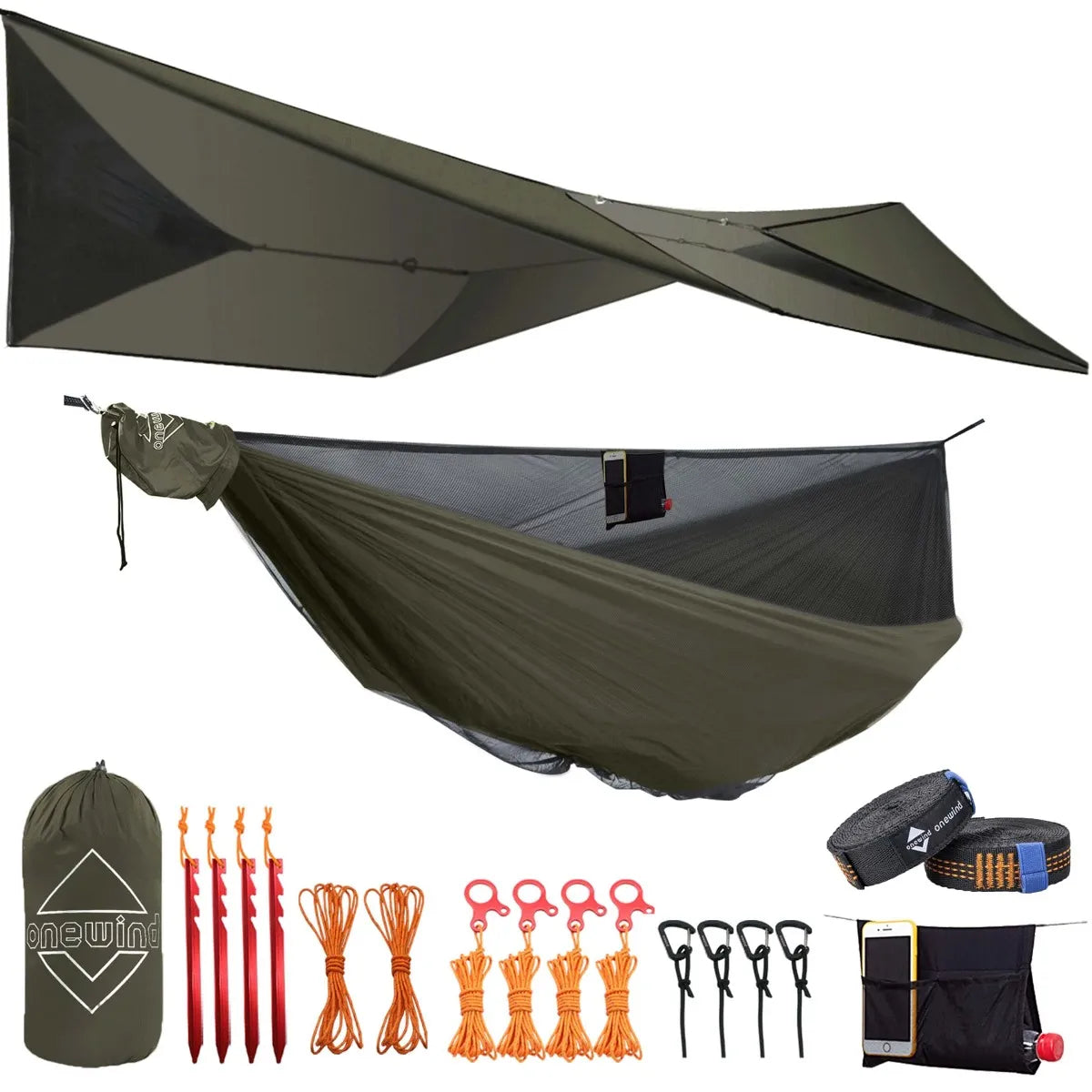
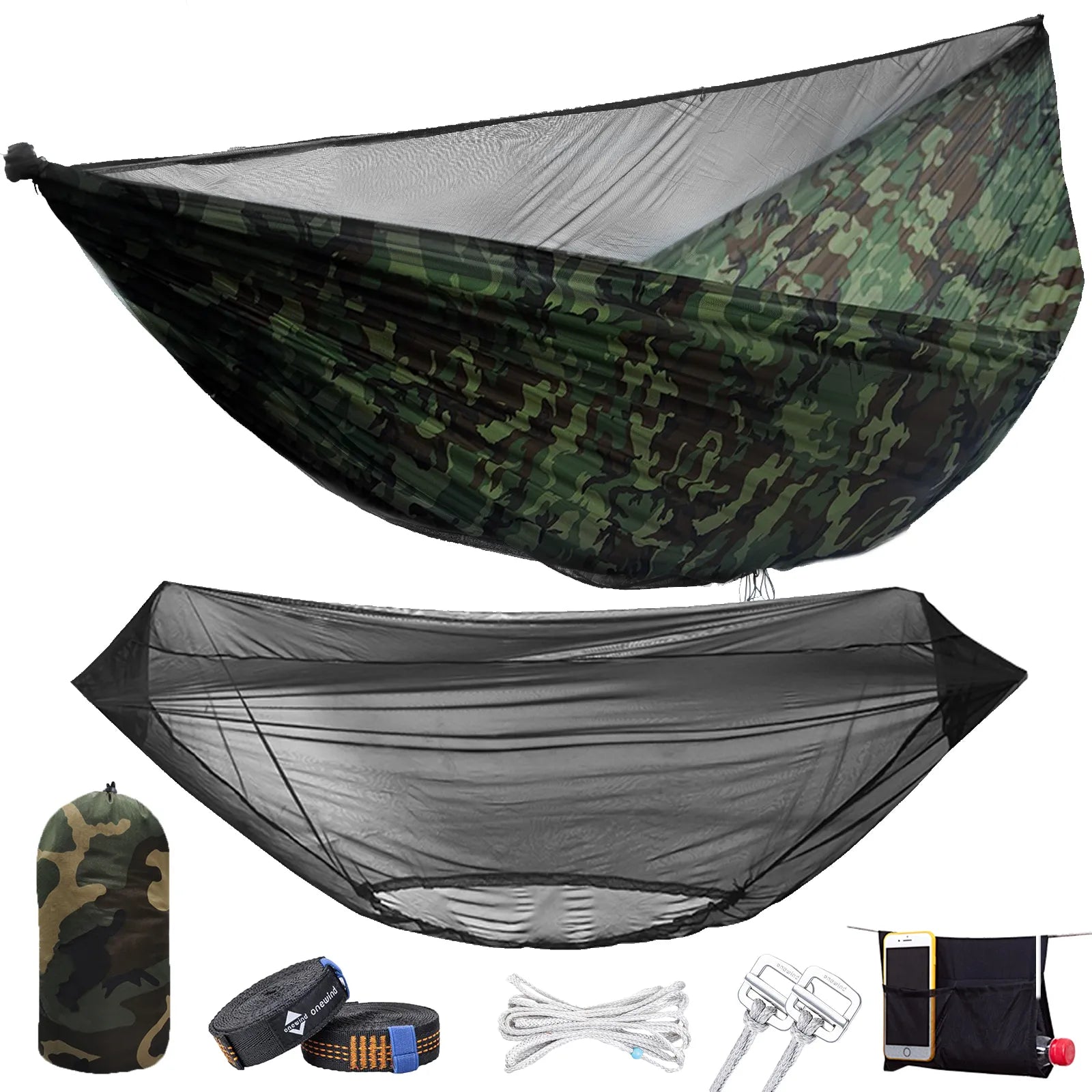
Configuration 1, the integrated all-in-one. Hammock body, insect netting, and rain fly built into a single unit. Real shipping weights run 3.3 lb to 7.7 lb.
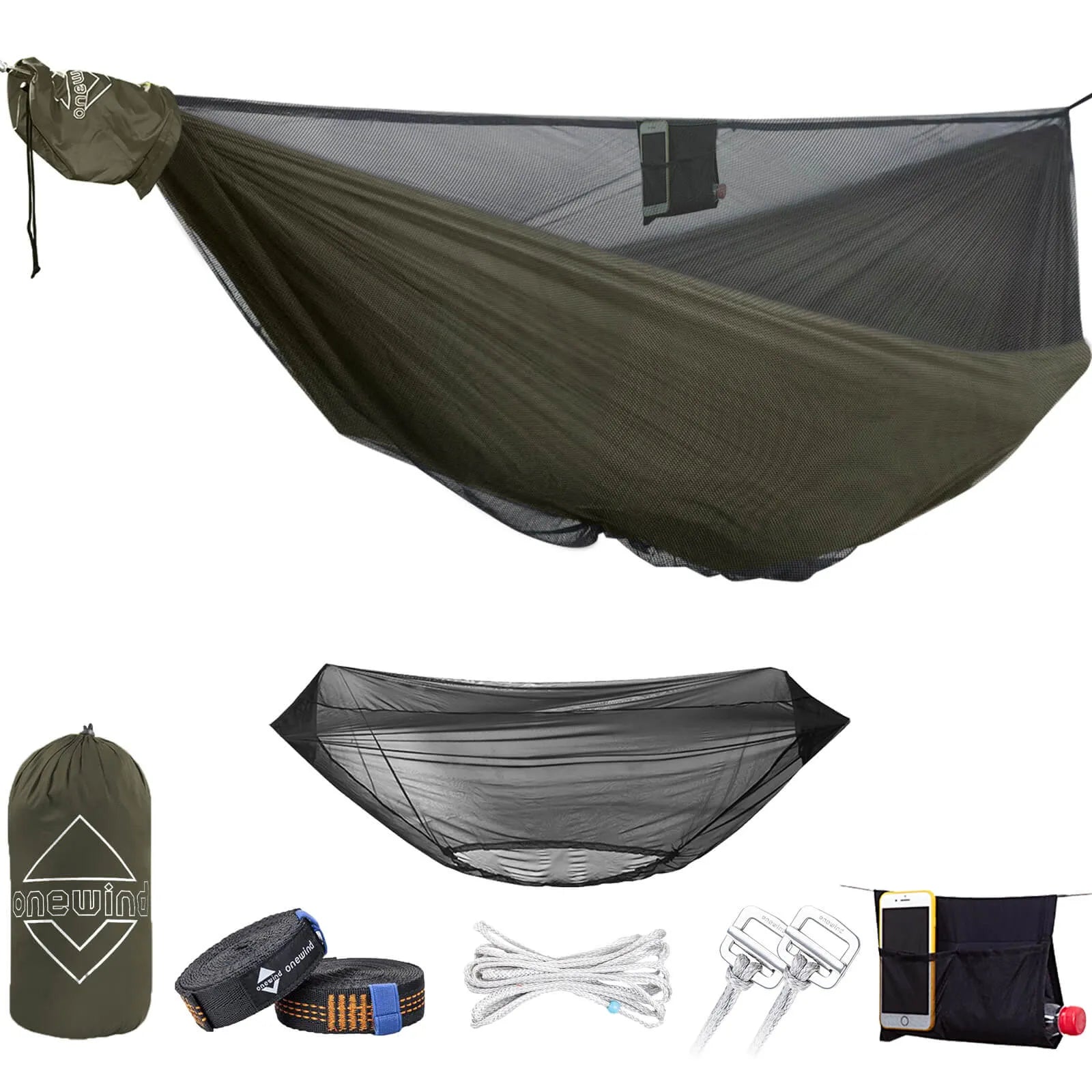
Configuration 2, the hammock with a sewn-in net. Hammock and bug netting are one piece, the tarp is separate. This is the middle path.
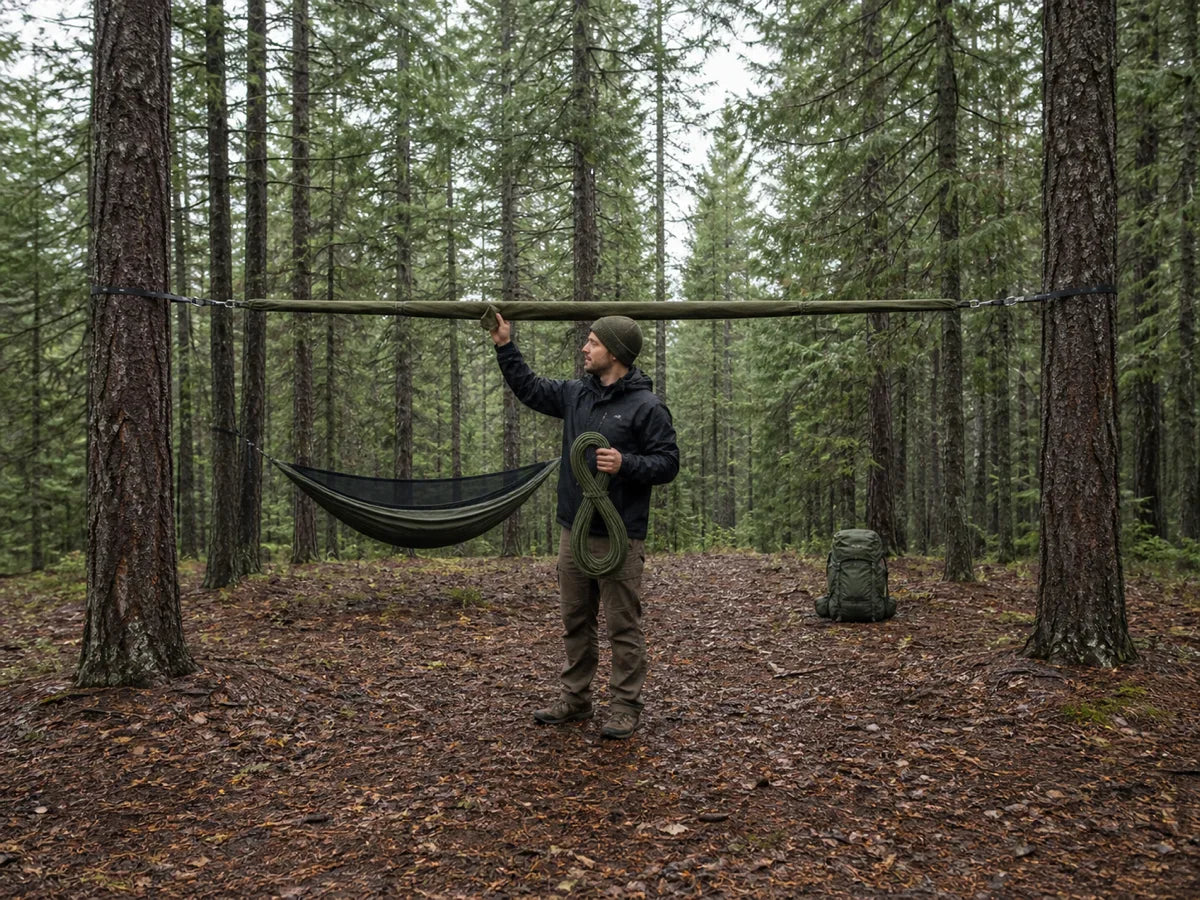
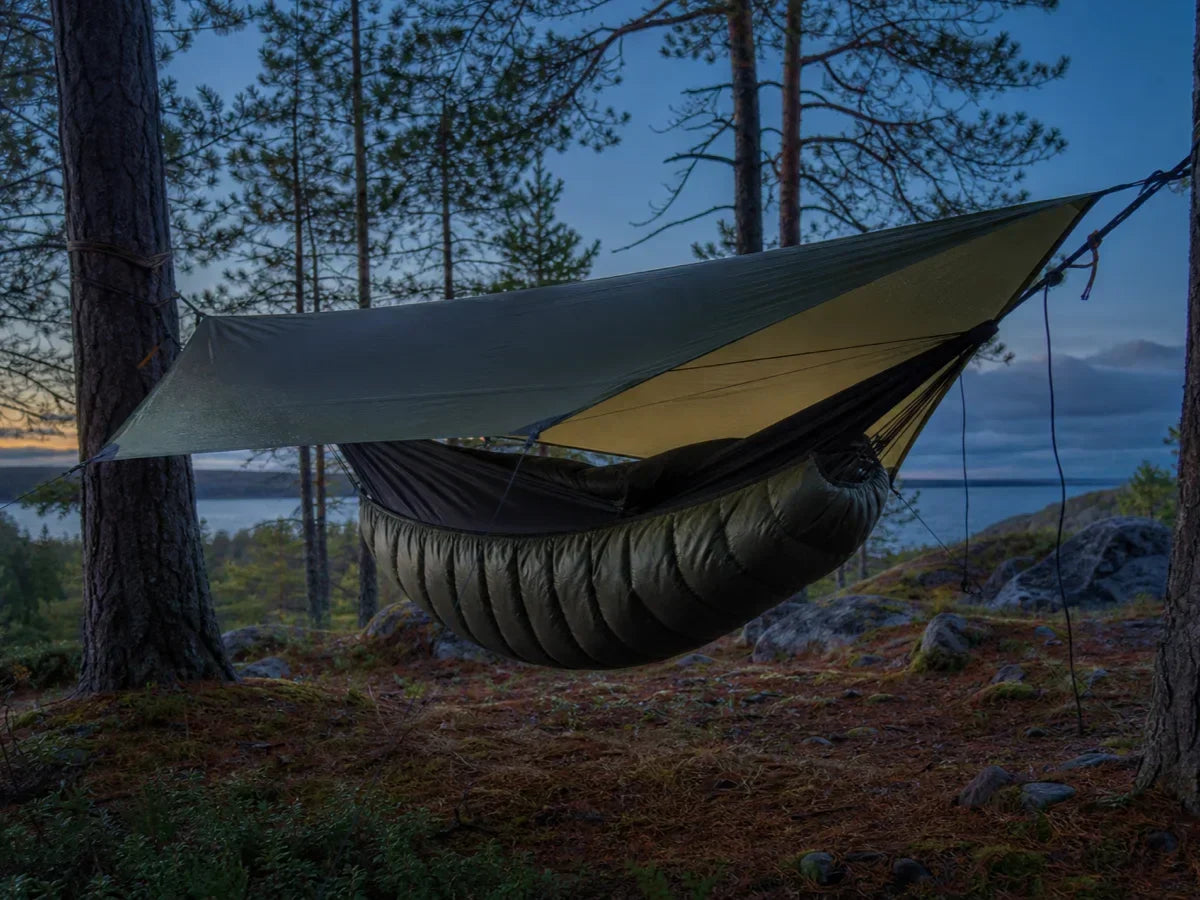
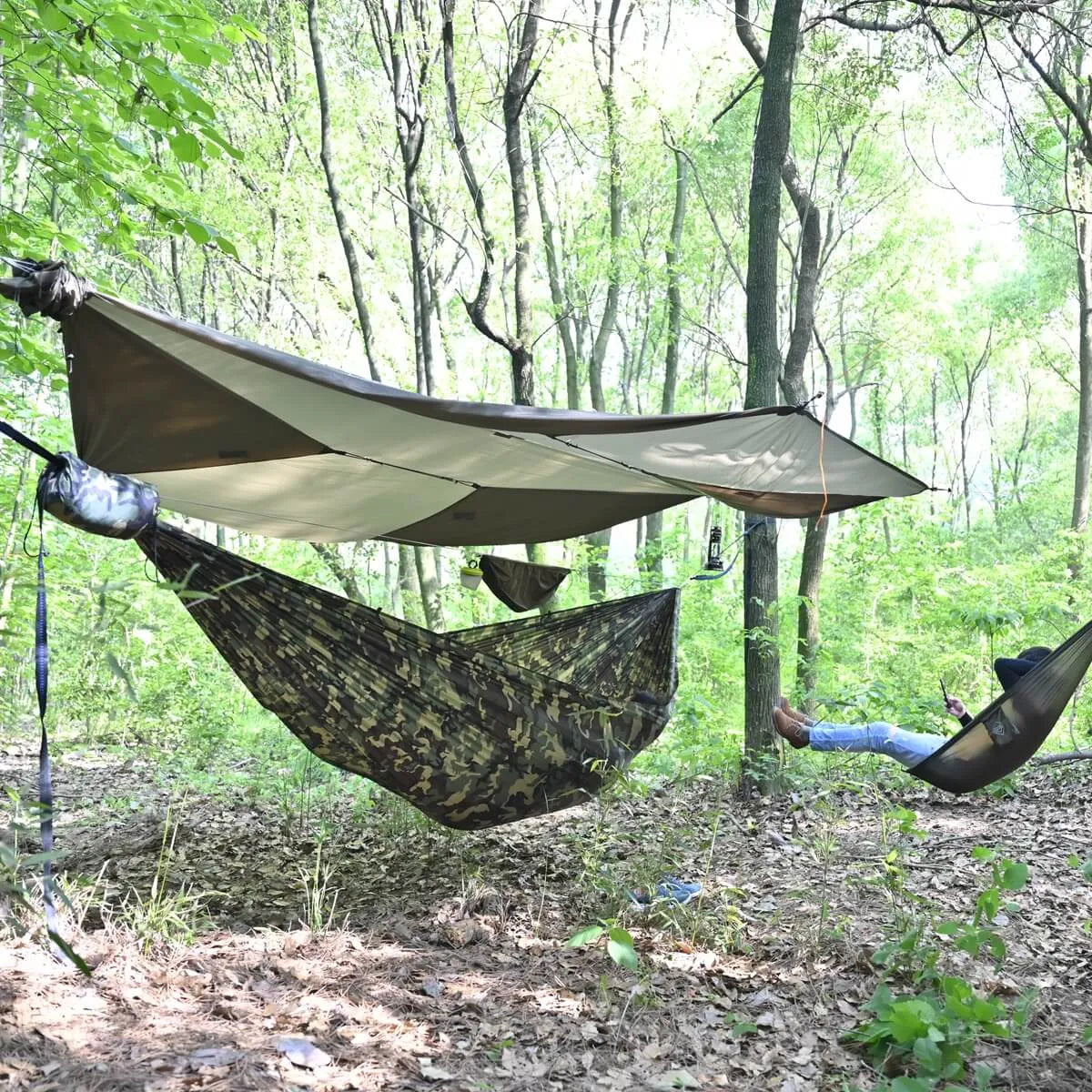
Configuration 3, the component system. Hammock, separate insect net, separate tarp, separate insulation. A matched setup lands near 2.9 lb.
For most people the component system is the better buy, and here is the blunt version of why.
A comparable ground tent system weighs about 2.4 lb.
So the integrated hammock tent that shows up first when you search is heavier than a component hammock setup, and heavier still than the ground tent it claims to beat.
- ✓ Choose the component system if you want the lightest hammock path and the ability to upgrade one piece at a time.
- ✓ Choose a sewn-in net hammock if you camp in bug season constantly and never want to think about it.
⚠ Choose the integrated all-in-one only if a single purchase and zero setup decisions are worth carrying one to five extra pounds with no upgrade path.
What A Camping Hammock Tent Actually Is
The category has no agreed boundary, and that is the root of most bad purchases.
For a model-by-model cost view, see our complete hammock system comparison.
Every source I checked agrees on one structural point: an enclosed hammock shelter is a system of hammock body, insect barrier, and overhead rain cover.
That stays true even when the system ships in one bag with one price tag.

The difference between the three configurations is not what they do. It is how tightly the parts are bonded together.
The integrated all-in-one bonds everything. The netting is sewn to the body, the fly is engineered to the frame, and some models add spreader bars to force a flat sleeping surface.
The pitch is simplicity, and the pitch is honest as far as it goes.
You unpack one thing, you hang one thing, you are done.
The sewn-in net hammock bonds the body and the netting but leaves the tarp separate.
This is what most people actually picture when they imagine a camping hammock with mosquito net protection.
The component system bonds nothing. Every layer detaches.
That sounds like more work, and on the first night it is.
It is also the reason experienced hangers carry it, which is a point I will come back to, because the reason is not the one most buyers expect.
Onewind's Bottom Entry Camping Hammock line spans all three, which makes the boundaries easy to see in one catalog.
The Skyperch Hammock Tent at $299.99 is configuration one, a fully integrated unit.
The Aerie 11 ft double camping hammock with mosquito net at $69.90 is configuration two, netting bonded to the body.
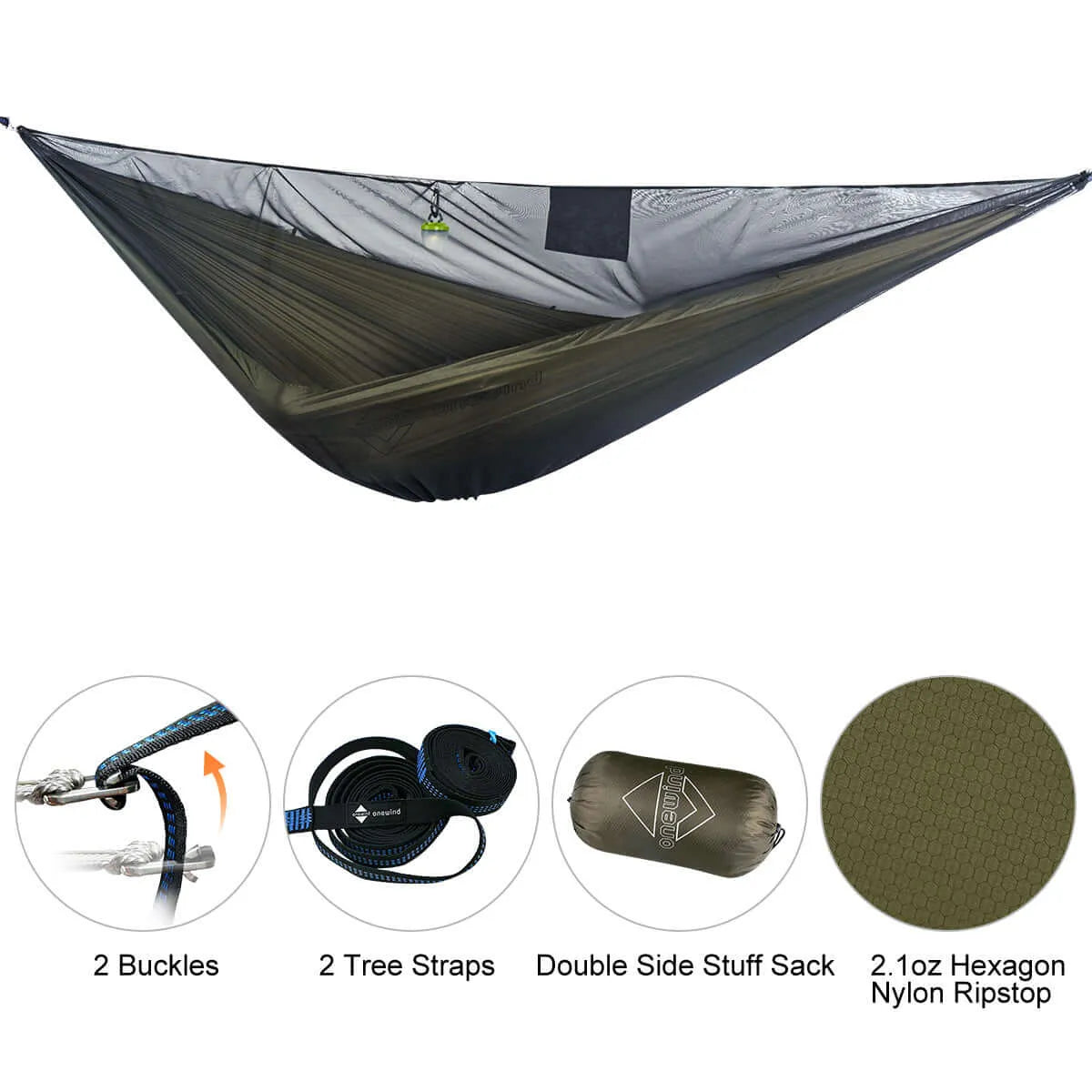
The Airstream 11 ft hammock with detachable zipper bugnet at $99.00 sits deliberately between two and three, because the net unclips when you do not want it.
The Weight Math Nobody Runs
Here is the comparison the buying guides skip.
Andrew Skurka published a matched set of shelter systems, meaning each one is a complete overnight kit rather than a bare component, which is the only way a comparison means anything.
I put his measured system totals next to the published shipping weights of the all-in-one hammock tents that rank for this category.
Read the bottom four rows again.
The lightest all-in-one hammock tent in that list ties the heaviest component hammock system.
The heaviest all-in-one is more than three times the weight of a comparable ground tent.
The component breakdown behind that 46 oz figure is worth seeing, because it shows where the mass actually sits.
Hammock body plus suspension came in at 21 oz.
Underquilt at 12 oz.
Tarp with guylines and stakes at 13 oz.
Nothing in that list is the insect net, and that is the detail that exposes the all-in-one weight problem.
A DIY zipperless bottom entry bug net documented on Reddit weighs 4.3 oz.
So the insect layer is roughly four ounces of a system that can ship at over seven pounds.
The weight is not going into bug protection. It is going into heavier fabrics, sewn-in structure, spreader bars, and the redundancy that comes from bonding parts that would otherwise share load.
If you are a backpacker counting ounces, that single fact should settle the configuration question before you compare brands.
If you are car camping and the pack never goes on your back, it genuinely does not matter, and I would not pretend otherwise.
Bottom Entry Or Zipper
Once you know which configuration you want, the next decision is how you get in.
This one is widely misunderstood as a weight decision. It is not.
Reviewers who have tested both report there is no meaningful weight difference between a zippered net and a bottom entry net.
The real split is failure mode against convenience.
Bottom entry clips both ends to your suspension and seals underneath with a shock cord opening. You slide in from below and your body weight plus the underquilt closes the gap.
There is no zipper, so there is nothing to snag, nothing to jam on ultralight fabric, and nothing to fail in the field.
Zippered entry gives you a faster exit. You unzip, you swing out, you are standing.
The community verdict on this is unusually consistent, and it splits by what people value.
One long thread on the tradeoff put it plainly: integrated zippered nets are slightly easier to exit because you just unzip, while bottom entry means locating the cinch cord and loosening the opening first.
Against that, another reply in the same discussion captured why people still pick bottom entry: no zippers means you cannot get fabric caught in it.
Another was blunter about the material risk, saying zippers and ultralight fabrics make them nervous.
It does not go one way for everybody. One camper found a bottom entry design impractical enough that they paid a shop to retrofit a zipper onto it.
But the most useful comment in that entire discussion had nothing to do with entry speed.
It was about modularity: one hanger keeps a separate bottom entry net specifically so they can leave it at home when bugs are absent, and swap it for a winter sock when the season turns.
That is the component system argument stated by someone who carries one, and it is the strongest case in this whole article.
An integrated all-in-one cannot do that. The net is sewn in, so it comes with you in November whether or not a single insect is awake.
If you want to see the mesh specification side of this decision, our hammock bug net guide covers built-in versus separate and why no-see-um mesh at over 500 holes per square inch blocks insects down to 0.6 mm while standard mosquito mesh at roughly 200 holes per square inch does not.
For the separate net path, the hammock mosquito net runs $22.90 and the cradle bugnet $44.90.
For the zippered path, the 11 ft zipper camping hammock is $74.90 and the 12 ft zipper camping hammock $84.90.
Flat Lay Or Gathered End
This axis decides everything for side sleepers and almost nothing for back sleepers.
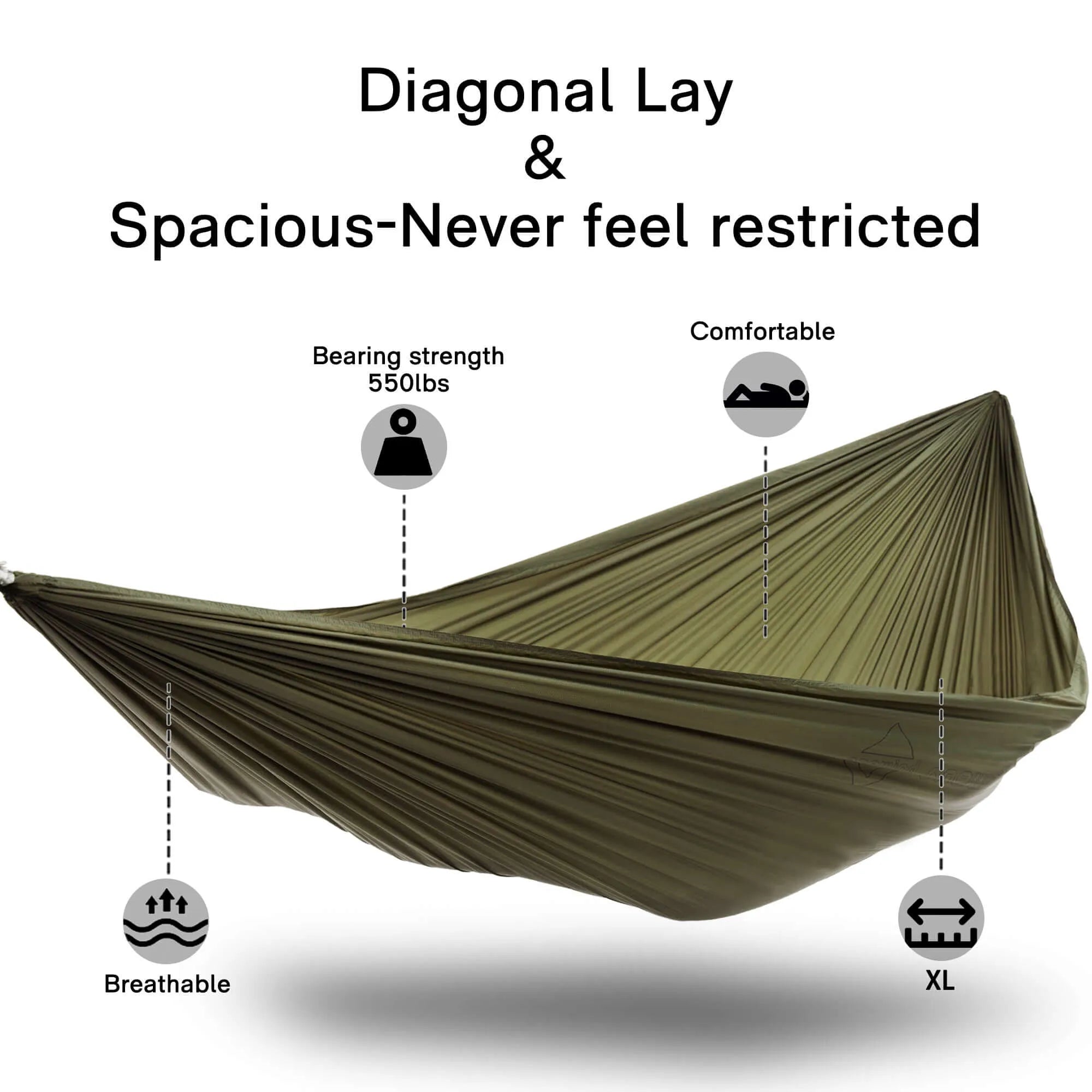
A gathered-end hammock bunches the fabric at both ends. Hung with proper sag and slept in diagonally, it gives most back sleepers a surface flat enough to sleep well on.
A bridge hammock uses spreader bars to hold the fabric open, creating a genuinely flat, trough-shaped platform, which is what the Crystal bridge hammock at $151.99 is built around.
If you are a side or stomach sleeper, this is your section, because the gathered-end diagonal trick has limits and the bridge does not depend on it.
The flat lay is not free.
According to the matched system data, the bridge setup came in at 53 oz against 46 oz for the gathered-end setup.
So a true flat lay costs roughly 7 oz and about $15 in that comparison.
It also costs site flexibility, because spreader bars need a wider gap between trees than a gathered-end body does.
That is a real constraint when you arrive at dusk and the only two sound trunks are close together.

Note what this does to the all-in-one math.
Several flat-lay hammock tents in the category reach their flat surface with built-in spreader structure, and that structure is exactly where the extra pounds live.
The Night Cat flat lay unit is listed at 7.7 lb with a 330 lb capacity and an 87 by 28 by 19 inch footprint.
You can reach a flat lay through a component bridge setup at 3.3 lb instead.
For the mechanics of spreader bars, hang geometry, and how a bridge actually carries load, our bridge hammock decision guide goes deeper than this article needs to.
One dimension applies to every configuration here.
An 11 ft body is the practical floor for a diagonal lay flat enough to sleep on, which is why Onewind builds the 11 ft camping hammock at $69.90 and the 12 ft wide hammock at $74.90 rather than the 9 ft lounging sizes that dominate general retail.
A double layer body adds a second fabric plane you can slide a pad into, which the 11 ft double layer hammock at $59.90 and the 12 ft double layer hammock at $74.90 are built around.
When A Ground Tent Wins
I am going to argue against the category for a moment, because the honest answer is not always a hammock.
Onewind sells ground shelters too, including the SoloVent bivy tent at $99.90 and the DuoVent ultralight tent at $259.99, so there is no reason to oversell the hanging option.
Three situations where the ground answer is simply better.
No reliable anchors. Every authority states this limit plainly. Above treeline, on open desert, on managed campgrounds that ban tree attachment, a hammock does not pitch at all.
Two people who want to share. Hammocks are single-occupant sleep systems in practice. A couple needs two hammocks, two tarps or one very large one, and two sets of insulation.
Pure weight and cost minimums. The matched data puts a ground tent system at 38 oz and $385 against a component hammock at 46 oz and $465. The ground option won both.
What the hammock buys you in return is real, and it is not weight.
It is site access.
A hammock lets you camp on slopes, on rock, on root-tangled ground, and on saturated soil where no tent would be pitched.
It keeps you off the ground and away from what moves along it.
It sets up fast and it does not need a flat, cleared, drained footprint.
If you are the kind of camper who repeatedly arrives at sites where good flat ground is the scarce resource and trees are abundant, the extra half pound buys you something a tent cannot sell you at any weight.
If you mostly camp where the ground is fine, you are paying a weight and cash premium for a comfort preference, and that is a legitimate thing to buy as long as you know that is what you are buying.
Site Limits And Failure Modes

The buying guides describe the upside. Here are the things that actually go wrong, and what each one is caused by.
Cold from below. This is the single most common first-night failure and it is not a hammock defect.
Compressed insulation under your body has no loft, so a sleeping bag alone will not work.
Reddit threads on this are consistent and occasionally brutal, with campers reporting a breeze waking them up with no underquilt even when overnight lows sat in the 60s and 70s.
The fix is an underquilt outside the hammock body, or a pad inside a double layer.
Bites through the fabric. This one surprises people, because a bug net implies total protection.
Insects can bite upward through hammock fabric where your body compresses it, and no insect net stops that.
The underquilt is the actual barrier. Campers who drop the underquilt in hot weather should still run an underquilt protector at $27.90, which adds no measurable warmth but blocks the bite path.
Shoulder squeeze. Derek Hansen names this among ten recurring hammock discomforts, alongside calf pressure, ankle strain, leg hyperextension, and the fear of rolling out.
He traces the cause to hanging the hammock too tight, which pulls the edges inward and produces what he calls the canoe effect.
The fix is a deeper sag, not a different hammock, and it costs nothing.
Condensation. Warm breath under a tarp in cold air collects on the underside of the fly and drips.
Tarp pitch height and ventilation control this, which is why a tarp that can be pitched high in fair weather and low in a storm is worth more than a fixed geometry fly.
No usable trees. Every camper will eventually face sites where the anchor situation fails, and there is no gear fix in the moment.
The honest planning answer is to know the sites you actually visit before you commit to a hanging system.
⚠ One genuine exclusion worth stating: anyone with a serious medical issue involving motion should avoid hammocks rather than try to engineer around them.
Weather protection lives with the tarp, not the hammock, which is why the Zephyr 10 ft hammock tarp at $79.99 and the Nebula 12 ft hexagonal rain fly at $79.90 do the heavy lifting in a storm, with the 12 ft silnylon ultralight tarp at $98.90 for wider coverage.
The Tarp Is The Layer That Makes It A Tent

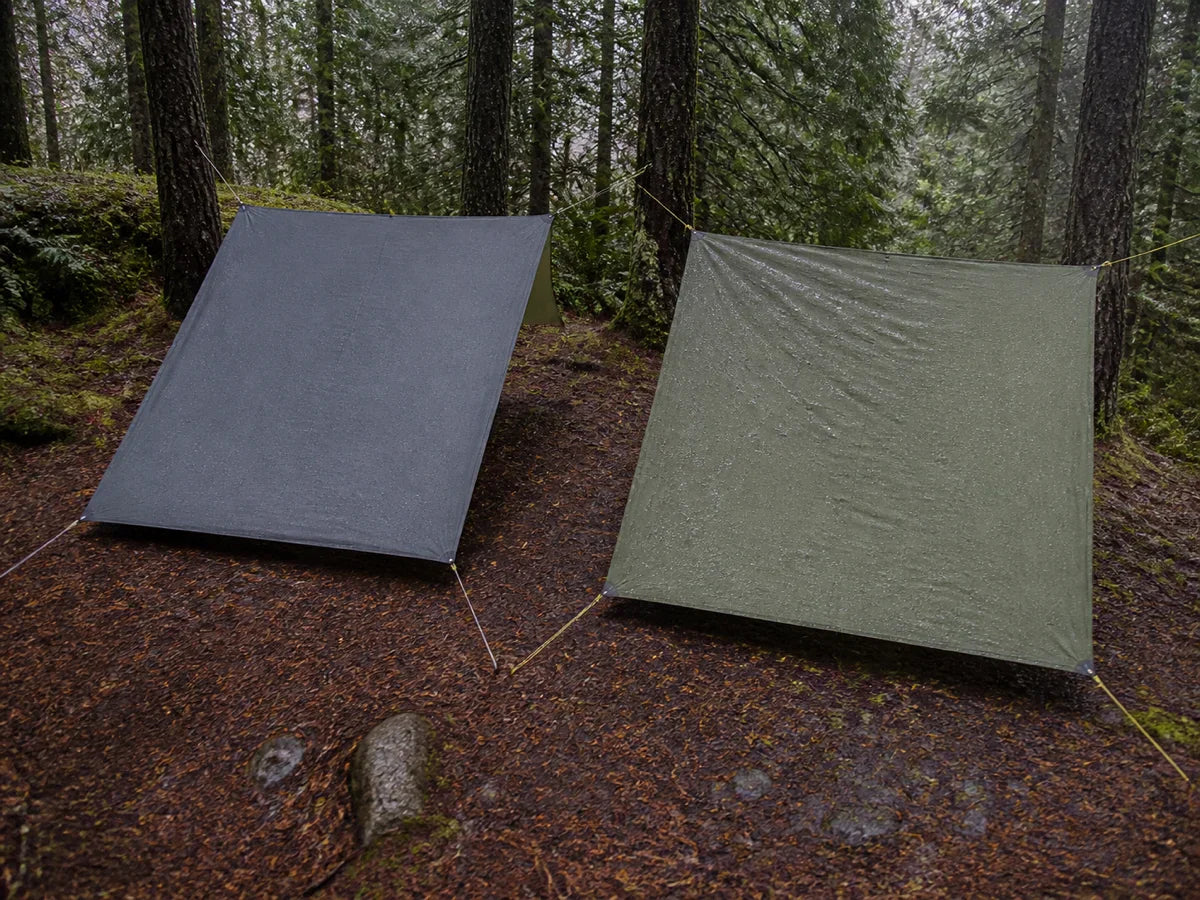
Strip the marketing away and the tarp is what converts a hammock into a shelter.
The hammock holds you. The net keeps insects off you. Neither one keeps weather off you.
This is the layer buyers underspend on most often, and it is the layer that decides whether a bad night is merely uncomfortable or genuinely dangerous.
Coverage is the first number that matters.
A 12 ft tarp over an 11 ft hammock body is the working baseline, because you need overhang past both gathered ends to stop wind-driven rain tracking along the suspension and soaking the head end.
Match a 12 ft tarp to a 12 ft body and you have effectively no margin.
That is why the 11 ft hammock and 12 ft tarp bundle pairs those two specific lengths rather than matching them one to one.
Shape is the second decision, and it is a straight trade between weather protection and weight.
A hex tarp trims the corners a rectangular tarp would carry, which saves fabric and weight while covering the diagonal you actually sleep on.
A rectangular or winter tarp keeps that material, so it pitches lower, seals better against blowing rain, and can be brought nearly to the ground in a storm.
If you camp mostly in fair three-season conditions, choose the hex and take the weight saving.
If you regularly camp in exposed sites or shoulder season, the extra coverage earns its weight the first time the wind turns.
Pitch height is the third decision and it is the one you make in the field rather than at checkout.
High pitch ventilates, which is how you fight the condensation problem, because warm breath needs somewhere to go other than the underside of your fly.
Low pitch protects, sealing the sides against rain that arrives horizontally.
A tarp that can do both is worth more than a fixed geometry shelter that can only do one, and this is precisely the flexibility an integrated all-in-one gives up when it engineers the fly into the frame.
Onewind's tarp range covers those choices directly, with the Nebula 12 ft hexagonal hammock rain fly at $79.90 as the standard pairing, the 12 ft silnylon ultralight waterproof tarp at $98.90 where weight matters more, and the 12 ft silpoly camo tarp shelter at $102.90 for wider storm coverage.
For campers who want the insect layer attached to the tarp rather than the hammock, the tarp bugnet at $64.90 builds a screened room under the fly instead of a sock around the body.
That configuration is worth knowing about because it is the one option that lets two people share an enclosed hammock space, which the standard single-occupant net cannot do.
Anchors, Spacing, And The Numbers That Decide A Site

Anchor requirements are stated vaguely almost everywhere, and vagueness is what gets people stranded at dusk.
The workable spacing for a standard 11 ft gathered-end body is roughly 12 to 15 ft between trunks.
Closer than that and you cannot develop proper sag without hanging the suspension uncomfortably high.
Wider than that and you run out of strap before you run out of gap, which is a supply problem rather than a geometry one.
Trunk soundness matters more than trunk size, but a living trunk of at least six inches in diameter is the common floor, and dead standing timber is never acceptable regardless of thickness.
Suspension angle is the number that quietly controls comfort, and roughly 30 degrees from horizontal is the target.
Pull the suspension tighter than that and tension rises sharply for the same body weight, which is the mechanism behind the canoe effect and the shoulder squeeze that follows it.
Bridge and flat-lay bodies with spreader bars need more distance than gathered-end bodies, so if you camp in tight second-growth forest, that requirement should weigh against the flat lay before comfort does.
Scenario 1: You Want One Purchase To Solve Shelter
You are a first-time buyer, the gear research has already taken longer than you wanted, and you would happily pay to stop deciding.
This is the honest case for the integrated all-in-one, and it is a real case.
One unit, one setup, nothing to match, nothing to forget at home.
The cost is between one and five extra pounds against a component system, plus the fact that when any part fails or stops suiting you, the whole unit is what you replace.
If you car camp and the pack never rides on your back, then that weight penalty is theoretical → take the simplicity.
If you carry the shelter any real distance, the penalty stops being theoretical fast.
Verdict: Buy the all-in-one only if convenience genuinely outranks weight and upgradability for you, and go in knowing it is the heaviest option in the category.
Scenario 2: You Are A Backpacker Counting Ounces
You already weigh your gear and you are trying to work out whether hanging saves you anything.
It does not, and every honest number says so.
A component hammock kit measured out at 46 oz against 38 oz for a comparable ground tent, and the hammock kit cost $80 more.
An ultralight hammock build gets down to 32 oz, but at $624 it is the most expensive option on the board.
So if your only goal is the lowest carried weight, then the ground system wins → buy the tent and stop here.
Users who hang anyway do it because a hammock lets them sleep well on terrain where a tent cannot be pitched at all, which is a comfort and site-access purchase rather than a weight one.
Verdict: Choose a hammock for site access and sleep quality, not for weight savings, because the weight savings do not exist.
Scenario 3: You Sleep On Your Side Or Stomach
The gathered-end diagonal lay works well for back sleepers and runs out of road for everyone else.
If you have tried a hammock and woken up with your shoulders compressed and your hips twisted, then this section is the reason.
A bridge design with spreader bars gives a genuinely flat platform, and it does not depend on getting the diagonal exactly right.
That flat lay costs about 7 oz and roughly $15 in the matched comparison, and it demands a wider gap between trees.
The all-in-one flat-lay units reach the same result far more expensively in weight, with one popular model listed at 7.7 lb.
Verdict: Recommend a component bridge setup at about 3.3 lb over a 7.7 lb integrated flat-lay unit, unless tight tree spacing is your normal condition.
Scenario 4: You Camp In Heavy Bug Country All Season
You are in the southeast in July, or anywhere the insects arrive before dusk and do not let up.
Here the modularity argument that favours a separate net loses most of its force, because you are never going to take the net off.
A sewn-in net removes a setup step you would otherwise repeat every single night.
The tradeoff is that you now carry insect netting in November too, and a torn net means the hammock body goes back to the maker with it.
Mesh specification matters more than entry style in this scenario, since no-see-um mesh at over 500 holes per square inch stops what standard mosquito mesh at roughly 200 holes per square inch lets through.
Verdict: Choose the sewn-in net hammock if bug season is your whole season, and prioritise mesh fineness over entry style.
Scenario 5: You Face Sites With No Usable Trees
You camp above treeline, in open desert, on beaches, or in managed campgrounds that prohibit tree attachment.
No configuration in this category solves that, and no amount of gear selection changes it.
A hammock needs two sound anchors roughly 12 to 15 ft apart, and when the site does not supply them the system does not pitch.
Carrying a hammock to a site like that means carrying a shelter you cannot use.
Verdict: Avoid the category entirely for these sites and buy a ground shelter, or accept carrying a tarp and bivy as the backup when the anchor situation is uncertain.
Choosing Your Configuration
Run these three gates in order. The first one that stops you is your answer.
A few defaults worth stating outright.
For most first-time buyers who camp in three seasons and want room to improve, I recommend starting with an 11 ft gathered-end body, a separate bottom entry net, and a 12 ft tarp.
That path costs less up front than most all-in-one units, weighs less, and lets you replace exactly one part when your needs change.
The 11 ft hammock and 12 ft tarp bundle at $149.90 assembles that starting point, and the 11 ft zipper hammock with 12 ft rain fly at $155.90 does the same for anyone who prefers the zippered entry.
Unless you are certain you will never change anything about your setup, avoid bonding your shelter into a single unit.
Gear preferences shift as you log nights, and the component path lets that happen one purchase at a time.
Buy the insulation before you upgrade the hammock. Cold from below ruins more trips than fabric choice ever will.
And if you camp in heavy-bug country through the whole season, the sewn-in net is a reasonable simplification, because the modularity argument only pays off if you actually take the net off sometimes.

The category will keep selling you the sealed pod, because it photographs beautifully and it is easy to explain.
Just weigh it against the alternatives before you carry it up a hill.

Build the component system: 11 ft hammock + 12 ft tarp
Shop Now →