
The material label does not create a universal winner.
Silpoly usually creates less wet-weather maintenance because polyester absorbs less water and changes tension less after rain.
Silnylon usually offers a strong strength-to-weight record, better abrasion tolerance, and more elastic give when gusts load the shelter.
I treat the coating details behind the labels as part of the product because “silnylon” and “silpoly” describe the base fiber more clearly than they describe the finished waterproof fabric.
Start by naming the problem you are trying to avoid.
I would start with silpoly if a wet pitch that loosens overnight would frustrate you more than a potentially lower tear reserve at the same fabric weight.
I would start with silnylon if strength-to-weight, abrasion resistance, and elastic load distribution matter more than avoiding occasional retensioning.
What You'll Learn
Quick Answer
- ✓ Quick rule: choose the finished construction that reduces the failure mode you are least willing to manage.
If wet-night retensioning is your deal-breaker, choose silpoly after checking the finished construction.
If abrasion, strength-to-weight, and elastic response are your deal-breakers, choose silnylon after checking the same construction details.
If a product page only says “waterproof nylon” or “silpoly,” stop before comparing prices.
Silpoly and Silnylon Are Base-Fiber Shortcuts
Silpoly VS Silnylon: Ultralight Tent/Tarp Talk
Silnylon means silicone-coated nylon.
Silpoly means silicone-coated polyester.
Those names identify a base fiber and suggest a coating family, but they do not describe every part of the finished tarp.
A tarp is also defined by denier, weave density, coating placement, coating thickness, seam design, tie-out reinforcement, panel geometry, color, and pitch system.
SlingFin describes nylon as a material with a strong strength-to-weight ratio and good abrasion resistance.
The same source explains that nylon’s stretch can distribute stress beyond a small reinforcement point instead of concentrating every force at one stitch area.
That elasticity can be helpful in gusts.
The same elasticity can also create a loose or sagging fly after moisture enters the fiber.
SlingFin describes polyester as more dimensionally stable and less affected by water absorption than nylon.
The tradeoff is that polyester often has lower tear strength than a comparable-weight nylon, although the exact textile construction can change the result.
NORTENT presents a similar split, with silpoly favored for low sag and silnylon favored for strength and elastic wind response.
Jotun Gear reaches a stronger pro-silpoly conclusion because its shelters prioritize stable wet-weather pitches.
Those opposing manufacturer positions are useful because they show why a material comparison should not copy a single brand’s winner.
I treat the words “waterproof,” “wet,” and “strong” as separate claims because they describe different tests.
A fabric can resist water pressure while still absorbing moisture into the fiber.
A fabric can remain waterproof while changing shape after rain.
A fabric can be light and strong in a laboratory comparison while having weak reinforcements or poor seams in a finished tarp.
The Seven-Check Material Decision Framework

Use seven checks before treating a fabric label as a buying recommendation.
The checks move from the base fiber to the finished shelter because performance is created by the entire system.
The first question is not “Which material is best?”
The first question is “Which failure mode would create the most regret on my trips?”
A rainy-region camper may value tension stability above every other characteristic.
A storm-exposed camper may value elastic load distribution and a conservative reinforcement pattern.
A multi-day hiker may care about how much water the shelter carries after packing.
A basecamp user may care more about UV exposure and abrasion than a few minutes of retensioning.
Check 1: Wet Tension and Retensioning

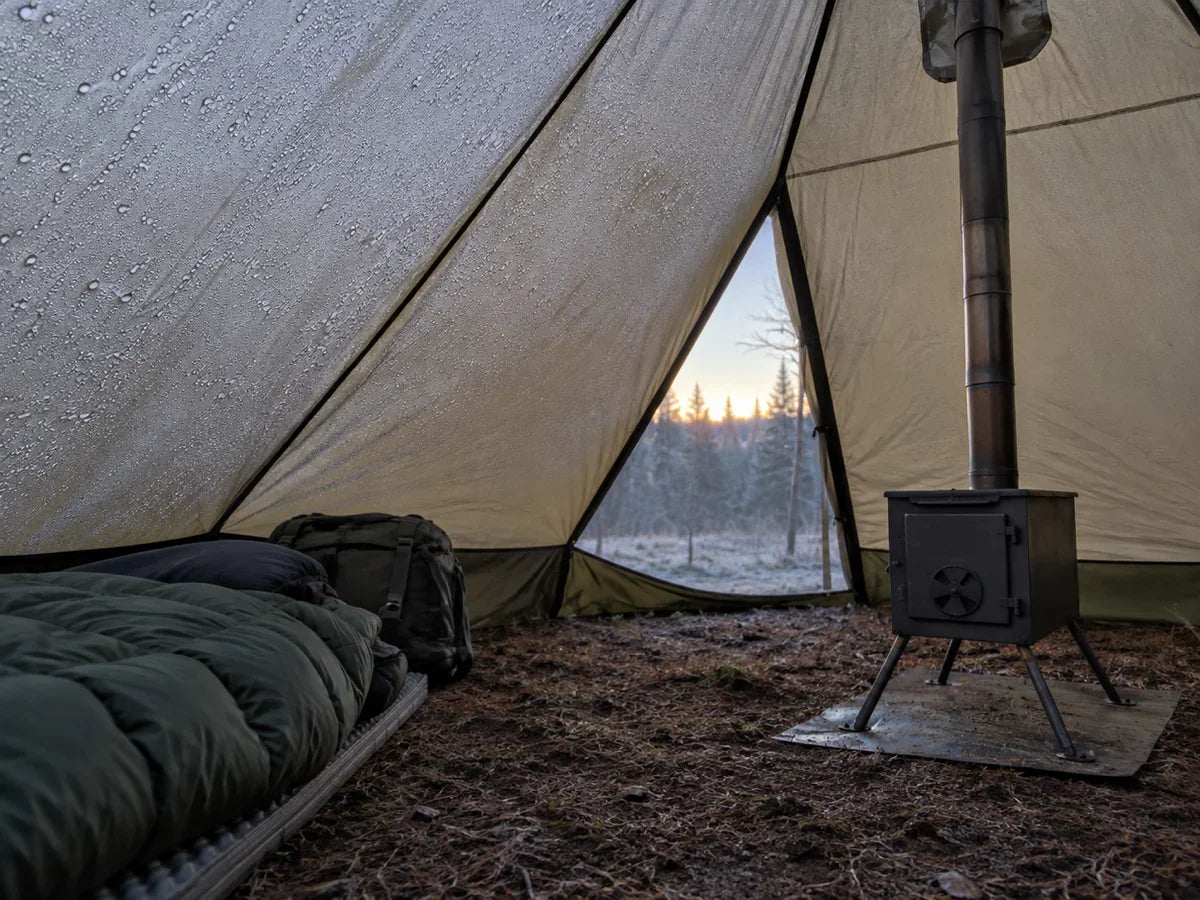
Nylon fibers can absorb water and expand.
That expansion can make a silnylon tarp loosen after rain or heavy dew.
The loosened pitch does not automatically mean the tarp has failed.
It means the user may need to adjust guylines, a center support, or another tensioning point.
Polyester absorbs less water than nylon in common shelter constructions.
That is why silpoly generally keeps a more stable pitch in wet conditions.
The severity of wet sag depends on more than the fiber.
A short tarp with generous clearance may tolerate movement without creating a problem.
A low pitch with a large panel can become annoying even when the fabric change is modest.
A shelter with accessible tensioners can turn retensioning into a quick adjustment.
A shelter with buried or distant tie-outs can make the same material behavior much more frustrating.
The r/Ultralight discussion about silnylon in rain shows this disagreement clearly.
Some participants treat wet sag as a manageable adjustment.
Others prefer silpoly because they do not want to monitor tension during a wet night.
The community disagreement is useful because it exposes a tolerance issue rather than proving that one fabric always fails.
Check 2: Water Pickup Is Not Waterproofness
Waterproofness is the overall performance property describing whether a finished fabric or shelter blocks liquid water from passing through.
Hydrostatic head is a laboratory pressure measurement, expressed in millimeters, used to evaluate when water begins to penetrate a fabric sample under the test conditions.
Water absorption or pickup describes how much moisture the fiber or coating retains after exposure.
Wet stretch describes how the fabric’s dimensions or tension change after that moisture exposure.
These four concepts interact, but they do not measure the same property.
A fabric’s hydrostatic-head number does not tell you how many hours a tarp can remain in a storm.
It also does not tell you whether the fabric will absorb moisture, sag, dry slowly, or suffer from poor seams.
SlingFin uses approximately 1,000mm as a general context for a fabric being considered waterproof.
That context does not turn a 4,000mm listing into a guaranteed storm-duration rating.
Published specification data from the matching Ripstop by the Roll examples makes this distinction concrete.
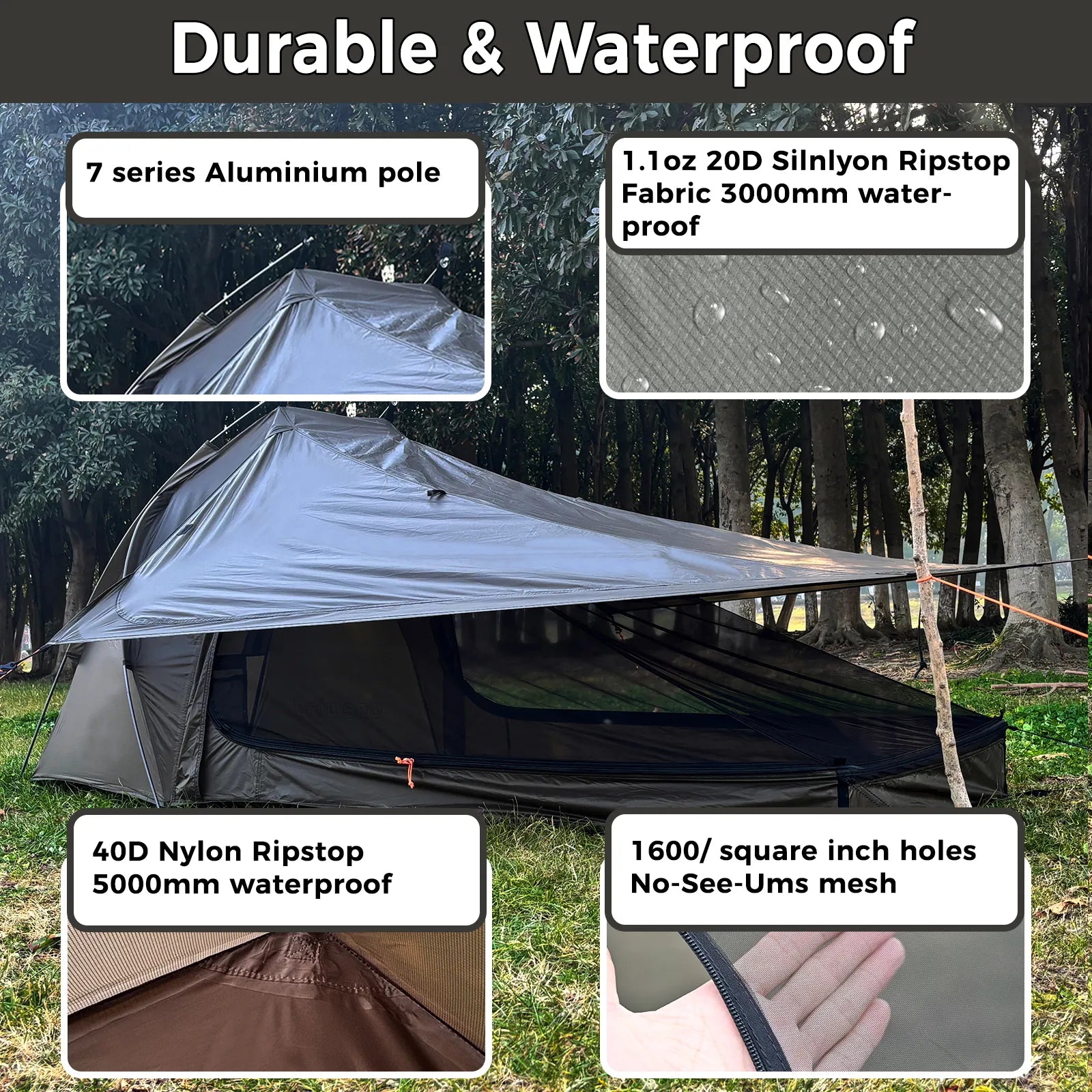
Its 1.1 oz silnylon listing describes a silicone and PU coating formulation and identifies the fabric as waterproof and non-breathable.
Its 1.1 oz silpoly listing emphasizes lower water absorption and lower wet stretch compared with the matching silnylon fabric.
Both examples are waterproof fabrics.
Their different base fibers can still change how the shelter behaves after exposure.
A dry tarp is easier to pack responsibly than a damp tarp.
A tarp that carries less retained water is not automatically stronger.
A tarp that beads water on the surface is not automatically protected at every stitched seam.
Check 3: Strength, Stretch, and Load Distribution
Silnylon’s stretch is not only a defect.
SlingFin explains that stretch can spread force across a larger surrounding fabric area.
That can reduce the concentration of a guyline load at a small reinforcement point.
The same source describes nylon as having a strong strength-to-weight ratio and useful abrasion resistance.
Silpoly’s lower stretch can keep a pitch visually and functionally stable.
Lower stretch can also concentrate force more directly at tie-outs when the reinforcement and geometry are not designed for it.
A comparison at equal denier is not automatically a fair comparison.
A tightly woven polyester can outperform a loosely woven nylon in one use.
A heavier polyester can compensate for lower material tear strength.
A lighter nylon can deliver excellent strength-to-weight performance while requiring more care around UV and moisture.
The tarp’s load path matters as much as the raw fabric.
A central tie-out, corner reinforcement, seam intersection, and guyline angle can each change local stress.
Rokslide participants repeatedly bring denier, panel size, reinforcement, seams, and shelter geometry into their silpoly versus silnylon discussion.
Their reports are not controlled laboratory tests.
They still identify the right buying question: what is the finished shelter, not only what is the fiber?
Check 4: UV, Abrasion, and Long-Term Care
Silnylon vs. Silpoly Field Test- We left these tents outside in the sun for 5 months!!!
Nylon and polyester respond differently to sunlight and moisture.
SlingFin describes nylon as more susceptible to UV degradation than polyester and DCF in general shelter use.
The source also warns that fabric thickness and color affect UV behavior.
Silpoly often receives the advantage in long-term sunny exposure because polyester generally resists UV better than nylon.
That advantage does not make every silpoly tarp immune to damage.
A lightweight fabric remains lightweight regardless of its fiber family.
I treat storage care as part of the material decision because a shelter can outlast its marketing category only if it is stored correctly.
A silpoly tarp stored wet can still develop odor, mildew, or coating problems.
A silnylon tarp stored dry can provide many seasons of useful service despite needing occasional retensioning.
A tarp sleeve can make deployment and packing easier, but it does not replace drying the shelter at home.
If you use a mesh tarp sleeve, treat it as a handling and organization aid.
Do not use a sleeve to hide a wet tarp in a closet.
Check 5: Coating Stack Changes the Answer

The phrase “silnylon tarp” can hide more information than it reveals.
A woven nylon base is not waterproof by itself.
A coating provides the water barrier.
Silicone and polyurethane can change tear behavior, water pickup, seam treatment, and aging in different ways.
SlingFin distinguishes pure silicone coatings from sil/PU constructions.
A sil/sil fabric uses silicone on both faces.
A sil/PU fabric combines silicone with polyurethane layers.
SlingFin explains that PU can achieve high hydrostatic-head ratings.
It also explains that PU can reduce yarn slippage and affect tear strength.
PU coatings can have different long-term moisture and hydrolysis concerns from silicone.
Silicone can increase tear strength in some woven constructions by allowing yarns to move relative to one another.
Silicone can also make seam treatment more specialized because common seam tape does not work the same way on every silicone-coated fabric.
Treat coating chemistry as a separate decision from fiber chemistry because many product pages combine both in one short label.
The Ripstop by the Roll silnylon and silpoly listings both show silicone and PU language.
That does not mean the two materials perform identically.
It does show why the buyer should ask for the full coating description.
Check 6: Seams, Reinforcements, and Geometry Beat the Label
A strong fabric cannot rescue a weak tie-out.
A stable fabric cannot compensate for a badly placed seam.
A high hydrostatic-head number cannot guarantee that needle holes or unsealed seams will remain dry.
The finished tarp carries force through panels, hems, seams, reinforcement patches, tie-outs, guylines, and anchors.
A square tarp and a shaped tarp can use the same fiber while behaving differently.
A low pitch can create more side protection while changing the stress on corners and panels.
A high pitch can improve airflow while exposing more of the hammock to wind-driven rain.
Those decisions belong to tarp geometry, not only to silpoly or silnylon.
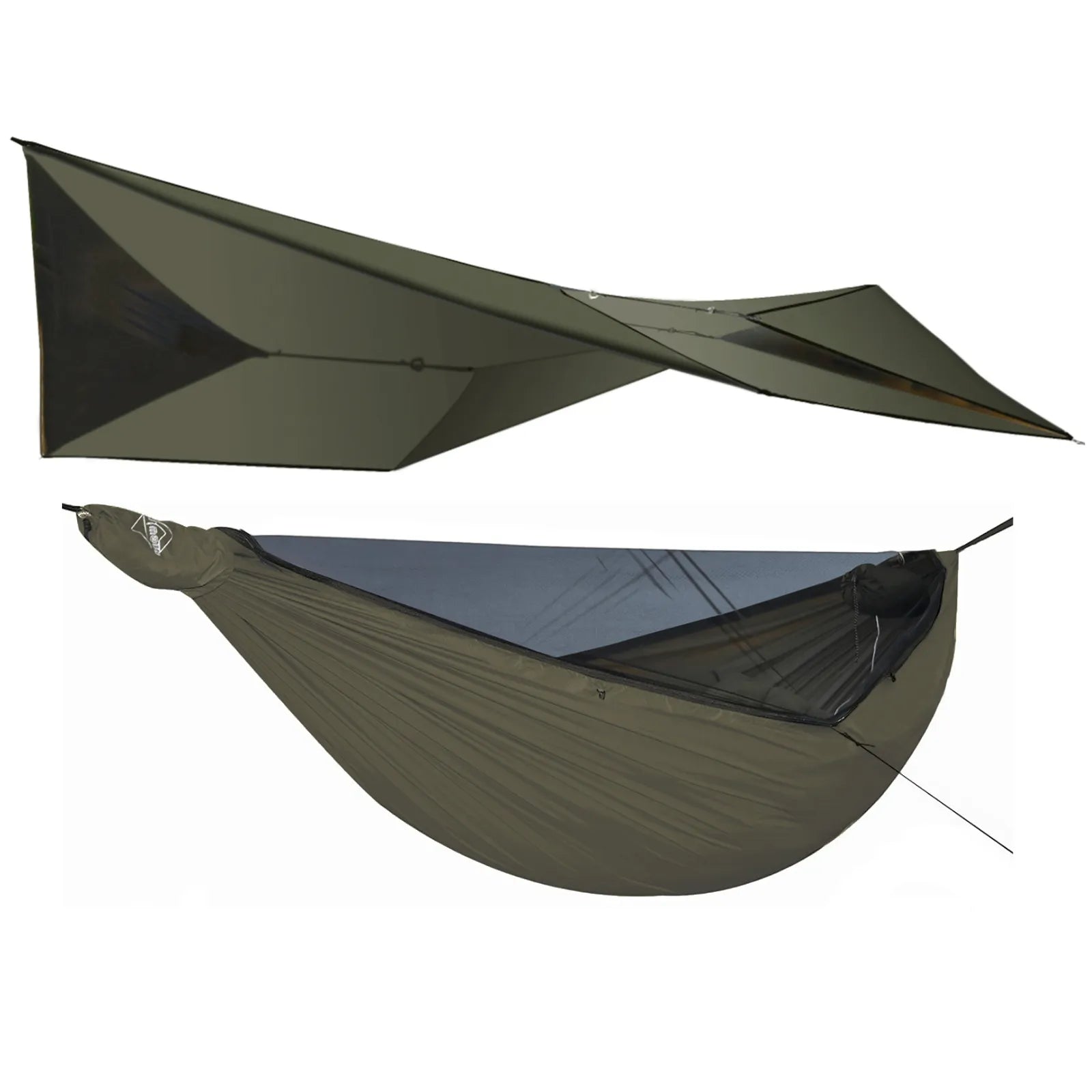
For pitch instruction, use the separate Camping Tarp Setup guide.
For coverage and rain-fly decisions, use the Hammock Rain Fly guide.
For coverage and full carried-system weight, use the Ultralight Hammock Tarp guide.
This guide does not repeat their tarp-size charts, pitch configurations, or full ultralight-system framework.
This article owns the base-fiber and coating-stack audit so those guides do not need to repeat the same material comparison.
How TarpZephyr-OD Fits the Framework
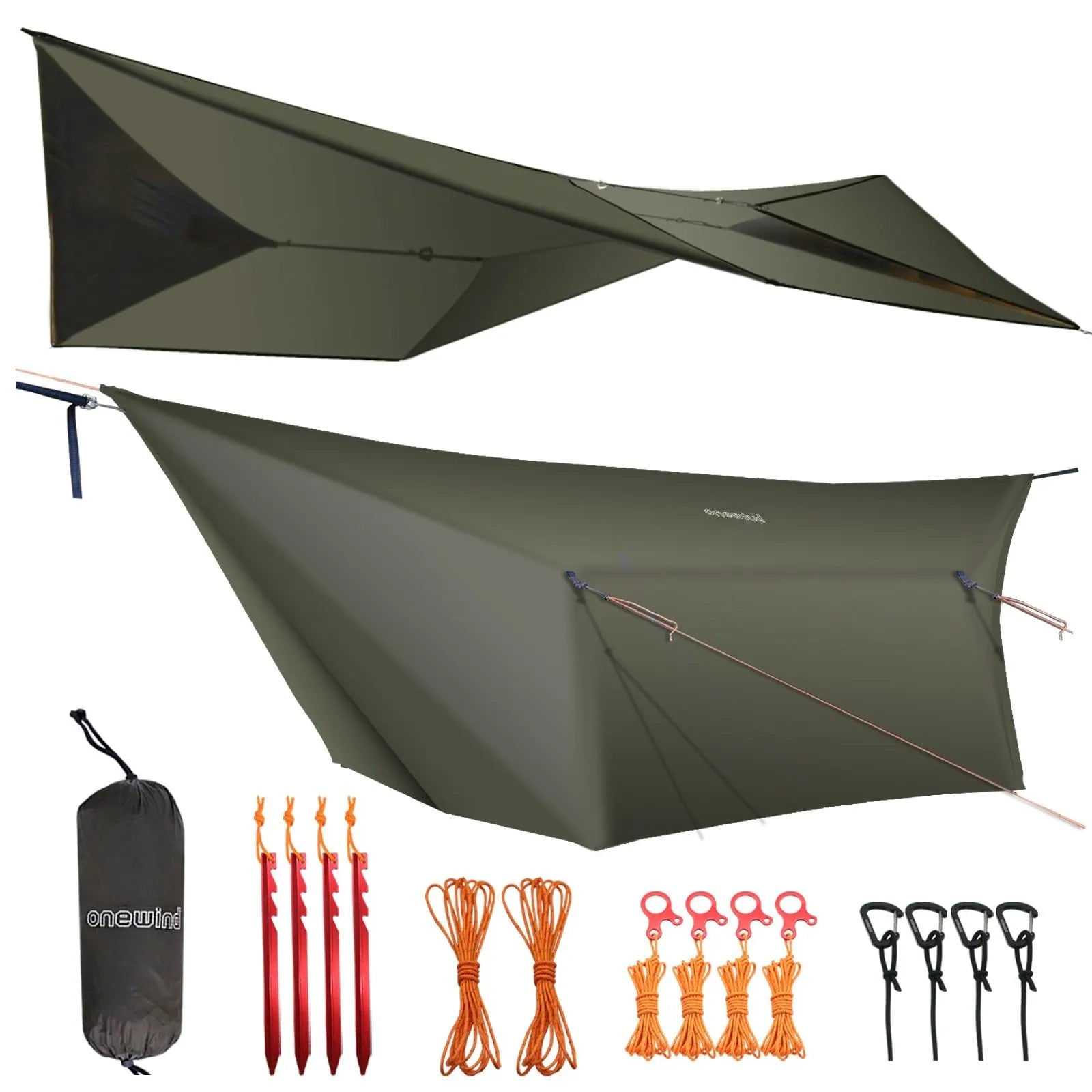
TarpZephyr-OD is a useful example because its product page exposes more than a single marketing label.
The live listing identifies it as the Zephyr 10ft Hammock Tarp in OD Green.
Its available variant is 10 ft by 10 ft, or approximately 3m by 3m.
The listed fabric specification is 1.1 oz 20D nylon.
The specification identifies silicone on the outer face and PU 4000mm on the inner face.
That makes it a sil/PU-coated nylon case rather than a generic pure sil/sil example.
The 4000mm figure describes the listed waterproof coating specification.
It does not tell you how long a tarp will remain waterproof in a particular storm.
It does not prove that the seams require no additional treatment.
It does not make the tarp equivalent to every other 20D nylon tarp.
If you want a square nylon tarp that accepts occasional retensioning, TarpZephyr-OD can fit that decision path.
If you want the lowest-maintenance wet pitch, compare the complete construction against a silpoly option instead of selecting from the label alone.
The broader tarp and shelter collection is useful for comparing shapes and systems, but the collection page cannot replace the material audit.
Scenario 1: Persistent Rain and Humidity
A hammock camper in a rainy or humid region may spend more time managing moisture than a fair-weather weekend camper.
The tarp can remain waterproof while the nylon fiber absorbs water and changes tension.
That change can place the canopy closer to the hammock or underquilt.
It can also create a late-night retensioning task.
A silpoly choice is strongest when the tarp must remain taut without attention.
A silnylon choice remains reasonable if the user accepts a quick adjustment and values its other properties.
The decision should include the underquilt because a loosened tarp can reduce wind protection around insulation even before rain reaches the hammock.
Verdict: Choose silpoly for the lower-maintenance wet pitch, unless you have a specific strength-to-weight or elastic-load reason to accept silnylon.
Scenario 2: Gusty, Exposed Camps
An exposed camp changes the priority from simple wet tension to load management.
Silnylon’s elasticity can distribute some stress rather than transferring every gust directly into a small tie-out area.
SlingFin describes this stress-distribution benefit as one reason nylon has remained common in shelters.
Silpoly’s stability can still be useful when a taut pitch and predictable geometry matter.
The word “windproof” does not settle the decision.
The final result depends on reinforcement, panel shape, seam design, anchor quality, and pitch.
The Rokslide discussion contains both silnylon and silpoly severe-weather success stories.
The useful common point is not the extreme anecdote.
The useful point is that participants repeatedly discuss panel geometry, reinforcement, seams, denier, and pitch tension.
Verdict: Choose silnylon if elastic load distribution and abrasion reserve are your primary concerns, but reject any fabric choice with weak or undisclosed construction.
Scenario 3: Multi-Day Wet Pack-Ups
A multi-day trip can force you to pack the tarp before it is completely dry.
Water absorbed into the fabric adds a different burden from rain that simply beads and runs off.
A damp shelter can also spread moisture to other gear inside the pack.
Silpoly usually has the cleaner case for this scenario because polyester absorbs less water than nylon in common shelter fabrics.
That does not mean a silpoly tarp should be packed wet indefinitely.
I treat water pickup separately from waterproofness because a high waterproof rating does not eliminate packing moisture.
The community discussions also show that users care about what happens after the storm, not only whether drops pass through the panel.
A lightweight sleeve can keep wet deployment organized.
It cannot remove moisture from the coating or fiber.
Verdict: Choose silpoly if repeated damp pack-ups are unavoidable, while still planning to dry either material completely after the trip.
Scenario 4: Sunny Basecamp Use
A tarp used for long periods in bright sun faces a different kind of wear.
UV damage can weaken lightweight fibers and coatings even when the shelter looks clean.
SlingFin notes that color, denier, and fabric thickness affect UV resistance in addition to fiber composition.
Silpoly generally has the advantage because polyester is commonly more UV resistant than nylon.
That advantage becomes less meaningful if the tarp is left pitched unnecessarily for weeks.
A silnylon tarp can still be the right choice for a sunny basecamp if its strength, price, or design better fits the use.
The material decision should include how often the tarp is packed, how long it stays deployed, and whether shade is available.
Verdict: Favor silpoly for prolonged sunny exposure, but treat denier, color, deployment duration, and storage as equal parts of the decision.
Scenario 5: The Product Listing Hides the Coating Stack
Some product pages use “silnylon” as a short commercial category.
The technical specification may reveal silicone on one face and PU on the other.
That difference affects what you can infer about waterproofness, seam treatment, tear behavior, and aging.
TarpZephyr-OD is a useful example because its listing identifies a silicone outer face and PU 4000mm inner face.
The correct interpretation is not “the product is bad because it is not pure sil/sil.”
The correct interpretation is “the product needs to be judged as a mixed sil/PU nylon construction.”
The TarpZephyr-OD listing contains conflicting weight entries.
That conflict is a reason to avoid an exact weight claim, not a reason to invent a more favorable number.
I also separated the product’s square 3m by 3m coverage from any unsupported claim about sewn doors.
The tarp can be evaluated as a square sil/PU nylon shelter without repeating every phrase on the page.
Verdict: If the listing hides the coating stack, do not choose from the material name; TarpZephyr-OD fits only after you accept its disclosed sil/PU nylon construction and the limits of its published specifications.
Common Silpoly vs Silnylon Mistakes
Weak recommendations often begin by treating a category label as the complete product.
The seven-check audit prevents that shortcut.
The Quick Decision Checklist
Use the following short decision order.
Choose silpoly if wet tension and low moisture maintenance are the first priorities.
Choose silnylon if strength-to-weight, abrasion, and elastic load distribution are more important.
Reject both choices if the seller does not disclose enough information to evaluate the finished shelter.
Compare the full system, not only the fabric name.
Final Verdict
Silpoly is usually the lower-maintenance choice for persistent rain, high humidity, damp pack-ups, and long wet pitches.
Silnylon is usually the more attractive choice for buyers who value strength-to-weight, abrasion tolerance, and elastic response enough to accept occasional retensioning.
Neither material is automatically stronger, drier, safer, or more durable in every finished tarp.
TarpZephyr-OD is a reasonable sil/PU nylon option for a camper who wants a 10 ft by 10 ft square tarp and accepts nylon’s wet-pitch maintenance tradeoff.
It is not a universal answer to the silpoly versus silnylon question.
The strongest purchase decision comes from matching the fabric, coating stack, construction, geometry, and care burden to the trip you actually take.