
Every comparison you have read ranks down against synthetic on a table of properties, then leaves you to guess which properties matter for your setup.
For a hammock, that guessing is the whole problem.
The decision is not really down against synthetic in the abstract.
It comes down to one part of your sleep system, the underquilt, and one question about it: can you keep it dry and lofted?
Answer that honestly and the material chooses itself.
What You'll Learn
Quick Answer

Down wins the spec sheet, and for a top quilt or a sleeping bag that sits above you and stays dry, you should just buy down.
The argument only matters for the underquilt, the piece that hangs underneath you in the wind and condensation.
Down is lighter, packs smaller, and lasts longer.
Synthetic keeps insulating when it is damp, dries fast, costs less, and shrugs off rough handling.
- ✓ Choose down if you camp cold and dry, keep gear in a dry sack, run a well-pitched tarp, and count ounces.
- ✓ Choose synthetic if you are new, on a budget, camp humid, sweat at night, or ever have to bail to the ground.
⚠ Do not buy down because a chart called it warmer, then discover the one place on a hammock that is hardest to keep dry is exactly where you hung it.
Before spending anything, add an underquilt protector to whatever you own and see whether your wet problem is the fill or just exposure.
The Spec Sheet Says Down, And The Spec Sheet Is Right
Start by giving down its due, because on the numbers a store shows you it wins cleanly.
Ounce for ounce, down lofts more than synthetic, so it traps more warmth per gram.
REI's own guide puts it plainly: down has the higher warmth-to-weight ratio, full stop.
It also packs smaller and lasts longer.
A down quilt maker, Hammock Gear, frames the longevity as replacing a sleep system "every five years instead of every three years," and calls synthetic in a stuff sack "comparable in shape to a lumpy basketball."
Here is the honest property table, before we complicate it.
Read only the first three rows and down looks like the obvious buy.
The whole article lives in the last three rows, and in one word in row five: wet.
The One Number The Store Never Shows: Wet
Every roundup says "down loses warmth when wet" and moves on, as if that were a footnote.
For an underquilt it is the headline.
Backpacking Light's by-the-numbers analysis found that a wet synthetic jacket keeps roughly 60 to 70 percent of its dry warmth, while a wet conventional down piece keeps only about 5 to 10 percent.
That is not a small gap. That is the difference between chilly and hypothermic.
Now, the down camp has an answer: hydrophobic down, treated to resist moisture.
It helps. REI notes treated down can "resist light moisture without compromising loft."
The key word is light.
Outdoor Life ran the case that matters and reported the limit clearly.
When a PrimaLoft Silver piece and a hydrophobic down piece were both fully soaked, wrung out, and left to loft for an hour, the tester found "the Primaloft Silver was providing the superior insulation."
So treated down narrows the wet gap. It does not close it.
Once your fill is genuinely soaked, synthetic still wins, treatment or not.
Top-Side Versus Under-Side: Where The Fight Actually Happens

Here is the reframe the generic comparisons miss.
A sleep system has two sides, and they do not face the same weather.
Your top quilt or bag lies on top of you, inside the tarp, shielded by your body heat rising through it.
It stays dry in almost any reasonable pitch.
For the top side, down is the easy call and you can stop worrying.
The underquilt is a different animal.
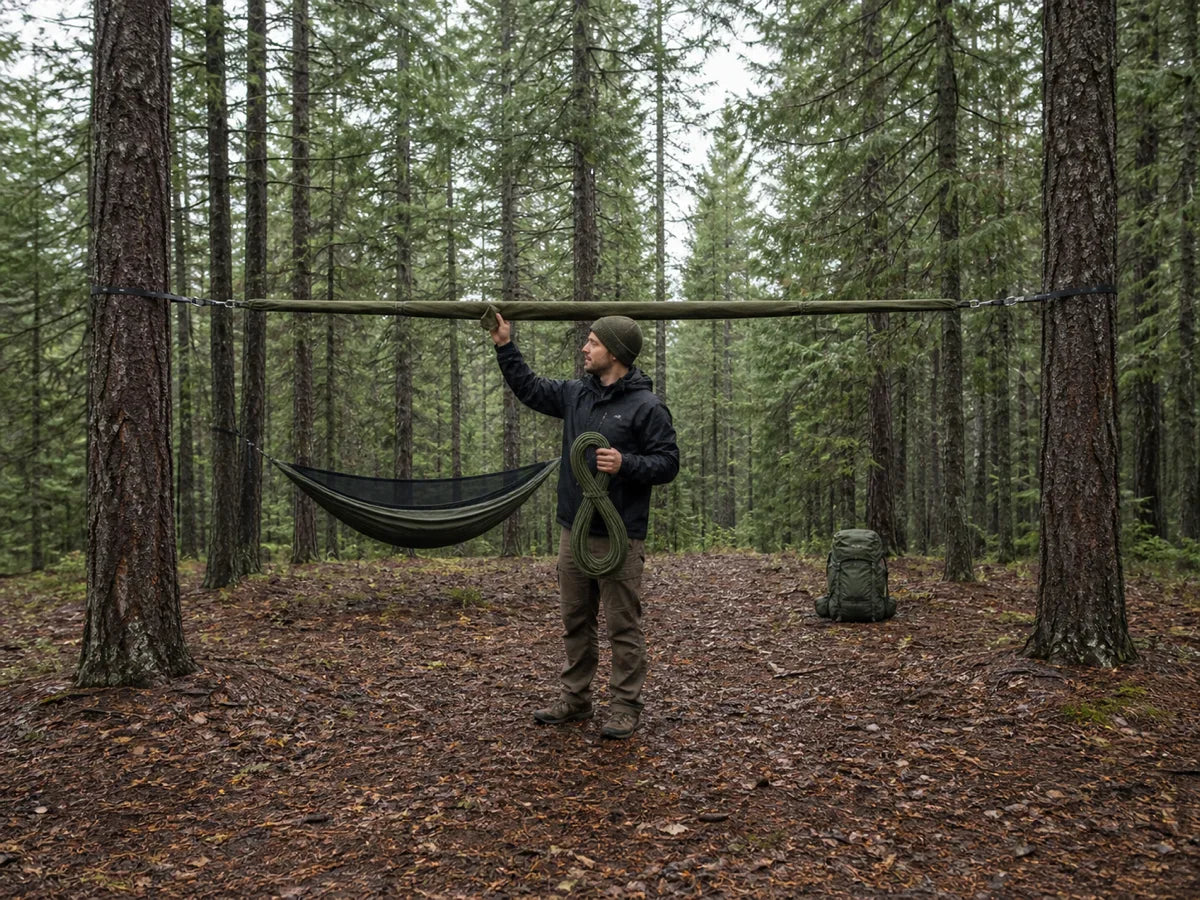
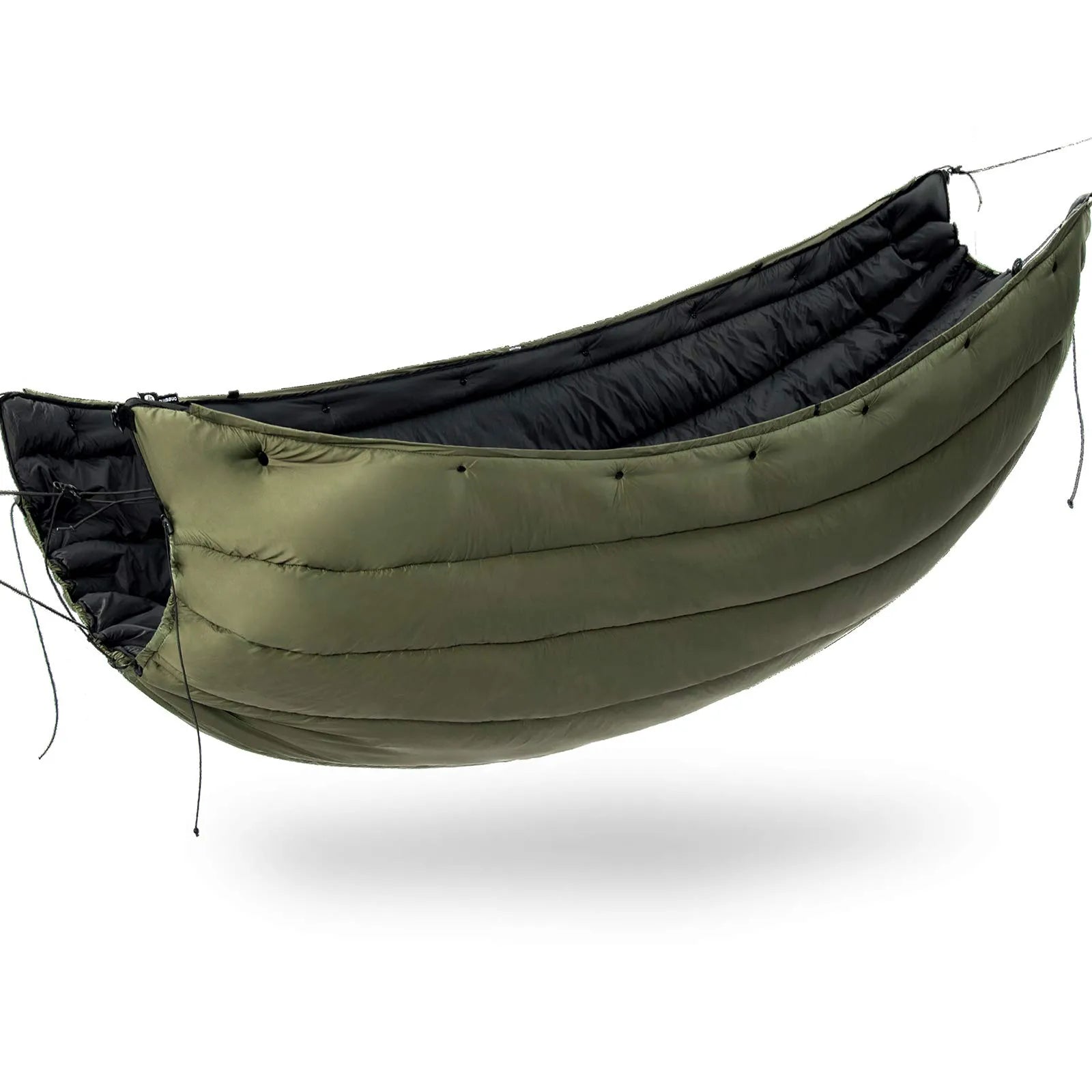
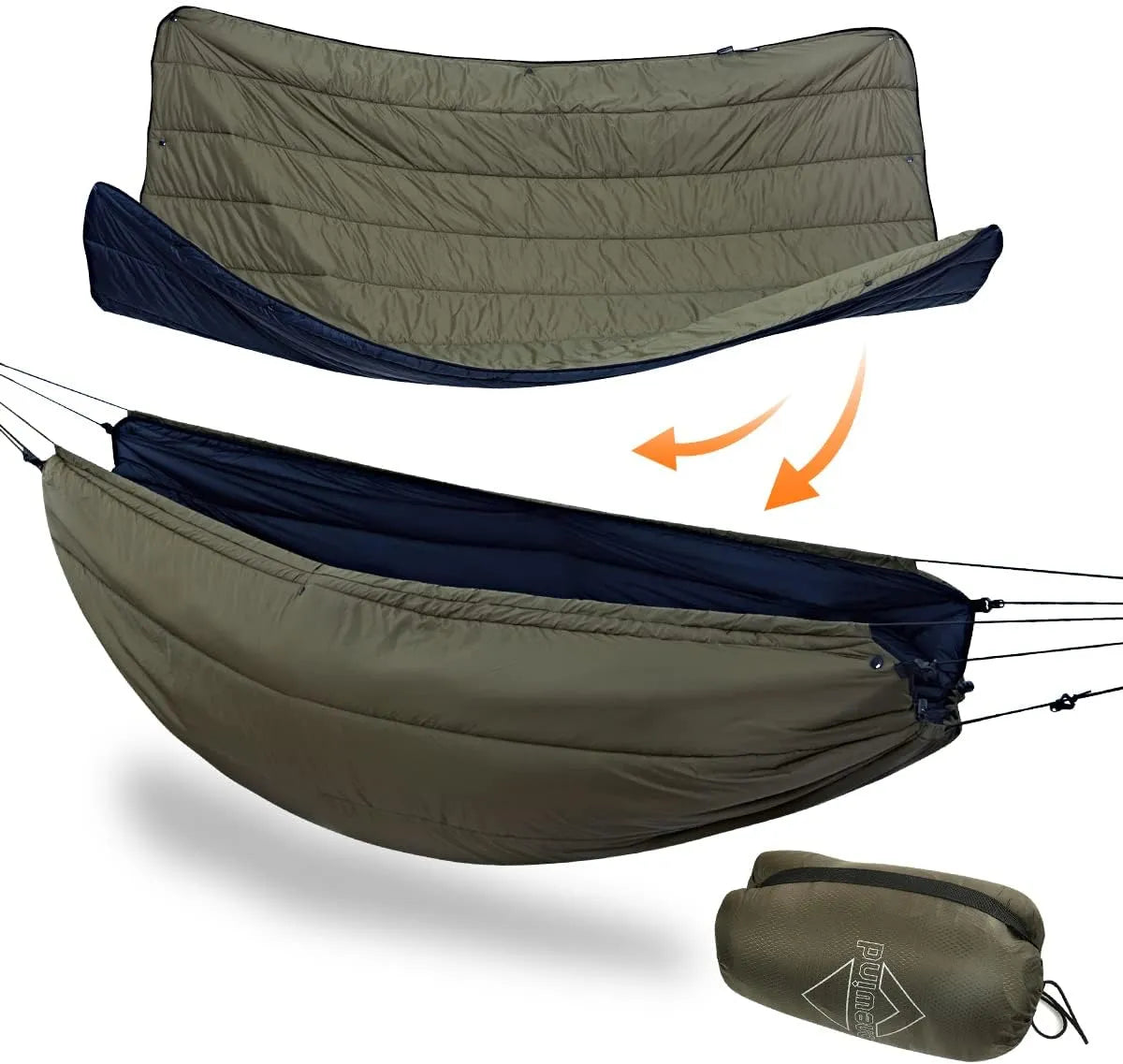
It hangs underneath the hammock, outside your body, in open air.
It sits in the exact zone where cold wind sweeps under the tarp and where condensation forms and drips.
That is the one piece of insulation on a hammock that the "keep it dry" assumption struggles to protect.
So when a chart says "down unless it is wet," the honest translation for a hanger is: down for the top, and a real question for the bottom.
Picture a single cold, damp night to see why the split matters.
Your top quilt spends the night trapped between your body and the tarp, warmed from below, never touched by outside air.
Your underquilt spends the same night hanging in that outside air, catching every drip the tarp sheds and every gust that slides under it.
Same fill, same rating, two completely different jobs.
That is why buying one material for the whole system is a mistake.
The right move is to judge each side on what it actually faces, and for the underquilt what it faces is moisture you cannot fully control.
What Your Underquilt Is Actually Exposed To

An underquilt faces three exposures a top-side quilt mostly avoids.
First, condensation. Warm, damp air meets a cold tarp and rains fine droplets straight down onto the quilt below.
Second, compression in storage. One Reddit hanger in r/hammockcamping described down that was "often compressed in my living situation," which flattens loft before the trip even starts.
Third, the ground fallback. When a site has no good trees and you end up on the dirt, the same hanger reported that "the down had no warming effect" once bodyweight crushed it flat.
A top quilt never has to survive being lain on. An underquilt sometimes does.
Notice the pattern. When conditions are controlled, down wins the bottom too.
Every row where synthetic wins is a row where control slipped.
What The Temperature Rating Assumes
A temperature rating is a promise made in a lab, and that promise assumes dry, fully lofted fill.
Mountain Equipment explains that an ISO 23537 rating comes from a heated manikin in a controlled chamber, measuring the power needed to hold a set temperature.
The number only holds while the insulation is at full loft.
A down underquilt that has soaked up a night of condensation and gone flat in patches is no longer the 20 degree quilt on the tag.
The label did not change. The quilt did.
Synthetic loses less loft in the same damp night, so its real-world warmth drifts less from its printed rating.
That is the practical meaning of warm when wet.
It does not mean synthetic is warmer than down.
It means synthetic's number survives contact with a wet night, and down's often does not.
A hanger in a dry climate can trust a down rating. In a wet one, read the same number with suspicion.
The Price Gap In Real Products
The down premium sounds scary in the abstract and turns out to be manageable in real catalogs.
Look at matched underquilts rather than jackets.
A gear comparison at Skilled Outdoors priced a OneTigris synthetic underquilt around $86 against its down version at about $133.
At the premium end, an ENO synthetic underquilt ran about $175 against the ENO down at roughly $300.
So the real-world down premium on an underquilt is roughly 1.5x to 2x, not the 5x that jacket shopping can suggest.
The Onewind step from synthetic to down, roughly $90 to $189, lines up with the OneTigris and ENO gaps.
For a first underquilt, that gap is real money.
For a fifth trip where you already fight condensation, it can be money spent on the wrong problem.
The Weight Gap Is Smaller Than You Think
The other down argument is weight, and it is true, but the size of it depends on what you are carrying.
At matched ratings, the underquilt weight gap is small.
Skilled Outdoors listed the ENO Vulcan synthetic at 30 ounces against the ENO Blaze down at 24 ounces.
That is a 6 ounce difference, which the source calls "negligible" for car camping and "notable" only when you count every ounce backpacking.
The gap widens in bags, where fill loads are larger.
Outdoor Life weighed a 40 degree synthetic bag at 1 pound 6 ounces carrying 13 ounces of fill, against an 850 fill down bag at 1 pound flat with just 8 ounces of fill.
For a car camper or a weekend hanger, a 6 ounce underquilt penalty disappears into the noise.
For a thru-hiker counting grams, it is exactly the kind of number that justifies the down premium.
Care And Longevity, The Quiet Cost
The last gap is the one nobody enjoys thinking about, which is upkeep and lifespan.
Down lasts longer, but only if you treat it well.
It wants gentle washing with a dedicated down cleaner, a long low-heat tumble with dryer balls to rebuild loft, and dry storage that is never left compressed.
Skip that routine and even good down mats down early.
Synthetic asks for almost none of this.
It washes easily, dries in hours, and forgives being stuffed in a sack between trips.
The trade shows up at the far end of the timeline.
Cared for, down can stay lofted for many years, while synthetic loft fades a little with every hard compression cycle.
Hammock Gear, a down maker, frames the difference as replacing a system every five years instead of every three.
So down rewards patience and punishes neglect, and synthetic does the reverse.
For most people who stuff a quilt away damp and forget it in a bag until the next trip, that pattern quietly favors synthetic in year one.
Down only pulls ahead over the years if the care habit is real, not aspirational.
What The Community Actually Does In Wet Country
Here is the surprise that keeps this article honest.
Even in famously wet regions, experienced hangers do not simply switch to synthetic.
A beginner in r/hammockcamping asked directly about down versus synthetic for the "humid/rainy" Southern Appalachians.
The top reply reported the community consensus: "down is the true champ," and moisture worries "usually met with the recommendation of a UQ protector."
Read that carefully. The wet-country default is not synthetic. It is down plus a protector, a light water-resistant shell that keeps drip and spray off the quilt.
The synthetic case is narrower and more specific than "it rains here."
It is for when you cannot reliably keep the quilt dry: heavy nightly condensation, gear that lives compressed, a budget that rules out both a down quilt and a protector, or the ground contingency.
On the material itself, the same community is precise. As one hanger put it, "Weight/Temperature you cant get better than Apex without Down," naming Climashield Apex as the synthetic benchmark to look for.
Where Onewind Sits, Honestly
Onewind sells both sides of this decision, so there is no single answer to push here.
That makes the honest recommendation a decision tree instead of a sales pitch.
On the synthetic side, the Flare Hammock Underquilt is $89.90 for the 30 to 50F rating and $74.90 for 40 to 60F.
The Bridge Hammock Underquilt is $94.99, and the Flare Underquilt and Blanket combo is $144.90.
On the down side, the Solstice Down Underquilt is $189.00 rated 32 to 59F, and the Equinox Down Underquilt is $249.00 rated all the way to 0F.
The full range lives in the hammock underquilt collection.
If you already know down is right for you, the deeper buying detail lives in the down hammock underquilt guide.
For the middle path that the wet-country community recommends, add the Hammock Underquilt Protector at $27.90 to a down quilt.
Scenario 1: You Hang In A Humid, Rainy Region
This is the Southern Appalachians case, and the answer is not the obvious one.
If you can pitch a good tarp and store the quilt dry, you should buy down and add a protector, because that is what the experienced crowd actually does.
Choose synthetic when the humidity beats your setup night after night, not just because the forecast says rain.
Verdict: Down plus a protector for most humid-region hangers with decent habits. Synthetic when condensation reliably wins.
Scenario 2: You Are A Beginner On A Budget
A first underquilt should be forgiving, because your first year is when the quilt gets stuffed damp and stored compressed.
For most beginners the smarter buy is a synthetic underquilt around $90, not a down quilt at $189 you have not learned to protect yet.
Upgrade to down later, once staying dry is a habit and you want the weight and pack savings.
Verdict: Choose synthetic first. Down is the upgrade you earn, not the entry ticket.
Scenario 3: You Count Ounces In Cold, Dry Country
Cold and dry is the exact case down was built for, and it delivers. When the air is dry and cold, nothing wets the quilt, so down's one weakness never shows up.
You should prioritize down here for its warmth per ounce and its small packed size, and step up to a 20 or even 0 degree rating for shoulder-season lows.
One hanger warned that a 30 degree quilt was "pretty much outgunned" on cold nights, so do not under-rate it.
Verdict: Down, and rate it colder than you think you need.
Scenario 4: Your Underquilt Keeps Getting Damp
If your quilt is damp most mornings, the material choice is already made for you.
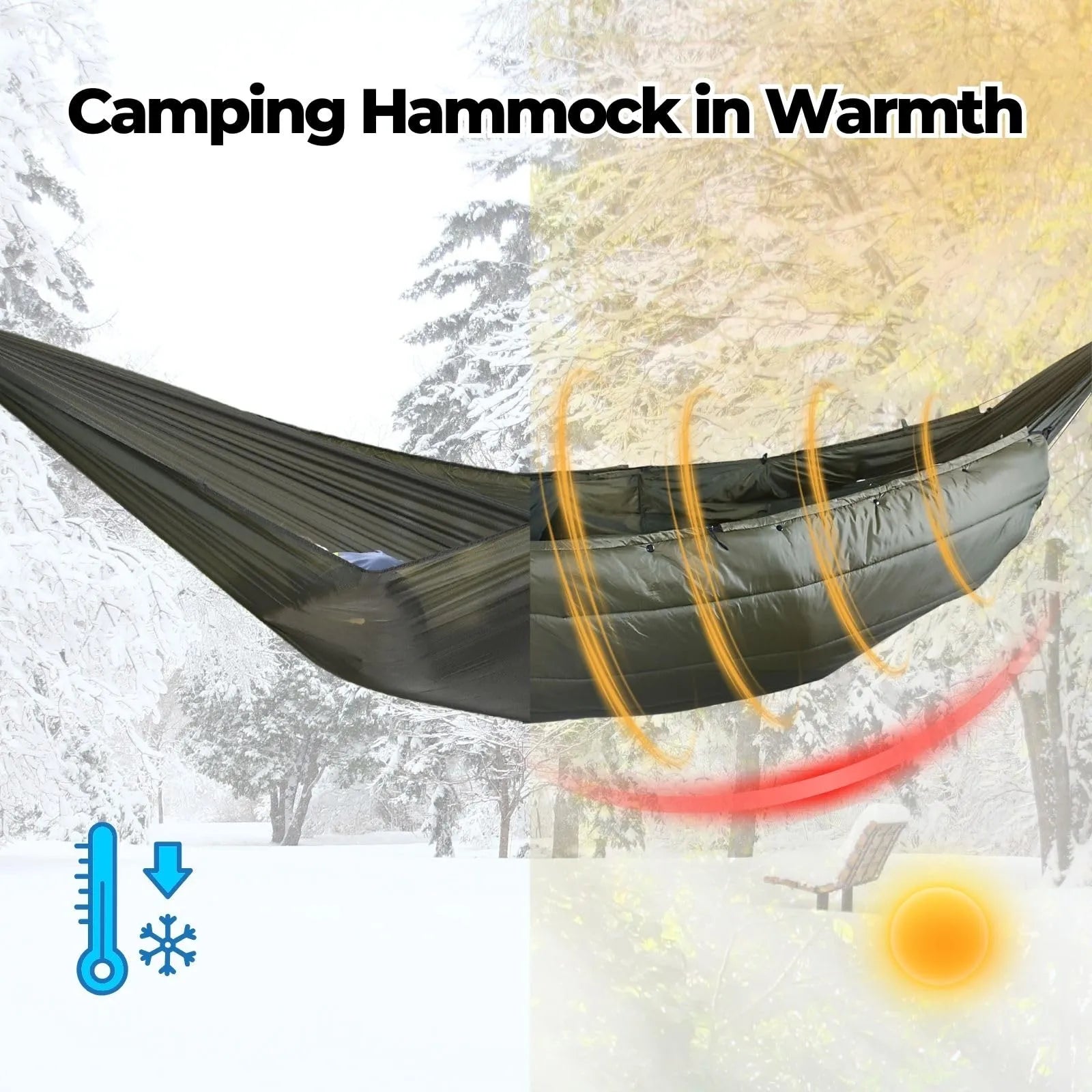
Synthetic keeps most of its warmth wet and dries in hours of sun or wind, while down needs a full, careful dry-out.
Choose synthetic here even if the price and weight favor down, because a warm damp quilt beats a cold dry-on-paper one.
Verdict: Synthetic. A quilt that works wet is worth more than one that only works dry.
Scenario 5: You Sometimes Have To Sleep On The Ground
An underquilt assumes you are suspended, and the one time that breaks is the one time down fails hardest.
Under bodyweight, down compresses to nothing, so a hanger who bails to the dirt with a down underquilt is effectively uninsulated.
If ground nights are a real possibility, avoid depending on down underneath, and either run synthetic or carry a sleeping pad for that contingency.
For how hang and ground insulation trade off, the hammock underquilt buying guide covers the full sleep system.
Verdict: Synthetic or a pad if the ground is ever on the table. Down only if you never leave the hang.
Choosing Your Insulation

The whole decision collapses to four questions, in order.
Down is not better and synthetic is not better.
Down is better when you can keep it dry and lofted, which on a hammock is easy on top and hard underneath.
Synthetic is better exactly where that control slips, which is where most people actually camp.
For most first-time hangers, and for anyone in humid country without dialed-in dry habits, you should start synthetic and treat down as the upgrade.
When you are ready to compare the whole sleep system rather than just the fill, the best hammock underquilt buying guide and the camping quilt versus sleeping bag guide pick up where this leaves off.