
The most upvoted first-hammock-night story on Reddit's r/hammockcamping is titled "the worst camping trip I've been on," and the top reply is blunt: hammocks can suck when you do everything possible wrong.
Almost nobody's terrible first night is the hammock's fault.
It is a setup you can correct, and it usually comes down to two mistakes the guides never fix.
You hung it tight and lay straight down the middle, so you slept in a banana curl.
And your back got cold, so you blamed a bad sleeping bag instead of the physics that made a good one useless.
Sleeping flat in a hammock is not a knack you are born with, it is a repeatable system, and the same three settings work every night once you know the numbers.
I cross-checked the hammock authorities, the manufacturer guides, and a stack of r/hammockcamping trip reports, and the flat-lay system below is what they all converge on once you strip out the vague advice.
What You'll Learn
I built this around three settings and one diagnosis, because lie diagonal is not enough if nobody tells you the numbers.
Here is what each part settles.
Quick Answer
A hammock lies flat when you build it as a system, not when you get lucky.
Set the sag, lie diagonal, fix it with a ridgeline, then read the symptom.
The rest of this guide explains why each fix is what it is.
The Flat-Lay System

Sleeping flat is three settings applied in order, and then a diagnosis when something still hurts.
Get them in sequence and the hammock becomes an ergonomic bed instead of a fabric taco.
Each setting depends on the one before it, so a tight hang cannot be saved by the diagonal, and the ridgeline only helps once the sag is right.
Setting 1: The Sag

The first thing beginners get wrong is pulling the hammock tight because a taut, level pitch looks correct.
It is the opposite of correct.
Hang the suspension strap at about 30 degrees from horizontal, which gives the deep sag the whole system needs.
A tight pitch forces your body into the banana shape, raises your center of gravity so the hammock feels tippy, and multiplies the force on your suspension and gear.
According to Onewind's own hang-angle explainer, a shallower angle raises the tension for the same body weight, so pulling tight literally increases the pressure you feel.
Derek Hansen, who writes The Ultimate Hang and is the closest thing hammock camping has to an authority, and the Scouting magazine guide he wrote both land on the same 30 degrees from horizontal, and Dutchware's beginner list says 30 degrees or greater.
There is a second payoff people miss.
A deep sag lowers your center of gravity, so the hammock feels stable instead of tippy, and users who switch from a tight pitch report the wobble disappears the moment they let it sag.
The deep sag is what lets the fabric conform so the next setting can flatten it.
Verdict: hang the strap at about 30 degrees from horizontal and resist the urge to pull it tight, because sag is not sloppiness, it is the setting the rest of the system is built on.
Setting 2: The Diagonal and the Foot End
How To Sleep In A Hammock The Right Way

Everyone says lie diagonal, and almost nobody tells you how far, so beginners guess and stay in the banana.
Here is the number the roundups skip.
Shift your feet 8 to 12 inches to one side and your head 8 to 12 inches to the other, which puts your body at roughly 30 degrees off the hammock centerline.
Lying across the curve instead of down it flattens the sag, and Derek Hansen describes the result as lying like a recumbent bicyclist, ergonomically flat.
Now the clarification that fixes more bad setups than any other.
There are two different numbers both called 30 degrees, and conflating them is the top beginner error.
One is how you hang the hammock, the other is how you lie in it, and they are set independently.
The diagonal does one more thing worth knowing.
Because you lie across the fabric, the sides rise into what Derek Hansen calls high walls that keep you centered, so you settle into the flat middle instead of rolling toward an edge.
Side sleepers push the angle further, to 30 to 45 degrees off center, which sources found gives the shoulder and hip room a straight lie never will.
The foot end does two jobs at once.
Raise the foot end 8 to 10 inches higher than the head, so you stop sliding into the center and the fabric ridge stops pressing the back of your knees.
On r/hammockcamping experienced hangers push this further, setting the head end 6 to 12 inches lower on purpose so the sleeper stays nestled at one end and finds the flat diagonal more easily.
The head itself wants a little support even on a flat diagonal.
Keep the head end slightly elevated, roughly 10 to 30 percent, and add a small pillow for the neck, because too flat drops your chin to your chest and too propped folds you forward, so a gentle rise is the sweet spot.
Verdict: lie about 30 degrees off center by shifting 8 to 12 inches each way, raise the foot end 8 to 10 inches, and never confuse the diagonal body angle with the 30-degree hang angle, because they are two separate settings.
Setting 3: The Ridgeline

The first two settings give you a good lay, and the ridgeline makes it the same good lay every single night.
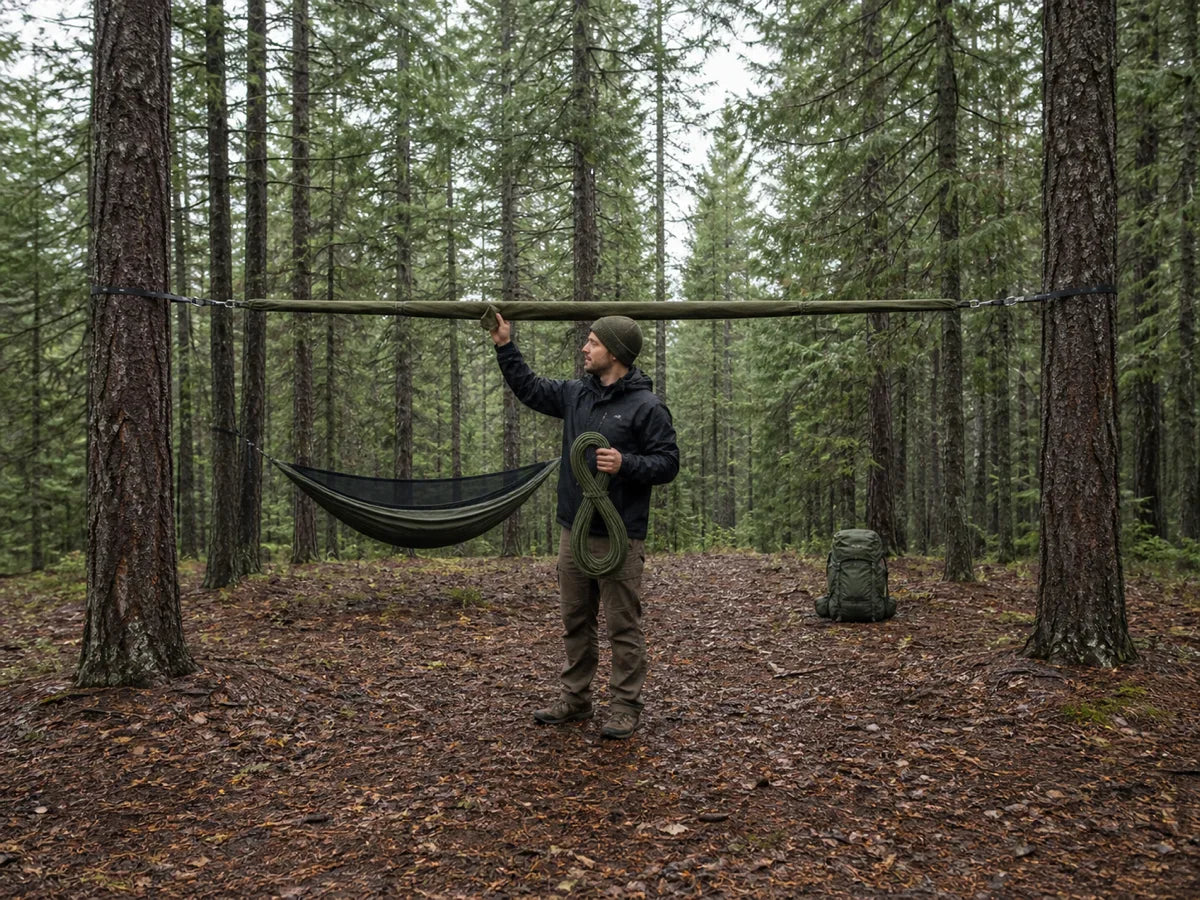
A structural ridgeline is a fixed-length cord between the two ends of the hammock that locks the sag depth regardless of how far apart your trees are or how tight you set the straps.
Without it, every hang is a slightly different bed and you re-solve the sag from scratch.
The rule is that the ridgeline runs about 83 percent of the hammock length.
A community thread on r/hammockcamping adds the correction the technical sources miss: measure that length off the hammock fabric, not the continuous loops, because the loops are suspension and do not count toward the ridgeline.
For a worked number, a 10-foot hammock wants a ridgeline near 100 inches, and an 11-foot hammock near 110.
Too tight and the sag shallows out and the banana curl comes back, too loose and you fold up in the middle, so you tune it by lying in it and adjusting the end knots.
When you get it right, the ridgeline also gives you a level line to hang a bug net or a small gear pocket from.
A dedicated structural ridgeline takes the guesswork out by fixing the length once.
Verdict: add a ridgeline at about 83 percent of hammock length measured off the fabric, and tune it by feel, because it is what turns a lucky good night into a repeatable one.
Diagnose the Symptom
How to Adjust Your Underquilt so you Stay Warm

Once the three settings are in place, any remaining discomfort has a specific cause, so you fix the symptom rather than fight the whole setup.
One position stays hard no matter what you do.
Stomach sleeping is the weak spot of a gathered-end hammock, and if you must sleep face down, a spreader-bar bridge hammock suits it better than any technique on a gathered-end.
There is a fast way to test your setup before you trust it for the night.
Lie in it in the daylight, go fully diagonal, and check three things: your back feels flat rather than curved, your heels are not pressed by a fabric ridge, and your shoulders are not squeezed inward.
When any of those fails, the symptom table below tells you which setting to change.
The cold back deserves its own explanation, because it is the one people fix wrong.
Your body weight compresses whatever insulation is beneath you, a sleeping bag or a pad, and crushes the air pockets that trap heat, so the underside becomes useless and cold air pulls your warmth away.
This is why a thicker, warmer sleeping bag does not help: the fill under you just gets crushed again.
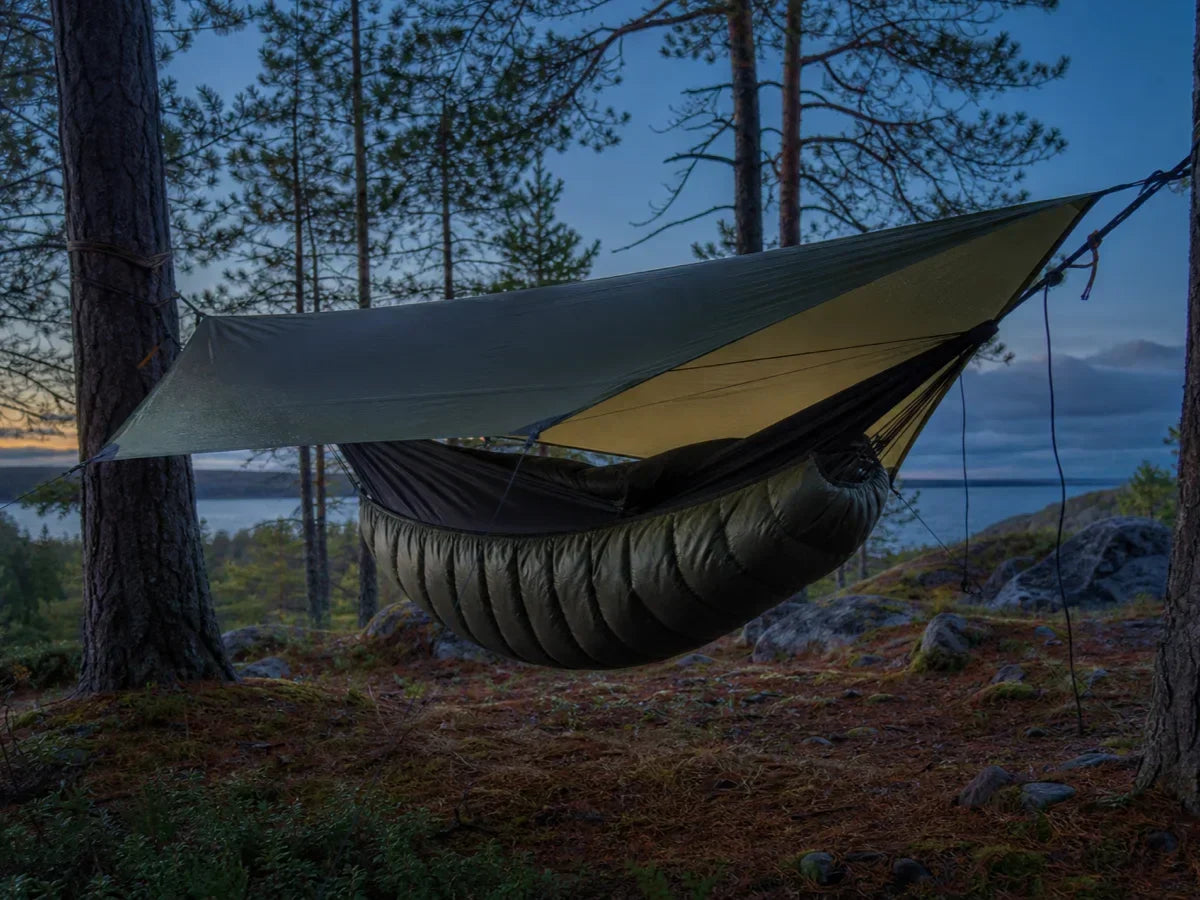
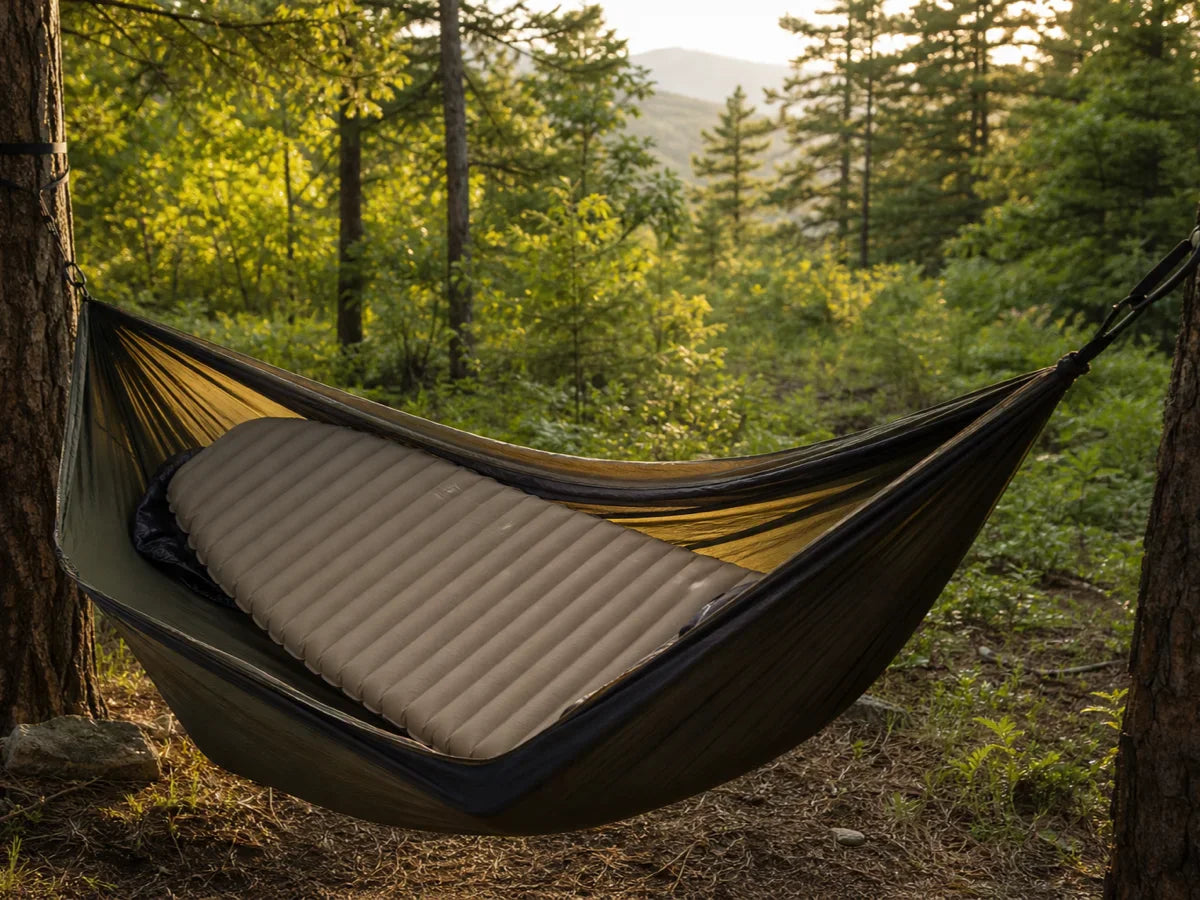
The fix is uncompressed insulation, an underquilt hung below the hammock so your weight never touches it, or a pad inside as a less comfortable alternative.
On the most upvoted first-timer thread, the community said exactly this: a sleeping bag gets squished under you so there is no loft to trap air, and an underquilt or pad is the real fix.
Verdict: match each symptom to its cause and fix only that, and treat the cold back as an insulation-compression problem an underquilt solves, not a sleeping-bag problem.
What Gear Actually Changes the Comfort

The techniques cost nothing and come first, but four pieces of gear genuinely change the outcome, and it helps to know which does what.
When length is the deciding factor, our hammock buying guide by length and system cost compares current options.
Length is the one people underspend on.
For most sleepers a longer hammock does more for comfort than any accessory, because it is what makes the diagonal reachable in the first place, so if you can change only one thing, change the length.
Width matters most to side sleepers and broad shoulders, and a wider hammock such as the 12-foot wide hammock moves your shoulders off the tight edges into the flat center.
The ridgeline and the underquilt each solve one specific problem, repeatability and the cold back, and neither substitutes for the other.
Verdict: when you buy, prioritize length first, then width if you side sleep, then a ridgeline and an underquilt, because length unlocks the technique the rest depend on.
Scenario 1: The Miserable First-Timer

You tried a hammock once, slept terribly, and now suspect hammocks are just uncomfortable.
Almost every part of that night was a setup error, not the hammock.
You most likely hung it tight and lay straight, which is the banana curl and shoulder squeeze combined, and if you were cold it was your compressed insulation, not the temperature.
Do the three settings, add an underquilt if the night was cold, and the same hammock becomes a bed.
The reframe matters, because when people quit after one bad night they usually blame the wrong thing and never try the fix.
Verdict: if your first night was miserable, do not conclude hammocks are uncomfortable, because you almost certainly hung it tight and lay straight, and the flat-lay system fixes both.
Scenario 2: The Back Sleeper

You sleep on your back and want the flat, supported lay a bed gives you.
The diagonal is native to back sleeping, so this is the easiest case.
Lie about 30 degrees off center, keep the head slightly elevated for comfort, and raise the foot end so you stay put.
A longer hammock helps a taller back sleeper reach the full diagonal, and when you still curl despite the diagonal, length is almost always the reason.
Many back sleepers report a hammock ended the pressure points a mattress gave them, because the fabric supports the whole body evenly.
Verdict: for a back sleeper, the diagonal plus a slightly raised head and foot end is usually all it takes, and length is the lever if you cannot get flat.
Scenario 3: The Side Sleeper

You sleep on your side and have heard that hammocks are only for back sleepers.
That is a myth, and side sleeping works on a wide enough hammock.
Go further off center, 30 to 45 degrees, and put a pillow between your knees for spinal alignment, which practitioners on r/hammockcamping confirm lets them curl up and sleep just fine.
Width is what makes it work, so a wider hammock matters more here than anywhere else.
When a side sleeper cannot get comfortable, the fix is almost always more width or more diagonal angle, not a different pillow.
Verdict: for a side sleeper, lie 30 to 45 degrees diagonal with a knee pillow on a hammock wide enough to hold you, and do not believe the back-sleepers-only myth.
Scenario 4: The Cold Back

Your sleeping bag is rated warm, you are still cold underneath, and you cannot understand why.
The bag is not the problem, compression is.
Your weight crushes the loft under you so it stops trapping air, and a warmer bag just gets crushed the same way, which is why the fix is an underquilt hung below the hammock where nothing compresses it.
This happens even in mild weather, so a cold back on a 50-degree night is normal, not a fluke.
When the forecast drops below freezing, sources found that hangers pair an underquilt with a top quilt, so the compressed underside is handled by the quilt that never bears weight.
Verdict: for a cold back, buy an underquilt rather than a warmer sleeping bag, because uncompressed insulation below the hammock is the only thing that keeps its loft.
Scenario 5: The Hammock Too Short to Lie Flat

You did the diagonal and you are still curved, and no amount of adjusting flattens it.
This is the hard limit the technique cannot beat.
A hammock under about 10 feet, especially 9.5 feet or less, does not give a taller person room to span the diagonal, so the sag stays under you as a banana no matter what.
Width matters too, since the diagonal needs fabric to spread into.
An 11 to 12 foot hammock is the upgrade, and a 12-foot hammock gives most people the room to lie genuinely flat.
Verdict: if you are still not flat after the diagonal, your hammock is probably too short, and length is the only real fix because no technique flattens a hammock you cannot span.
Scenario 6: Replacing a Bed

You are wondering whether a hammock can genuinely replace a bed, not just serve for a nap.
The people who have done it say yes, emphatically.
On r/hammockcamping a full-time hanger reports a decade of sleeping in one that ended 35 years of chronic back and neck pain, others note a hammock releases pressure better than a mattress, and hammocks remain the normal everyday bed for millions of people in northeast Brazil.
The same flat-lay system applies, with a permanent ridgeline setting and an underquilt or pad for warmth.
The difference indoors is that you can leave the sag and ridgeline dialed in once and never touch them, so every night is the same good bed.
Sources found that the people who make the switch tend to size up to a wider hammock, since a home bed has no pack-weight penalty to worry about.
Verdict: a hammock can replace a bed for many people, and the flat-lay system is what makes it a real bed rather than a novelty.
Common Mistakes

The first mistake is hanging the hammock tight, which forces the banana curl the whole system exists to prevent.
The second is lying straight down the middle instead of shifting a measured 8 to 12 inches onto the diagonal.
The third is confusing the two 30-degree numbers and setting the wrong one.
The fourth is a flat or foot-low hang, which slides you to the center and presses the calf ridge.
The fifth is answering a cold back with a warmer sleeping bag, when compression means only an underquilt helps.
The sixth is forcing a diagonal on a hammock too short to span, where length, not technique, is the answer.
The seventh is skipping the ridgeline, so the sag changes with every tree spacing and you never learn what a good lay even feels like.
The eighth is stomach sleeping in a gathered-end hammock and blaming the hammock, when that position needs a spreader-bar bridge instead.
The Quick Setup Checklist
Run this before you commit to the night.
Set the sag, lie diagonal, fix it with a ridgeline, then read the symptom, and let the length of the hammock carry the technique the rest depend on.
A 12-foot hammock with a structural ridgeline and an underquilt is the setup that handles all three settings at once, and you can browse the range in the camping hammock collection.
Do that and the hammock that gave you the worst night of camping becomes the bed you sleep better in than the one at home.

Shop 12ft Hammocks for a Flat Lay
Shop Now →