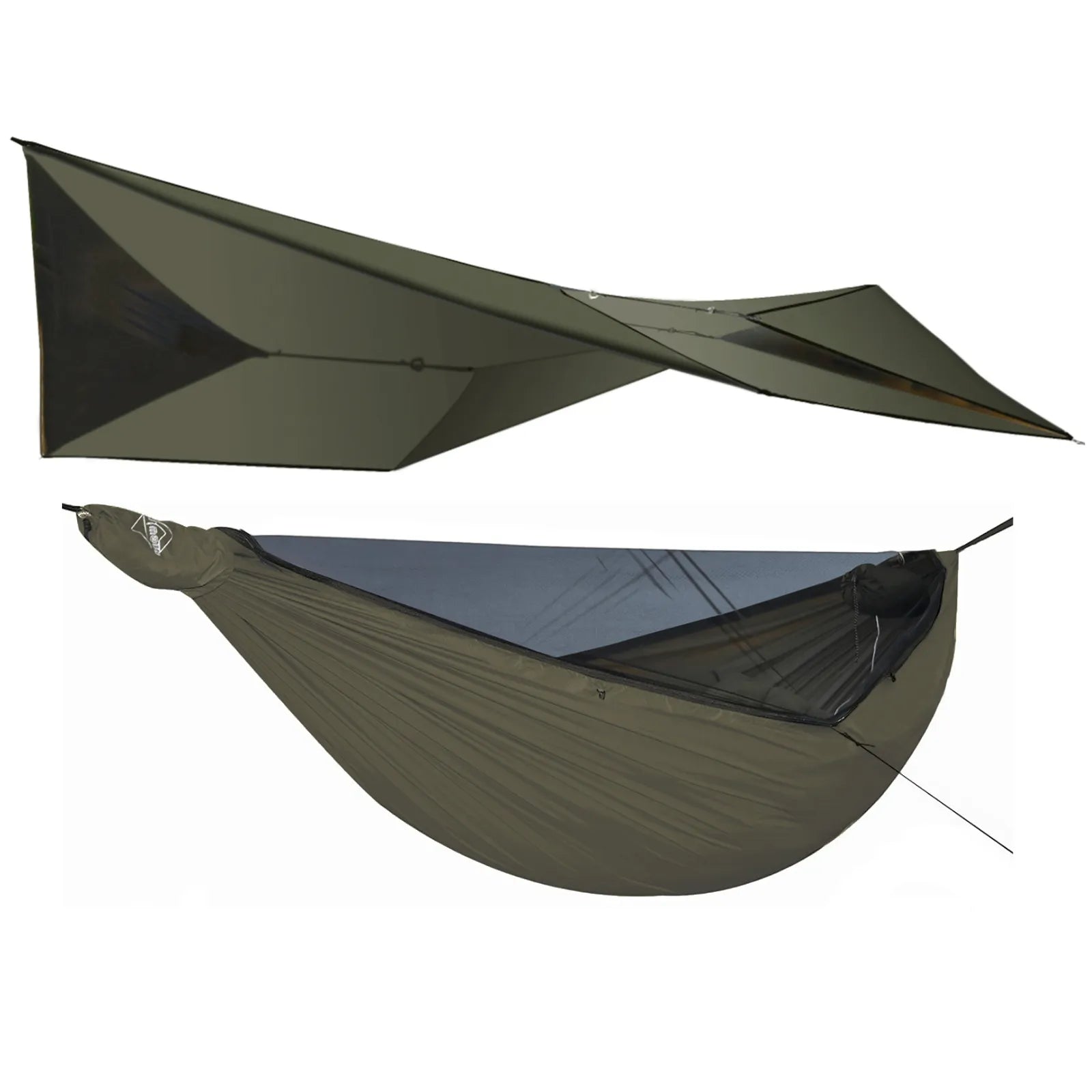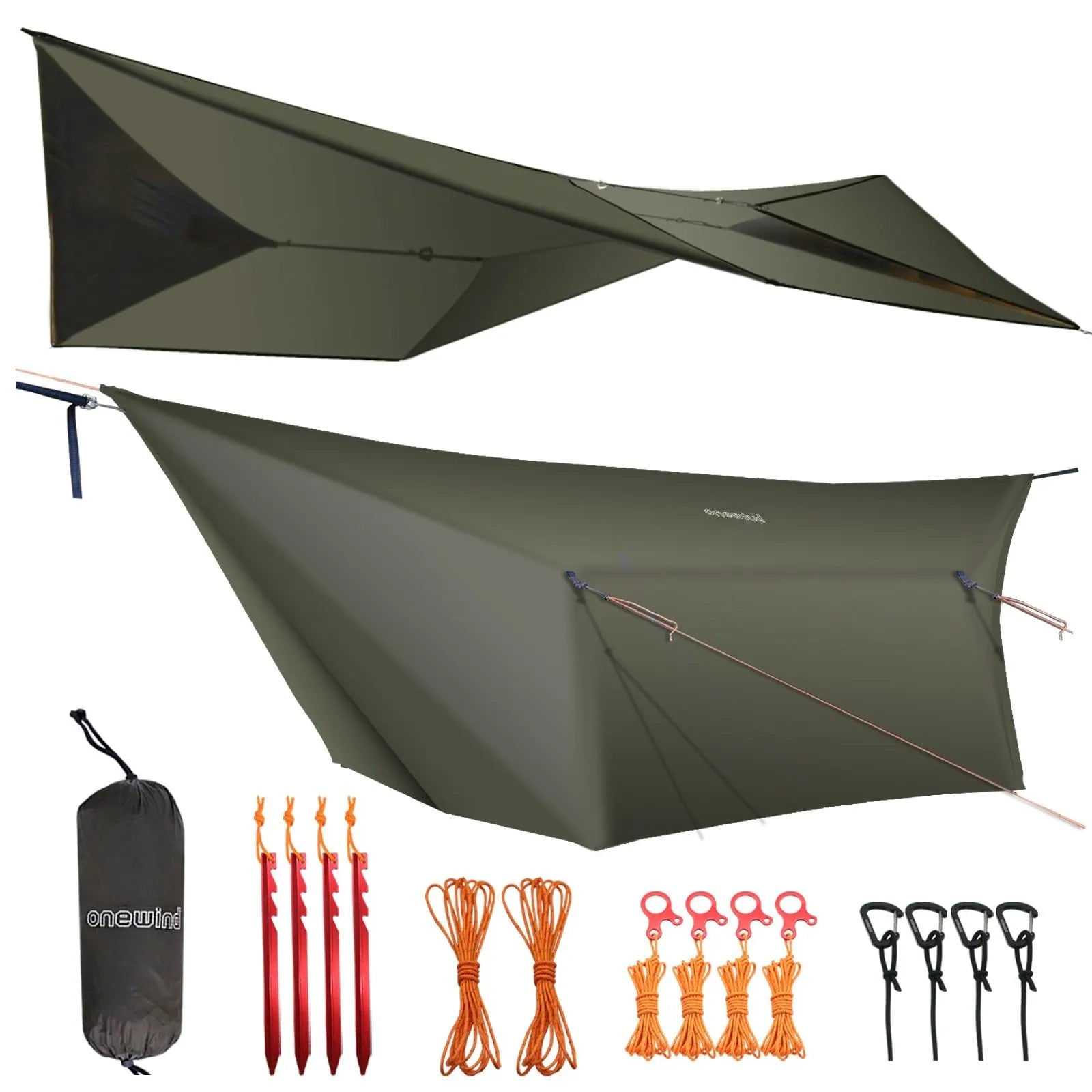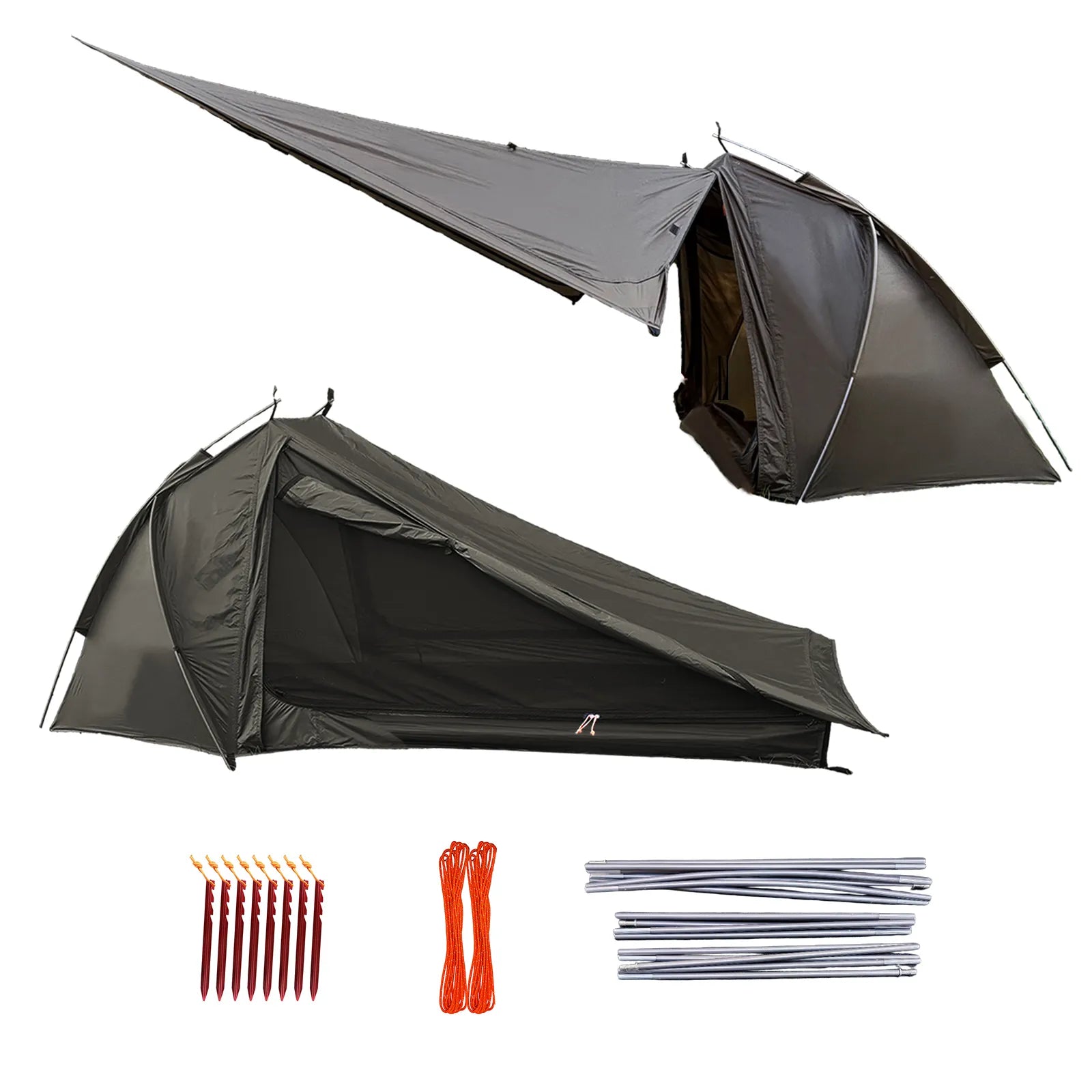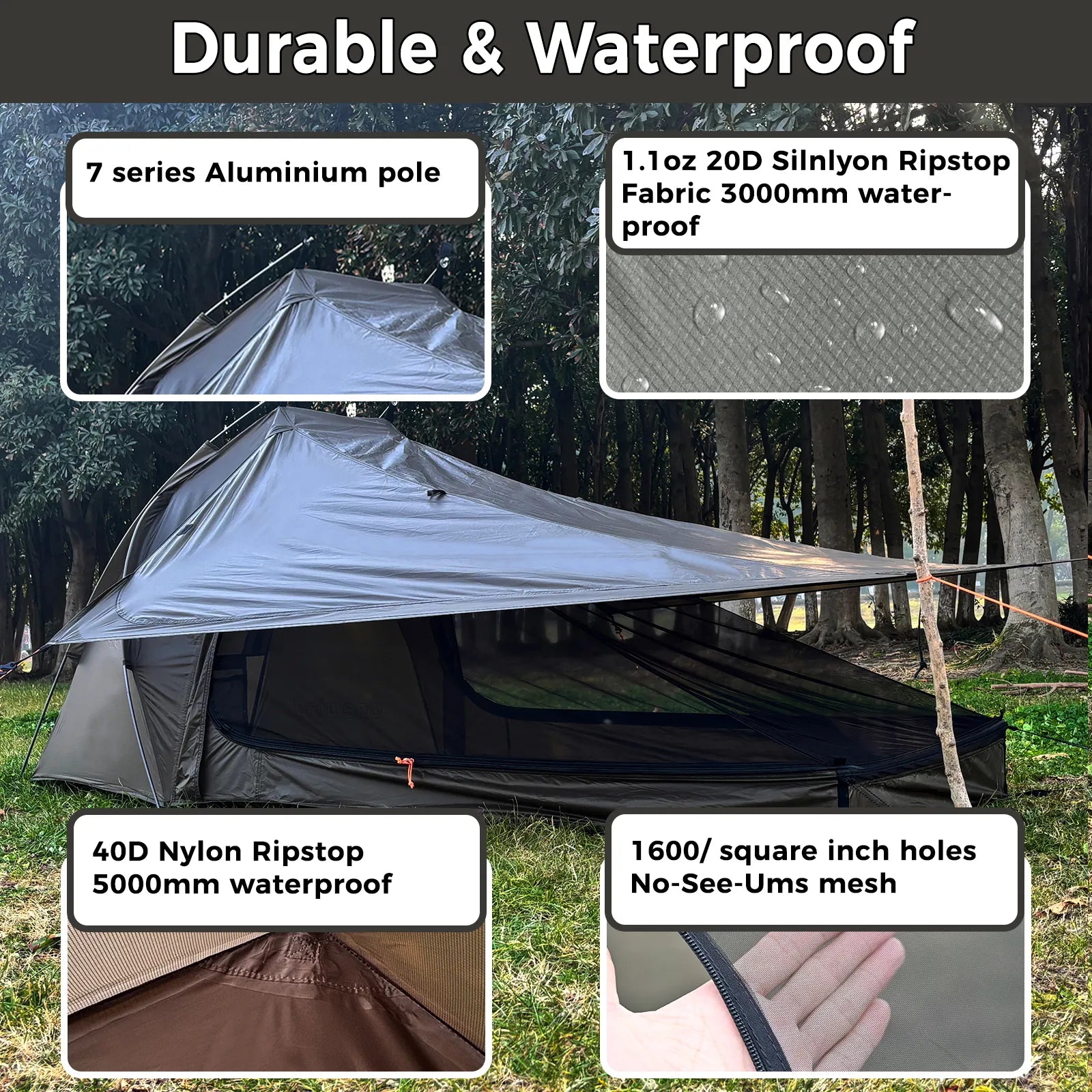

Onewind lists its compact Tarp Pole Mods at 56 inches extended, 12.4 inches folded, and 8 ounces per set.
Data from that spec sheet gives a practical benchmark: 56 inches is side-lift height, not kitchen-awning height.
Those three numbers tell you what the poles are actually for.
They are not standing-height kitchen awning poles.
They are compact lift poles for porch mode, side airflow, door support, and controlled tarp geometry.
I compared that size class against REI's tarp setup advice, Kelty's tarp pitching instructions, and camper discussions about pole height, guyline distance, and wind stability.
The same pattern showed up every time.
The best camping tarp poles are not the tallest poles you can pack.
They are the shortest stable poles that create the shape you need without turning your tarp into a sail.
A low storm edge, a mid-height hammock porch, a compact backpacking lift, and a tall car-camp canopy are four different jobs.
One pole size can help with some of them, but no pole size solves all of them.
This guide gives you a height and stability framework before you buy poles, replace trekking poles, or add a porch mode to a hammock tarp.
What You'll Learn
This is a gear decision, but it is also a geometry decision.
I start with height because it is the number most people compare first.
Then I move to wind and guyline stability because that is where a good-looking pitch fails.
The final layer is packability because a pole that works from a car trunk can be miserable inside a backpack.
By the end, you should know whether you need compact tarp pole mods, trekking poles, full-height canopy poles, more guylines, or no poles at all.
Quick Answer
Choose compact camping tarp poles if the job is controlled lift.
Choose tall tarp poles if the job is living space.
Choose trekking poles if you already carry them and the pitch height matches the tarp connection.
Choose trees or a ridgeline if they create the same shelter shape with less carried weight.
Do not choose a pole because the listing says it extends higher than another pole.
Choose it because the height, packed length, and anchor geometry match the tarp pitch you plan to use.
The Decision Framework
Tarp shelter setup with poles

According to REI's tarp shelter guidance, tarp pitch shape depends on pole height, guyline angle, stakes, and tension sequence.
Pole choice is only one part of the shelter system.
I use four questions before recommending any camping tarp poles.
What shape are you trying to create?
What weather will hit the exposed side?
How large is the tarp panel that the pole must support?
How far do you have to carry the pole before setup?
The 56 inch class makes sense when you need a controlled side lift on a hammock tarp, a porch wing, or a compact backup when tree spacing is wrong.
The 7 to 8 ft class makes sense when the tarp is acting like a campground roof over chairs, a picnic table, or a cooking area.
According to Kelty's Noah's Tarp instructions, the stability sequence is simple: stand the poles at corners, stake the guy cords, then tighten the system.
That sequence matters because changing pole height after tensioning changes the whole pitch.
I treat every pole as a lever.
More height gives more room, but it also gives wind more surface area to push.
The safer default is to build only as much height as the trip needs.
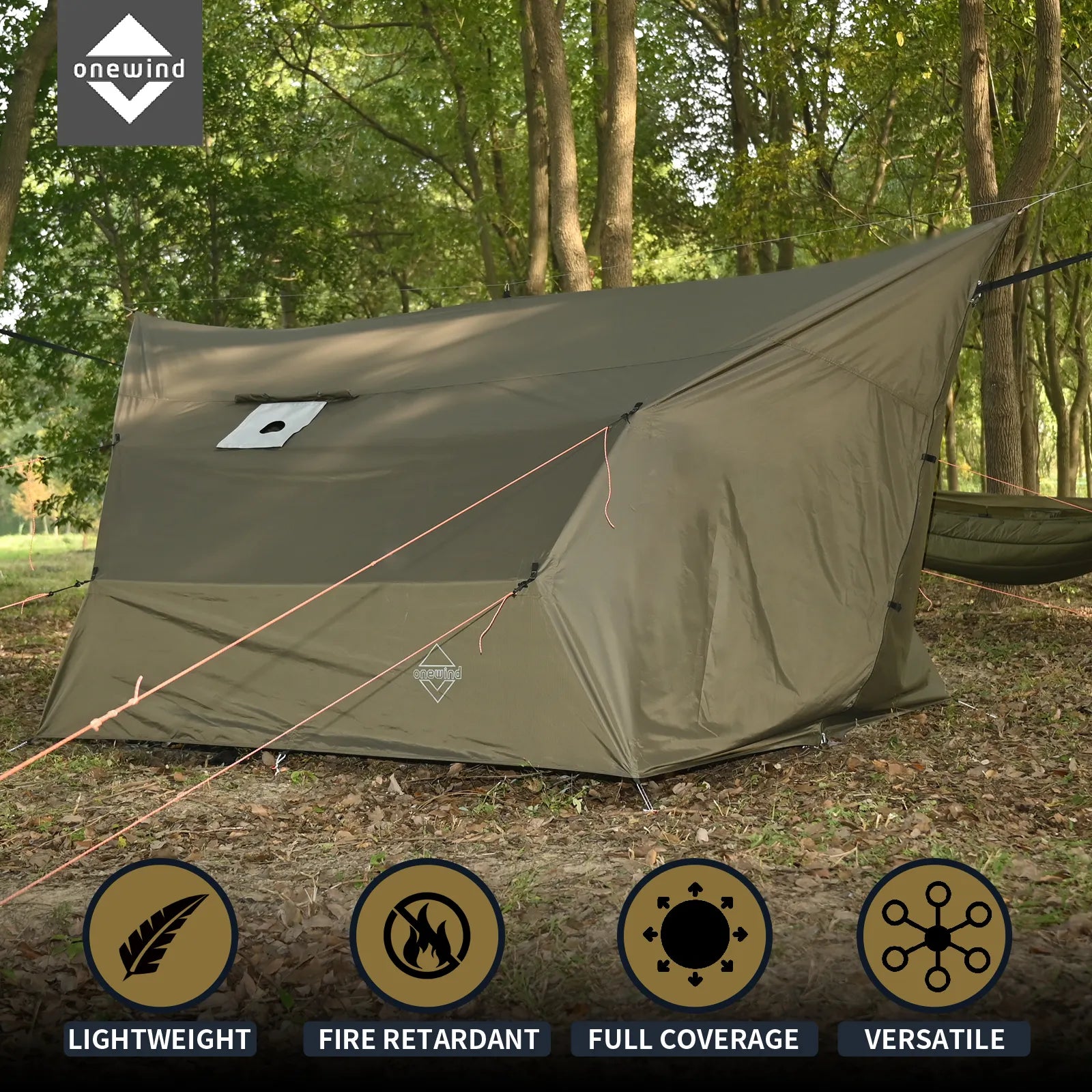
Scenario 1: Hammock camper raising a tarp edge into porch mode for airflow and less claustrophobic coverage.

This is the strongest case for compact camping tarp poles.
The tarp is already doing the hard weather job above the hammock.
You are not trying to create a standing-height shelter.
You are trying to lift one edge enough to see out, vent humid air, cook carefully outside the drip line, or make a long rain day feel less boxed in.
A 56 inch pole is often a better match than a tall awning pole because the lift is moderate.
The tarp still keeps a low enough profile that you can drop the porch quickly if rain starts blowing sideways.
According to Onewind's tarp pole specs, the Tarp Pole Mods fold to 12.4 inches and extend to 56 inches, which fits the porch-mode job better than a bulky car-camp pole.
I would pair this kind of pole with a hammock tarp, a clean guyline angle, and enough stake distance to keep the lifted edge from bouncing.
The pole should raise the edge, not pull the tarp body out of shape.
I would also keep the windward side lower than the porch side.
REI's rain and wind tarp advice points out that extra height can help, but loose fabric becomes noisy and unstable.
Porch mode works best when the open side is the protected side.
If the forecast changes, collapse the porch first and save the dry sleep area.
In this porch setup, Tarp Poles Mods, Light-Reflective Guyline, and a hammock tarp such as Billow Ultralight Hammock Tarp Shelter 12' work as a system rather than separate accessories.
Verdict: Choose compact adjustable poles for hammock porch mode, and treat them as airflow and visibility tools rather than storm-height poles.
Scenario 2: Backpacker using poles only when tree spacing is wrong or a ridgeline is unavailable.

Backpackers have a different problem.
Every carried inch matters.
Every carried ounce has to earn its place.
A full-height tarp pole can be useful at a campground, but it becomes a liability if it rides awkwardly outside the pack or replaces something you already carry.
If you hike with trekking poles, start there.
Trekking poles can pitch many tarp shelters when their height range, tips, and handles match the tarp's tie-outs or grommets.
If you do not carry trekking poles, a compact dedicated pole can solve the backup-pitch problem without the bulk of a canopy pole.
The key is to decide whether the pole is primary shelter support or insurance.
If the route has reliable trees, the pole may only need to lift a side panel or support a porch when tree spacing is off.
If the route crosses beaches, alpine zones, or exposed campsites, the pole may be part of the primary shelter plan.
According to the CampingGear tarp pole discussion, campers repeatedly treat the problem as geometry, not just shopping.
People compare pole height, tarp width, guyline distance, and real covered area because flat tarp size does not tell you the pitched shape.
I would pack compact poles when I need a repeatable side lift or backup structure and cannot count on trees.
I would skip them when trekking poles already create the exact ridgeline height and my tarp attachment is secure.
A compact pole also pairs well with a smaller tarp sleeve or a storage piece such as the 12 ft Tarp Sleeve because the whole system stays packable.
Verdict: For backpacking, choose the smallest pole system that creates the required pitch, and use trekking poles first if they already fit the tarp geometry.
Scenario 3: Car camper wanting a tall kitchen or sitting-area awning.

Car camping changes the decision because packed length matters less.
You are not counting every ounce.
You are trying to create shade, standing space, or a dry cooking edge near a vehicle, table, or group hangout.
In that use case, compact porch poles can feel too short.
A 56 inch lift works beside a hammock, but it does not create comfortable standing room for a kitchen tarp.
For that job, taller 7 to 8 ft poles usually make more sense.
The tradeoff is extra wind load.
A tall tarp edge gives you comfort in calm weather and more risk in exposed weather.
According to REI's rain and wind guidance, tarps work as quick shelters only when height, wall angle, and tension match the weather.
Kelty's instructions also show poles working with guy cords and stakes, not alone.
That combination is the part many car campers underbuild.
If you raise a large tarp high enough for people to walk under it, add more anchor points and widen the guyline angles.
If the tarp is big, do not expect two poles to manage every corner and side panel.
Use extra side support when the panel sags or flaps.
Onewind's tarp and shelter collection includes 11 ft, 12 ft, hex, and larger shelter options, and each shape changes how many poles and guylines you need.
For a hammock product ecosystem, compact pole mods are the porch and side-lift tool, while a campground kitchen roof may need a different pole class.
Verdict: For car-camp awnings, choose taller poles only when you also bring enough guylines, stakes, and anchor spread to control the extra wind load.
Scenario 4: Camper pitching in wind or rain who should lower the windward edge instead of maximizing height.

Rain changes the pole decision fast.
The comfortable fair-weather pitch is often not the dry storm pitch.
A lifted tarp edge gives airflow, but it also gives wind a larger opening.
If rain is arriving sideways, the first move is not to add height.
The first move is to lower the windward edge and tighten the shelter shape.
According to REI's tarp tips, rain and wind tarp use cases include extra height, temporary vestibules, and tight front walls.
The phrase to pay attention to is tight front walls.
That is the opposite of leaving a tall open edge facing weather.
I use a simple rule in this scenario.
The exposed side gets lower.
The protected side can stay livable.
If both sides are exposed, lower both sides and stop treating the tarp like an awning.
According to Kelty's setup sequence, poles, guy cords, and tension need to be adjusted together.
If you raise or lower the pole after the pitch is loaded, retension the guylines.
If the tarp starts snapping, the pole may not be the weak part.
The problem may be a shallow guyline angle, a poor stake hold, or too much fabric exposed to gusts.
I would rather lose six inches of headroom than wake up to a flapping shelter that sprays mist under the tarp.
Verdict: In wind or wind-driven rain, choose the lower stable pitch before choosing taller poles.
Scenario 5: Beginner who owns a tarp but does not know whether to use trekking poles, dedicated tarp poles, trees, or vehicle tie-off points.

This scenario is common because a tarp gives you too many setup choices.
Trees can hold a ridgeline.
Trekking poles can hold a backpacking shelter.
Dedicated tarp poles can lift corners and sides.
A vehicle can anchor one edge at a campsite.
The mistake is trying to choose the pole before choosing the job.
Start with the pitch.
If you need a ridgeline between two trees, poles may be unnecessary.
If one side of the tarp needs a porch lift, compact poles are useful.
If a freestanding-ish shade area is the goal, dedicated taller poles and more guylines make more sense.
If the campsite has a vehicle in the right place, a tie-off point can replace one pole, but it can also lock you into bad orientation if wind shifts.
I would practice all four options in daylight before trusting any one of them on a first trip.
Kelty's tarp instructions recommend test pitching before a trip, which is exactly the right habit here.
Test pitching tells you whether your pole tip fits the tarp point, whether the guyline reaches the stake position, and whether your tarp drains instead of pooling.
This is also where product restraint matters.
Do not buy three pole styles before you know which pitch you actually like.
Start with the support you already carry, then add compact tarp poles if they solve a repeat problem.
Verdict: Beginners should choose the pitch first, test it in daylight, and buy poles only for the setup gap that remains.
Scenario 6: Large tarp user who needs more than two poles and stronger guyline geometry.

Large tarps expose bad pole decisions quickly.
A big fabric panel catches more wind.
It also sags farther between support points.
Two tall poles can raise a ridge or edge, but they do not automatically control the corners, side pullouts, and panel belly.
The larger the tarp, the more the system depends on distributed support.
Reddit community reports about tarp pole size often move from pole height to ridge height, side height, and covered area because those variables decide the usable shelter.
That is the right way to think.
A 12 ft rectangular hammock tarp, an 11 ft tarp, a Nebula 12' Hexagonal Tarp Hammock Rain Fly, and a larger hot tent or Blackthorn-style tarp do not ask the same thing from poles.
Onewind's tarp collection makes that visible because the shelter shapes serve different uses.
For a large tarp, I would plan pole count before pole height.
Two poles may support a simple ridge or porch.
Four poles can create a broader awning but need better guyline spread.
Side pullouts may need short lift points rather than tall main supports.
The worst version is one tall center lift that makes the tarp look spacious while the side panels flap and shed water poorly.
Use stronger cord, more stake points, and lower exposed edges when the tarp gets large.
If you use Onewind-style modular tarps, pair pole decisions with HMWPE Tent Cordage Guyline or a guyline kit before chasing extra height.
Verdict: Large tarps usually need more support points and better guyline geometry before they need taller poles.
Common Mistakes That Make Tarp Poles Feel Useless

Most tarp pole failures start before the pole touches the ground.
The camper chooses a height, tarp, or anchor pattern that does not match the weather.
Then the pole gets blamed for a problem created by shelter geometry.
The same pattern appears across setup guides, manufacturer instructions, and community questions.
People compare pole specs as if height is the whole decision.
The working pitch depends on height, tarp size, wind angle, guyline length, stake hold, and how fast the setup can be lowered.
The five mistakes below are the ones I would check before replacing a pole.
Mistake 1: Buying the tallest pole before defining the pitch

Tall poles feel like an upgrade because more headroom is easy to picture.
The problem appears when weather arrives.
A high tarp edge catches more wind, and a wide tarp panel can start lifting, snapping, or dumping spray under the protected area.
REI's tarp advice includes both extra height and tight walls because those are different tools for different weather.
Using the tall setting all the time ignores that split.
I would define the pitch before buying the pole.
A low storm pitch needs less height.
A hammock porch needs moderate height.
A car-camp awning needs more height, but also more guyline control.
If a pole listing looks attractive only because it is taller, pause.
Ask whether that height creates runoff, shade, or access that your actual trip needs.
If the answer is only "more room," the pole may be solving comfort while creating weather risk.
Avoid it: Pick the target pitch first, then choose the shortest pole height that creates that shape.
Mistake 2: Treating pole choice separately from tarp size

A pole does not support an abstract tarp.
It supports a specific tarp shape, width, tie-out layout, and fabric panel.
An 11 ft hammock tarp with a porch lift behaves differently from a wide kitchen tarp or a larger hot-tent style shelter.
Onewind's tarp lineup includes several sizes and shapes, which is a reminder that pole choice has to follow tarp design.
A compact pole can be excellent on a side lift and too short for a tall group canopy.
A tall pole can be useful on a car-camp awning and awkward on a narrow backpacking tarp.
Reddit geometry discussions make the same point from a different angle.
Campers ask about tarp size, ridge height, side height, and covered area because the flat tarp measurement changes after pitching.
I would sketch the pitch before choosing pole height.
Mark the ridge or lifted edge.
Mark the low edge.
Mark where rain should run off.
Then count how many support points need a pole, tree, trekking pole, vehicle, or stake.
Avoid it: Match pole height and pole count to the tarp's pitched shape, not to the tarp's product category.
Mistake 3: Ignoring guyline angle and stake distance
Tarp and tent guy line setup guide

A tarp pole standing straight under fabric is not a stable shelter by itself.
The guyline system holds the pole in the direction wind wants to move it.
According to Kelty's tarp instructions, poles, guy cords, stakes, and tightening belong in one setup sequence.
That sequence is the lesson.
If the stake is too close to the pole, the guyline pulls downward more than outward.
If the stake is too far without enough tension, the pitch can sag or flap.
If the ground is soft, the stake may fail before the pole does.
I like to set pole height, place the guyline at a clean angle, and then retension after every height change.
Changing one pole can change the whole tarp.
This is especially true in porch mode because one lifted side can loosen a neighboring panel.
A pole that feels weak may actually be fine.
The setup may need a better angle, a stronger stake, or a lower pitch.
Avoid it: Treat the pole, guyline, stake, and tarp tie-out as one system every time you change height.
Mistake 4: Carrying full-height canopy poles on a backpacking trip

A campground pole can be the wrong backpacking pole even if it is strong.
Packed length matters when the pole has to ride inside a pack or strap cleanly outside it.
Weight matters when you are carrying a tarp, hammock, insulation, water, food, and stakes.
Onewind's compact pole specs are useful because they show the opposite design target: 12.4 inches folded and 8 ounces per set.
That size class fits the modular shelter problem better than a tall canopy pole.
The question is not whether a full-height pole can hold a tarp.
The question is whether it is the right carried object for the trip.
I would carry full-height poles when a vehicle carries the weight and the goal is sitting or standing room.
I would carry compact poles when the goal is a side lift, porch mode, or backup support.
I would carry no dedicated poles when trekking poles or trees already solve the pitch.
For a hammock camper who wants a small porch option, Tarp Poles or compact pole mods make more sense than a long canopy pole strapped to a pack.
Avoid it: Let packed length and carried weight decide whether you need a compact pole or a campground pole.
Mistake 5: Leaving the windward side high in rain

The porch pitch that feels great at 5 p.m. can be wrong at 2 a.m.
Wind direction changes the shelter job.
If the open side faces rain, the pole height is now inviting spray into the dry zone.
According to REI's tarp tips, rain and wind shelter uses require shaping the tarp around weather direction.
According to Kelty's setup instructions, users should tighten the system after standing poles and staking guy cords.
That matters because lowering one side changes tension.
I would never leave a high open edge facing wind-driven rain just because the tarp looked good earlier.
Drop the windward side.
Retension the lifted points.
Move the sitting area or gear pile if the dry zone changes.
Keep porch mode for the lee side or fair weather.
This is also why adjustable poles beat fixed-height poles for many tarp users.
The ability to drop a side quickly can matter more than the maximum height on the label.
Avoid it: Lower the exposed edge first, then retension the pole and guyline system around the new weather direction.
The Quick Decision Checklist
- ✓ Start by naming the job: porch mode, storm pitch, backpacking backup, car-camp awning, or large-tarp support.
- ✓ Choose the shortest stable height that creates the job.
- ✓ Match pole count to tarp size and tie-out layout.
- ✓ Use wider guyline geometry when the tarp gets taller or larger.
- ✓ Lower the windward side before rain hits.
- ✓ Test the pitch in daylight before relying on it at camp.
I would buy compact camping tarp poles when I need a repeatable hammock porch, tarp-edge lift, or packable backup support.
I would buy taller poles when the goal is a campground living area and I can carry extra anchors.
I would skip new poles when trees, trekking poles, or a vehicle tie-off already create the same stable shape.
If you already use Onewind hammock tarps, the clean upgrade path is compact pole support plus enough guyline control, not maximum height for its own sake.
That keeps the shelter easy to pitch, easy to lower, and less likely to fight the weather.