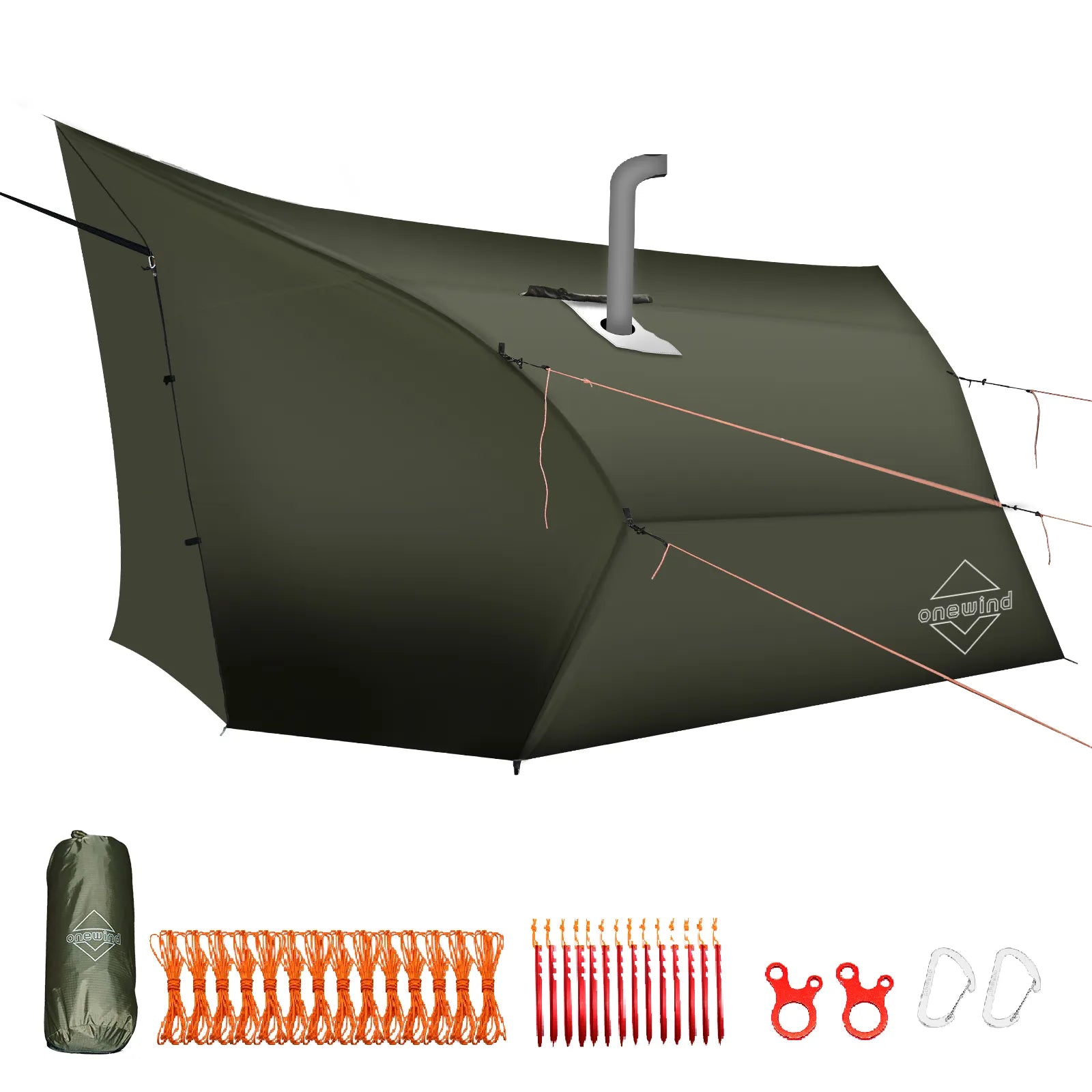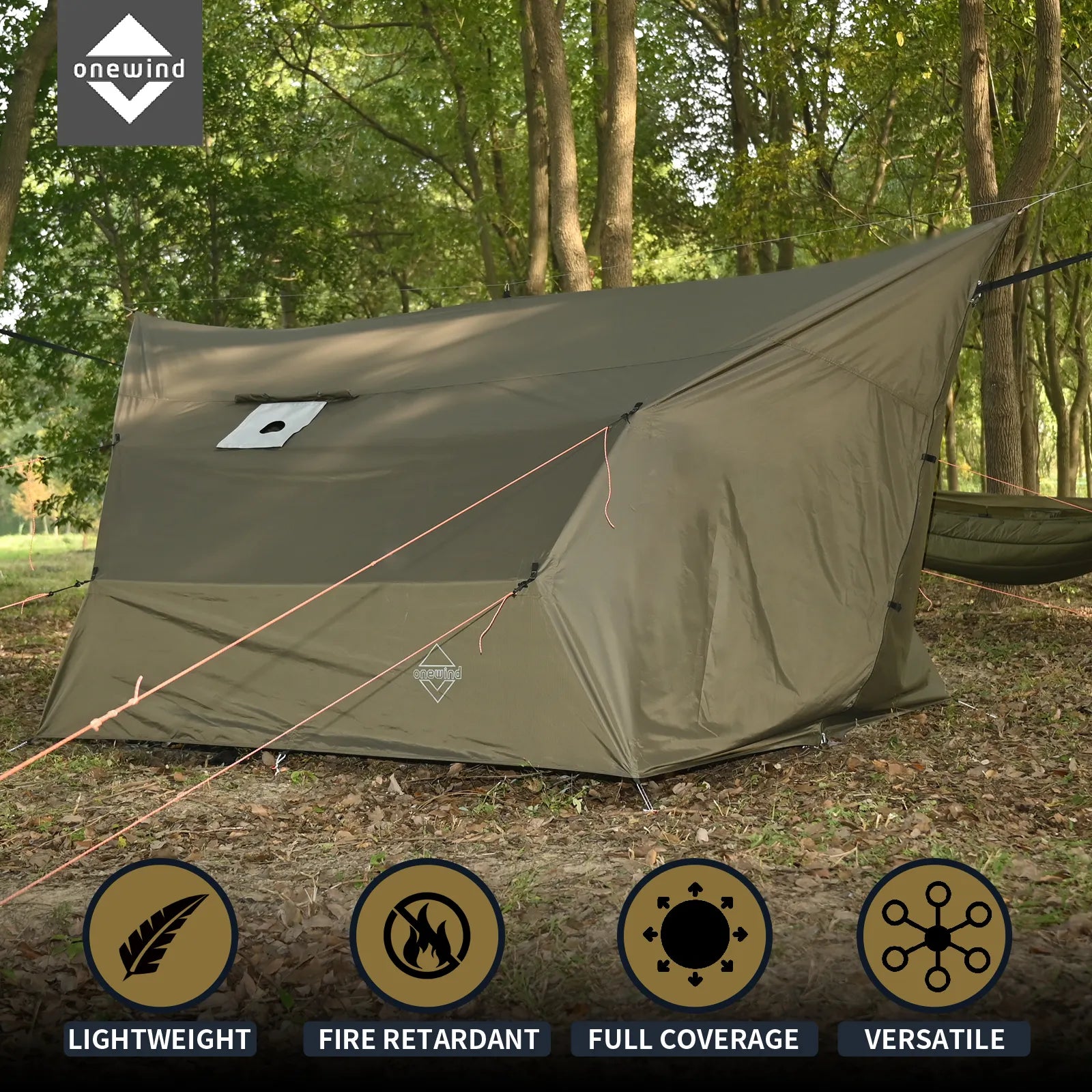

Onewind lists its Penumbra hammock hot tent at 18 m² (190 sq ft) and markets it for two hammocks, but the product page does not give interior dimensions or a hammock load rating. Those omissions matter more than the headline area when a hammock, a stove zone, and a usable exit must share one shelter.
The practical decision is not simply whether a hammock can hang under a hot tent. It is whether the complete hammock-and-occupant envelope, the exact stove and chimney space required by their manufacturers, and a direct exit route can coexist without overlap.
I treat that as a geometry-and-instructions check, not a yes-or-no answer from square footage alone.
This is a layout audit, not a stove-safety certification. A stove jack does not prove that every stove, pipe, fuel, or operating method is safe in that shelter. Follow the exact shelter and stove instructions and applicable official guidance; if instructions conflict or omit a required value, do not improvise.
This article does not recommend sleeping with a wood stove burning.

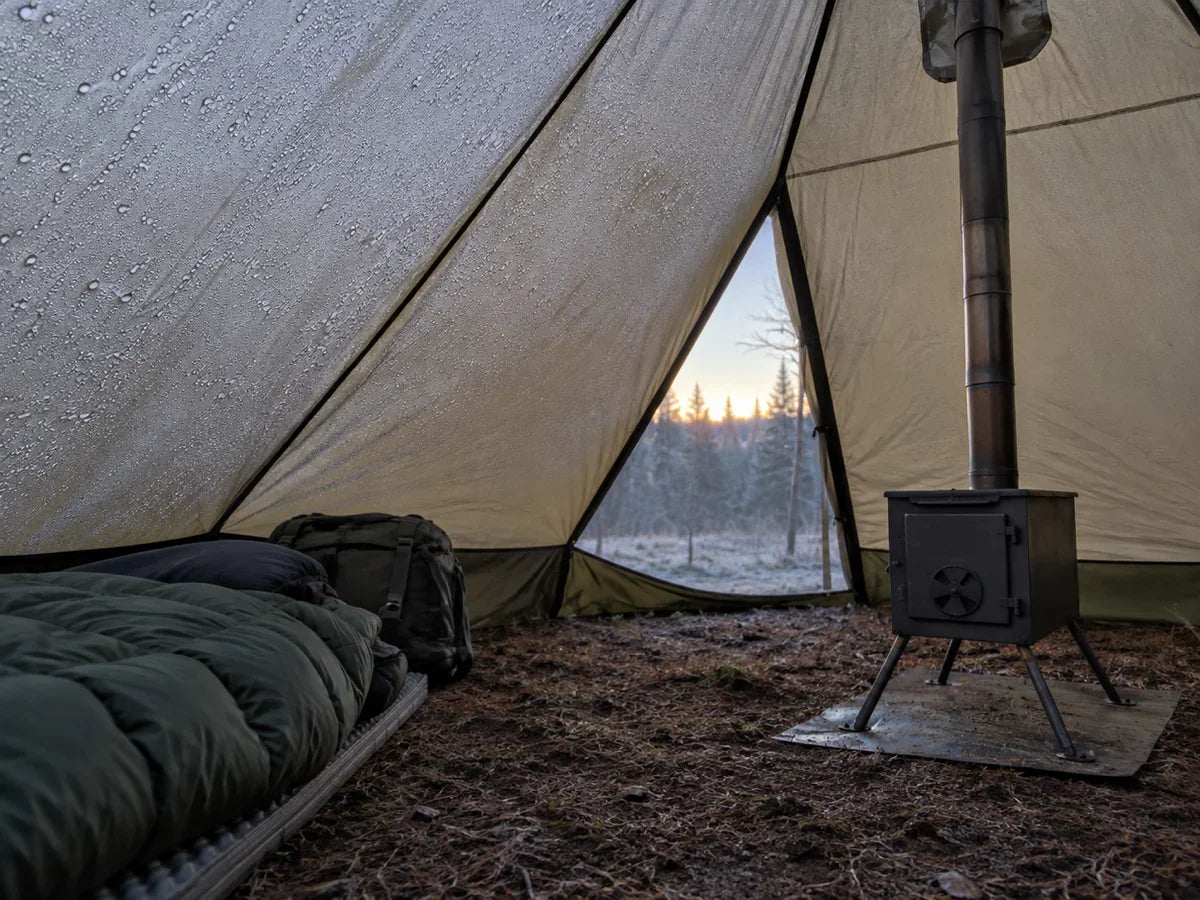
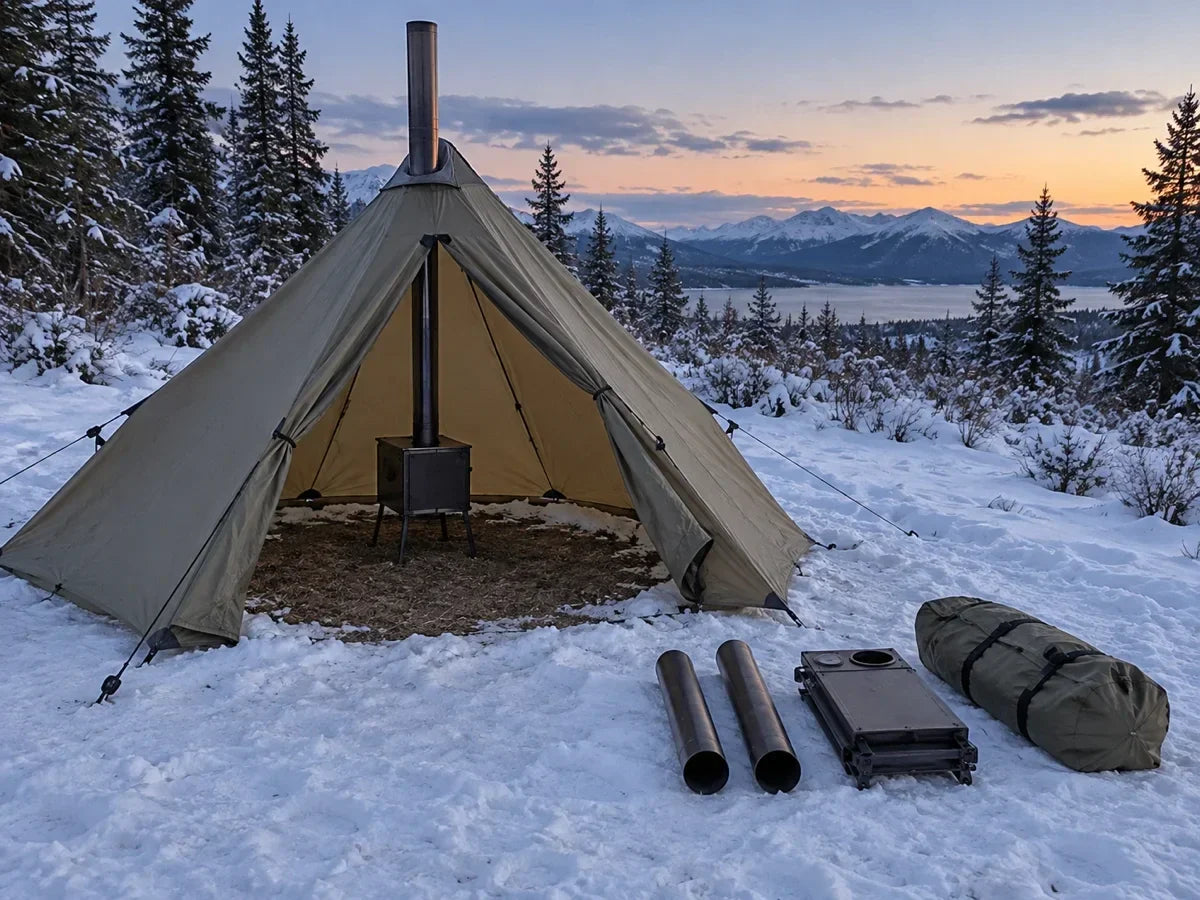
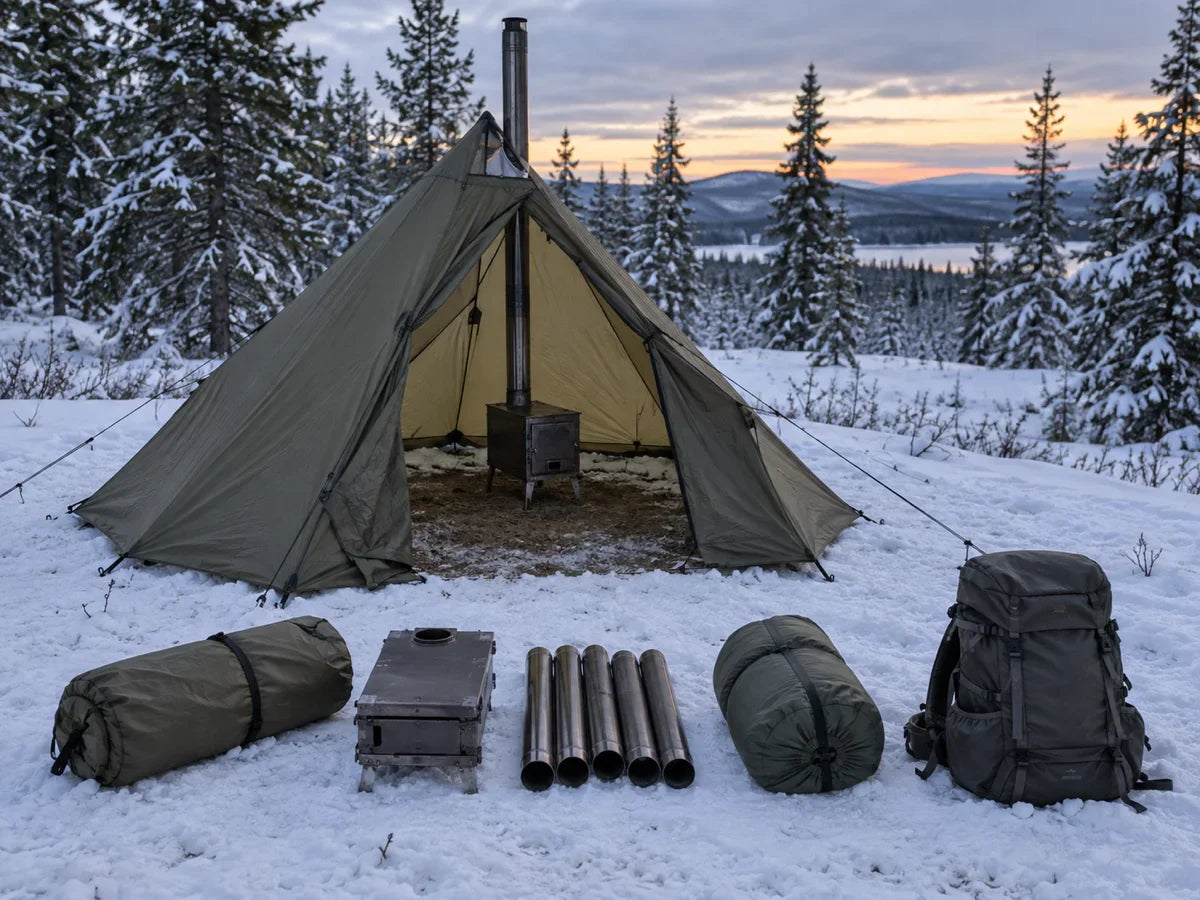
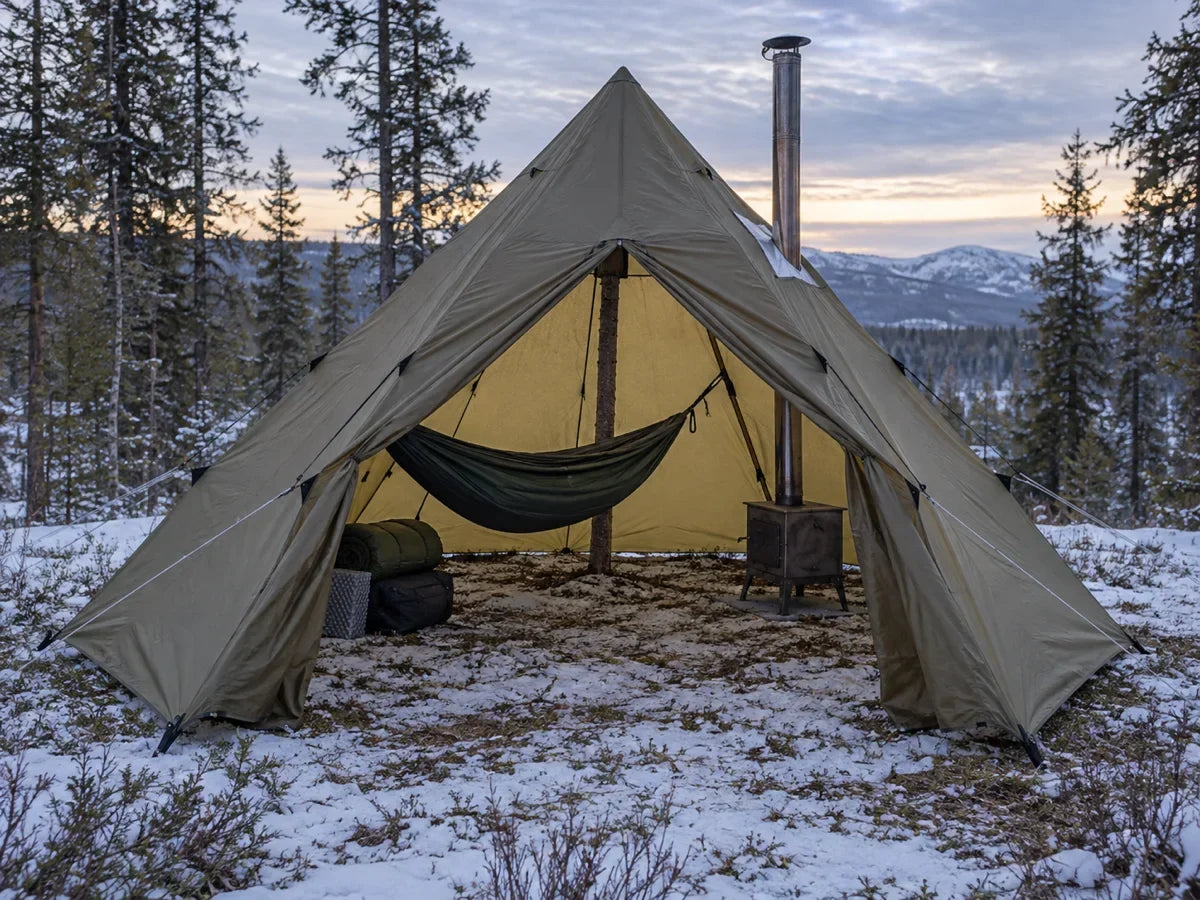
Generated illustrations show general planning scenarios, not specific products or verified installation clearances.
What You'll Learn
- ✓ How to map the occupied hammock and its suspension path instead of treating the unloaded fabric as the whole footprint.
- ✓ Why a product's square footage, stove jack, or “two hammock” claim cannot establish exact fit or clearance.
- ✓ How to reserve a continuous exit route before committing to a stove position.
- ✓ Which conditions call for a different configuration rather than another round of gear shuffling.
Quick Answer
A hammock hot tent works as a layout only when the actual hammock envelope, the stove-and-chimney zone defined by the exact product instructions, and a clear exit corridor remain separate.
If a manufacturer does not publish a necessary clearance or the proposed arrangement forces a line, occupant, gear pile, or exit through a restricted area, stop and change the configuration.
Do not infer the answer from a tent's advertised area, a stove jack's presence, a photo, a video, or a different model's dimensions.
Why Square Footage Does Not Answer Fit
A floor-area figure is a two-dimensional total, not a map of where people, hanging fabric, suspension hardware, a chimney, and a door can go.
It does not identify the shelter's usable interior length, the stove's required clearance to fabric, the suspension system's load limit, or the width of an exit path.
I don't use total floor area as a clearance measurement because it does not identify where the restricted zones sit.
The Onewind Penumbra product page lists an area figure, 2.9 kg (6.4 lb) weight, packed size of about 45 cm × 15 cm diameter, floorless construction, a fiberglass stove jack, and a two-hammock claim.
The same available page text does not state an interior plan, hammock load rating, stove-pipe diameter, or model-specific stove clearance.
For another shelter model to investigate, see the Onewind teepee hot tent or browse the Onewind tent collection; neither link changes the need to verify the exact product instructions.
A third-party Family Camp Tents review of the OneTigris TEGIMEN reports dimensions of 300 × 200 cm and a 190 cm peak height for that particular model.
Those review figures are not a substitute for the selected shelter's manual, and they do not establish clearance requirements for another tent.
The review describes its own product features and setup observations; use it to understand one example, not as a template with dimensions to copy.
A GearJunkie review titled “Warbonnet Tsunami Hot Hammock Tent Review” is another named-product example surfaced in the review-oriented search results.
A product-specific review can suggest questions to check, but only the exact shelter, hammock, and stove instructions can establish whether a proposed setup is permitted.
Map the Three Envelopes Before You Pitch

Draw the three occupied zones on the site plan before setting the stove or hanging the hammock.
The map can be a simple sketch, but it must reflect the selected gear and the actual site rather than the shelter's marketing diagram alone.
Start with the shelter door and trace the path a camper would take while getting out of the hammock.
Mark the stove manufacturer's clearance boundaries next, using its stated reference points rather than estimating from the pipe or stove body.
Then sketch the hammock at its occupied shape and include the line and fittings that reach its approved supports.
If the instructions do not say where a clearance is measured from, do not choose a convenient interpretation.
If a hammock's expected movement is uncertain, use the actual manufacturer's setup instructions and leave the uncertain zone unoccupied until the maker clarifies it.
When I map a layout, I mark the door path and the manual-defined stove zone before deciding where the hammock can go.
The audit is a conflict detector, not a new standard that assigns universal numbers to a hammock, stove, or doorway.
Keep the Suspension Independent

A hammock's suspension is part of its load path, not a convenient place to hang the shelter, stove, or other heavy equipment.
Use only supports and attachment methods approved for the specific hammock system.
Do not treat tent fabric, a stove jack, a tarp guy point, or an accessory loop as a hammock anchor unless the relevant maker explicitly rates and approves it for that load.
The manufacturer may describe a shelter as suitable for two hammocks, but that statement does not publish the load limit of the selected hammocks or supports.
Check each hammock's setup instructions and its support requirements independently.
The article Camping Hammock Setup for Beginners covers general suspension setup; this page narrows the question to whether that complete hang can coexist with an exact hot-tent and stove layout.
If the supports do not exist at the site or a freestanding stand takes up the only safe route, the plan may fail before the stove is unpacked.
Choose a different pitch or shelter instead of attaching a load to an unapproved point.
Treat Stove Clearances as Model-Specific

A stove jack is an opening or reinforced pass-through feature; its presence is not an independent safety approval for every appliance and chimney.
The POMOLY stove-jack tarp guide treats compatibility as a product-specific decision and does not give one clearance number that can be transferred to all stoves and shelters.
Use the exact manual for the selected stove and the exact manual for the selected shelter.
Record the required clearances, approved pipe arrangement, jack compatibility, and any instructions about contact, movement, or operation.
Do not use a product review's advice about a side opening as a clearance instruction for a different product.
The Family Camp Tents review's description of the TEGIMEN is about that tent's layout, not a tested universal rule for sparks or pipe position.
The CDC carbon-monoxide guidance identifies fuel-burning equipment as a CO source and describes symptoms including headache, dizziness, weakness, nausea, vomiting, chest pain, and confusion.
The CPSC camping-equipment guidance warns about CO risks from camping equipment in enclosed spaces. Its explicit sleep warning covers portable fuel-burning heaters and lanterns; it is not a product-specific wood-stove/tent approval.
CPSC's camping fire-hazard guidance advises keeping stoves, lanterns, and candles outside tents, keeping fires and stoves away from tents and sleeping equipment, and extinguishing fires before sleeping. This general guidance is not an exception for a tent with a stove jack. If applicable official guidance prohibits the intended use, do not operate the stove inside the shelter.
For this layout, do not sleep while a wood stove is burning and do not leave it unattended. Before anyone sleeps, extinguish the stove exactly as the instructions for that stove model require. Do not substitute an open door, ventilation feature, or CO alarm for those instructions or for applicable official guidance.
If a CO alarm sounds or anyone may have CO-poisoning symptoms, get everyone out to fresh air immediately. Contact emergency services or the fire department (911 where available), and do not re-enter until responders say it is safe. The CPSC carbon-monoxide fact sheet gives this emergency response guidance.
These sources do not certify a wood-stove/tent combination, and the product listing does not override official warnings or model instructions. If a required safe-use instruction conflicts with the intended layout, do not light the stove in that configuration.
Reserve the Exit Path Before Arranging Gear

An exit path is not the last gap left between the hammock and a stove after every other item has been placed.
It is an intentional route from the occupant's normal exit point to the open door and outside.
Test it with the hammock occupied or approximated in the configuration the maker specifies, with gear in its actual travel positions.
Do not define a universal width from this article; keep the route unobstructed and follow applicable shelter and emergency-egress instructions.
If a stove must sit in the only direct route, the layout fails even if the tent's area number sounds generous.
If a second hammock line crosses the path, move the line only within its approved configuration or choose another arrangement.
When snow, darkness, or uneven ground makes the route hard to use, the reason to preserve a clear corridor gets stronger; this does not create a new numeric clearance rule.
Do not store the door's only clear approach under the hammock's lowest point or behind gear that would have to be moved first.
Scenario 1: One Hammock Beside One Stove Zone
This is the simplest layout to assess because there is one hammock body, one suspension system, and one stove zone to compare.
The stove still cannot be placed by visual balance alone.
Start by deciding which side of the shelter contains the door and which side is eligible for a stove under the exact manuals.
Verdict: Choose this arrangement only if the three mapped envelopes remain distinct and the exact instructions allow the selected equipment combination.
If the hammock can swing or shift into a restricted zone, a static empty-hammock photo is not enough to call the plan clear.
If the stove occupies the route that the occupant needs to reach the door, do not solve the problem by promising to remember where it is in the dark.
If an alternative stove position violates its manual, move the hammock or choose a different configuration instead.
A smoke pipe passing through a jack does not remove the need to check the full appliance and route.
Scenario 2: Two Hammocks and One Doorway
A two-hammock setup adds another occupied envelope, another pair of supports, and another movement path.
The maker's two-hammock description is a reason to investigate the configuration, not a guarantee that every pair of hammocks fits alongside a stove and a usable door.
I read that claim as a reason to test the exact hammock pair, not as proof that its fit is already established.
Verdict: Use a two-hammock layout only when both hangs can be independently set within their own instructions and both occupants retain a usable path to the door.
If either suspension line crosses the stove zone or blocks the other camper's route, do not call the arrangement compatible because the tent listing mentions two hammocks.
If one camper must move a hot stove or chimney to exit, the shared layout fails.
The available product listing does not provide the dimensional or load data needed to certify every two-hammock pairing.
Record the exact hammock models and support arrangements when asking the shelter maker about a specific configuration.
Scenario 3: A Bridge Hammock or Wide Sleep System
A wide or bridge-style hammock can use more lateral space than a narrow silhouette suggests.
The point is not that one hammock type is universally incompatible with a hot tent; the point is that shape and entry movement change the layout that needs checking.
Verdict: Choose the hammock by its actual setup envelope, not by its product label or an assumed “standard” width.
If the manufacturer does not publish a measurement needed to judge fit, ask for it instead of borrowing another model's dimensions.
If the spreader bar or entry path intrudes on the reserved stove space, choose a different hammock orientation only if its maker permits it.
Otherwise use a different shelter or stove-free layout.
This distinction keeps the decision grounded in the actual hardware rather than an unsupported comparison between hammock styles.
Scenario 4: An Uneven, Snow-Covered, or Constrained Site
A campsite can remove the apparent flexibility shown in a product diagram.
Tree placement, slope, snow, rocks, water, and the chosen door orientation may leave only one practical hammock line or walking route.
Verdict: Choose the site only if the required hammock supports, manufacturer clearances, and usable exit can all be established in that actual terrain.
If the only apparent solution moves the stove into a prohibited area, the site is a no-go for that stove layout.
If suspension geometry becomes uncertain because the trees are too close, too far, or poorly positioned, do not invent an alternate load path.
Choose another pitch or leave the stove out of the sleeping shelter in accordance with official guidance and the equipment manuals.
The spatial-fit decision is separate from sleep-system insulation; see the winter hammock insulation framework for that related topic.
IF/THEN: Make the Go/No-Go Call
Use this decision table after recording the exact shelter, hammock, and stove models.
It does not replace the product manuals, official CO advice, local restrictions, or an inspection by the manufacturers.
IF any boundary is unknown, THEN do not replace it with a guess.
I use an unknown as a stop condition, not an invitation to estimate.
IF the only way to fit the hammock is to compress a stove clearance, THEN choose another arrangement.
IF the only route out passes a stove or requires moving it, THEN the layout is not an acceptable exit plan.
IF the setup changes after the initial check, THEN repeat the three-envelope audit before use.
Seven Mistakes That Make a Layout Look Workable
A plan can appear roomy in a diagram and still fail once a person enters the hammock or the gear is in place.
The most common reasoning error is to treat every unknown as spare space.
An unknown interior measurement is not empty clearance, and an unlisted load is not permission to attach a hammock there.
A missing manual value should stop the decision at that point, not trigger a “common sense” estimate.
What Two Reddit Threads Surface as Reader Questions
A public search result for “Position of hot tent stove” frames the issue as where a stove might sit relative to a hammock: near the feet, in the middle, or around the knees.
The title and public search summary for “Advice for hot tent hammocking” surface a broader request for advice about combining the two systems.
These links are question-discovery evidence only. They do not replace exact product manuals or official fire and carbon-monoxide guidance.
Community discussion can help surface questions, but it is not a substitute for exact stove or shelter instructions.
The answer here therefore stays conditional: map the actual geometry, verify exact product instructions, and stop when a necessary fact is missing.
Penumbra Setup Walk-Through: What the Video Covers
How To Setup Onewind Penumbra Hammock Hot Tent Step by Step
JTD Outdoors lists the title “How To Setup Onewind Penumbra Hammock Hot Tent Step by Step.”
Before using any proposed hammock-hot-tent layout, check it against the exact product documents.
If any answer is unknown or no, do not operate the stove in that layout.
Penumbra Product Review: What to Verify Yourself
Camp Upgrade With The Onewind Penumbra Hammock Hot Tent Review
JTD Outdoors lists the title “Camp Upgrade With The Onewind Penumbra Hammock Hot Tent Review.”
Use the actual manufacturers' documents to verify the setup you intend to use.
What to Record Before You Buy or Pitch
A compact record prevents the same unknowns from returning each time the shelter is pitched.
Write down the model names and the specific manual page or product passage that answers each compatibility question.
Do not record a value from a similar product as if it belonged to the selected model.
If an answer depends on what a seller means by “two-person,” “hot tent,” or “compatible,” ask for the model-specific manual or written clarification.
If the information still cannot be verified, leave the stove out of that layout.
Final Verdict
A hammock hot tent is a spatial compatibility question before it is a product-feature question.
The area number, a stove jack, and a two-hammock claim may help identify a candidate shelter, but none proves that the chosen suspension, exact stove clearances, and exit path fit together.
Choose the layout only when every row can be checked against the actual products and site.
I would call a layout compatible only for the exact models and instructions that were checked, not as a general safety certification.
IF one required value is missing or any envelope overlaps, THEN do not improvise a clearance, load, or escape route.
Choose another pitch, another shelter, or a stove-free arrangement, and follow official carbon-monoxide guidance and the exact manufacturer instructions.
This is the useful meaning of compatibility: not that every advertised feature fits every plan, but that the real arrangement stays within verifiable limits without blocking the way out.

Compare the Penumbra hammock hot tent
Shop Now →