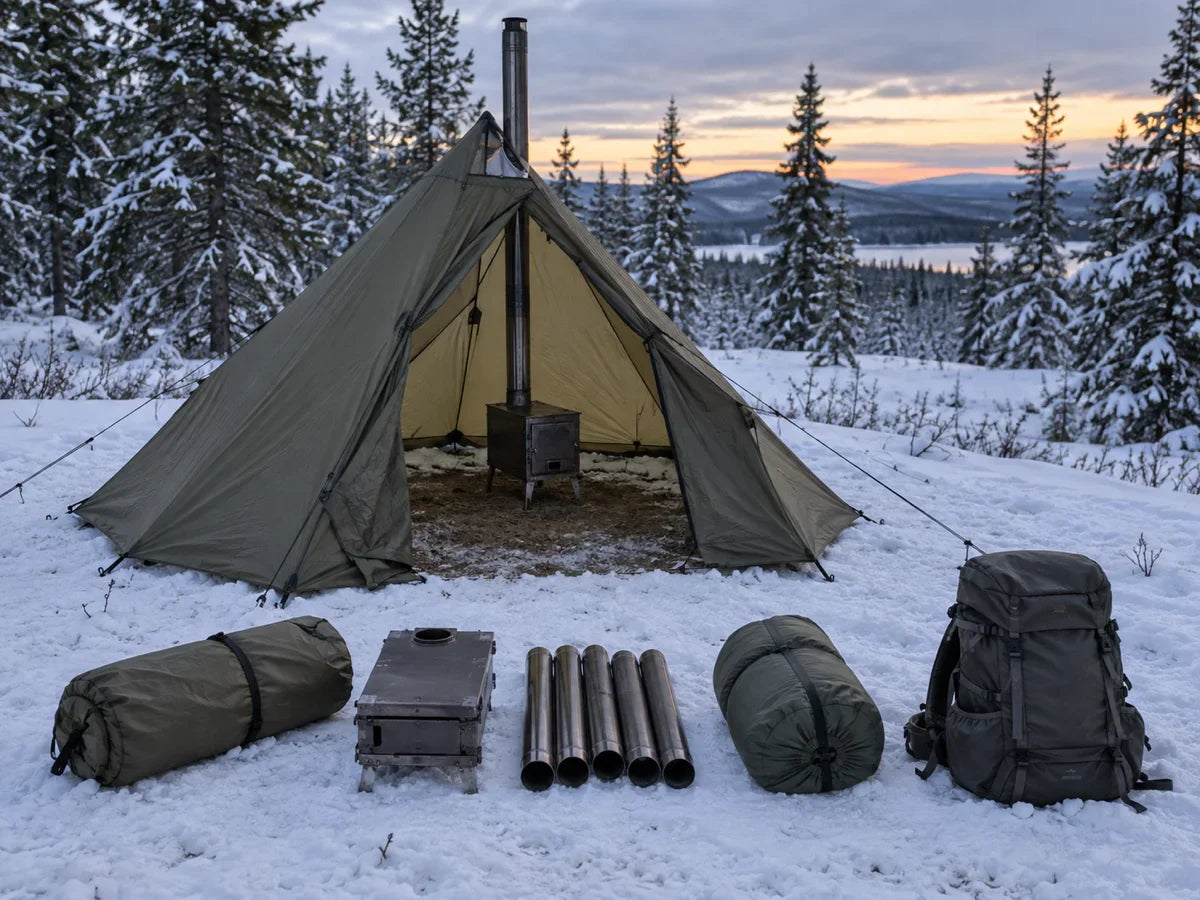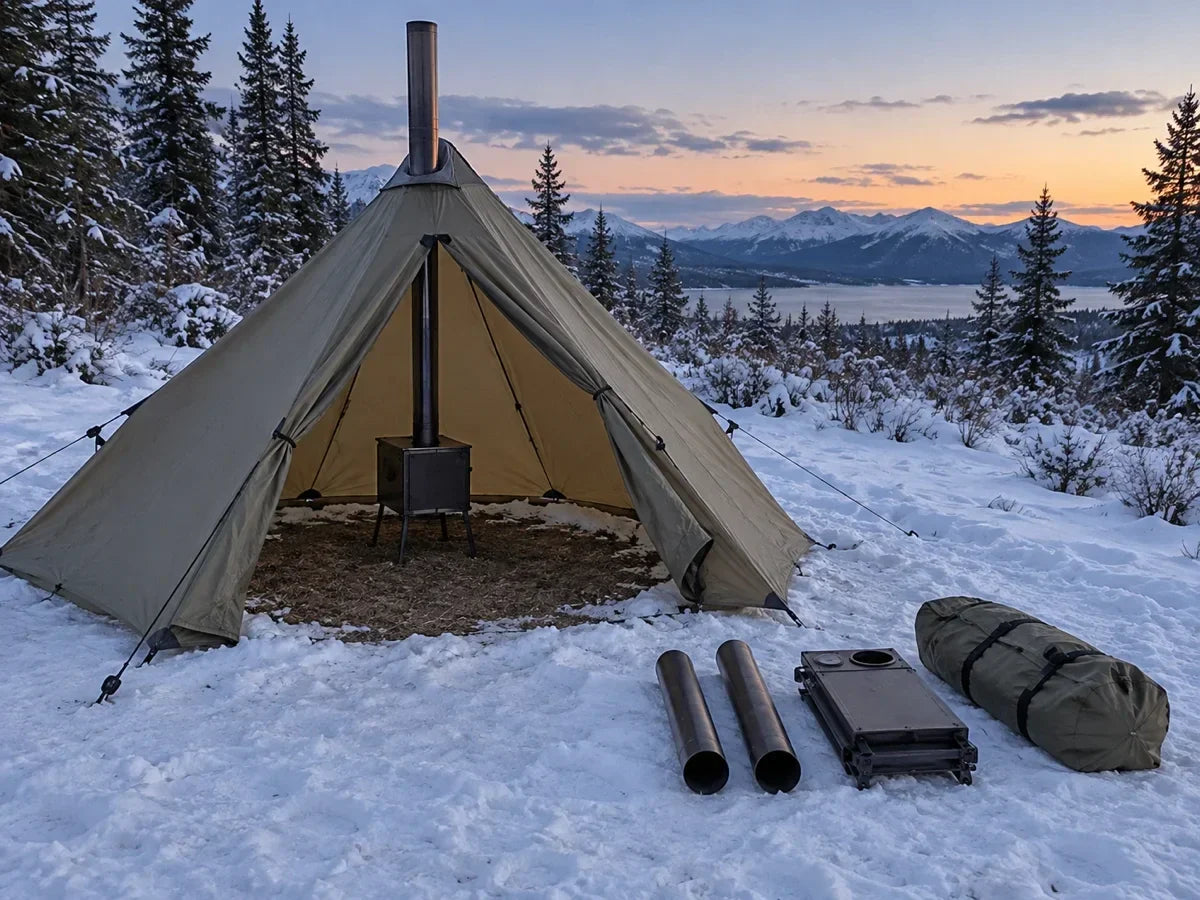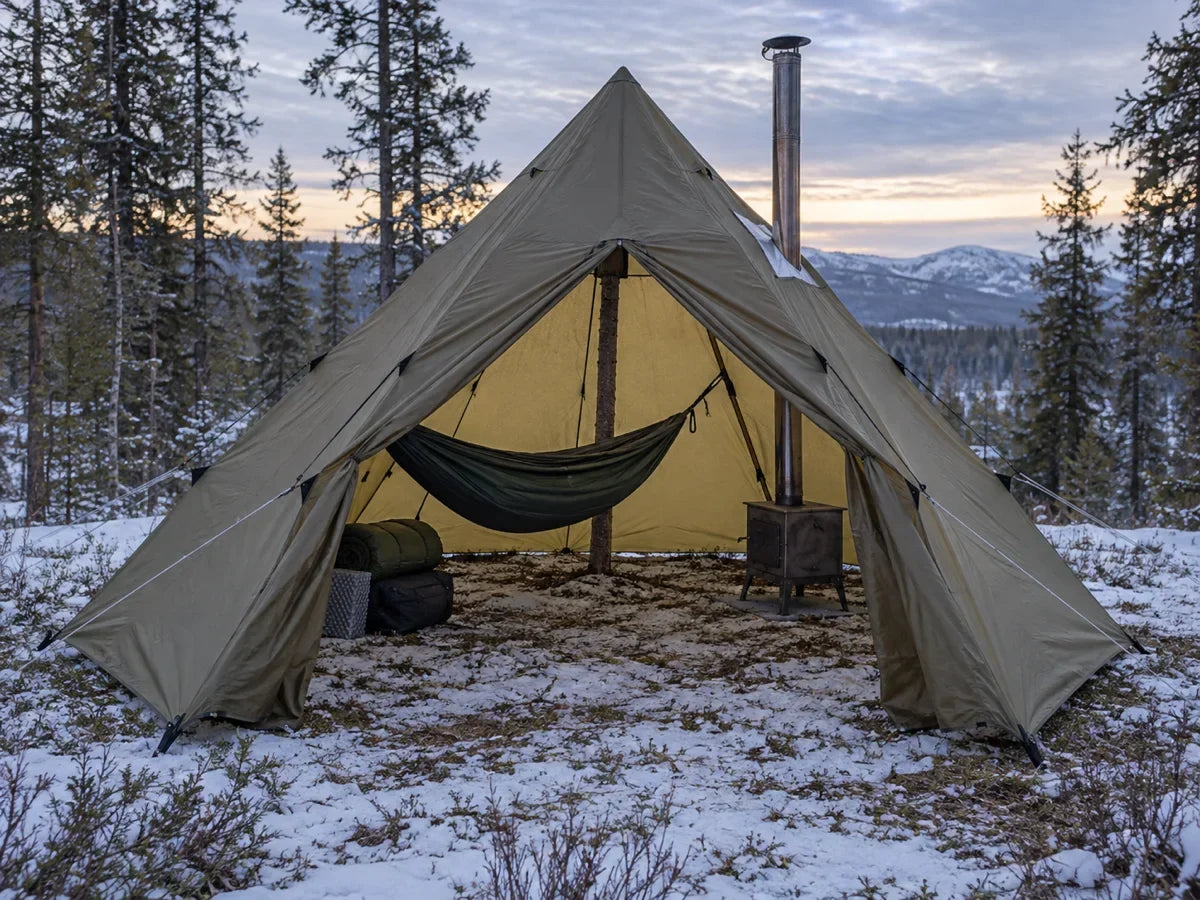

A stove jack’s published pipe limit can vary sharply by model: CanvasCamp lists its Exit 1 Mini for flues up to 7 cm (2¾ in), while Bear Paw lists four Standard Stove Jack sizes with different maximum pipe diameters, from 2⅜ in to 8 in (CanvasCamp; Bear Paw Wilderness Designs).
Those figures describe named products, not one shared standard and not permission to install any stove in any tent.
A complete fit check must connect the exact tent, its jack, the actual flue section at the exit, all required heat-protection parts, and both manufacturers’ instructions.

My editorial rule is to treat a missing measurement as unresolved, not as a likely fit.
What You'll Learn in This Guide
- ✓ How to identify the five separate pieces of evidence that a compatibility decision needs.
- ✓ Why the pipe’s actual outside diameter at the tent exit matters more than a product name or nominal stove size.
- ✓ How to separate a physical fit from permission in a tent maker’s and stove maker’s instructions.
- ✓ What to do when a factory jack, cut-to-fit claim, or “universal” label leaves key dimensions unstated.
- ✓ How to send a manufacturer a focused question that names the tent, jack, pipe, stove, and protective parts.
- ✓ Why a stove jack, ventilation feature, or carbon-monoxide alarm is not a safety guarantee.
I recommend completing this table before buying a separate jack or deciding that an existing combination is compatible.
Quick Answer
If the exact tent, jack, exit flue, protective components, and current instructions all match, use only the configuration those instructions describe.
If any model, dimension, required part, or permission is unknown or contradictory, stop and ask the relevant manufacturers before operating the setup.
A pipe that can physically pass through a hole is not, by itself, a compatible system.
What a Stove Jack Does, and Does Not, Prove
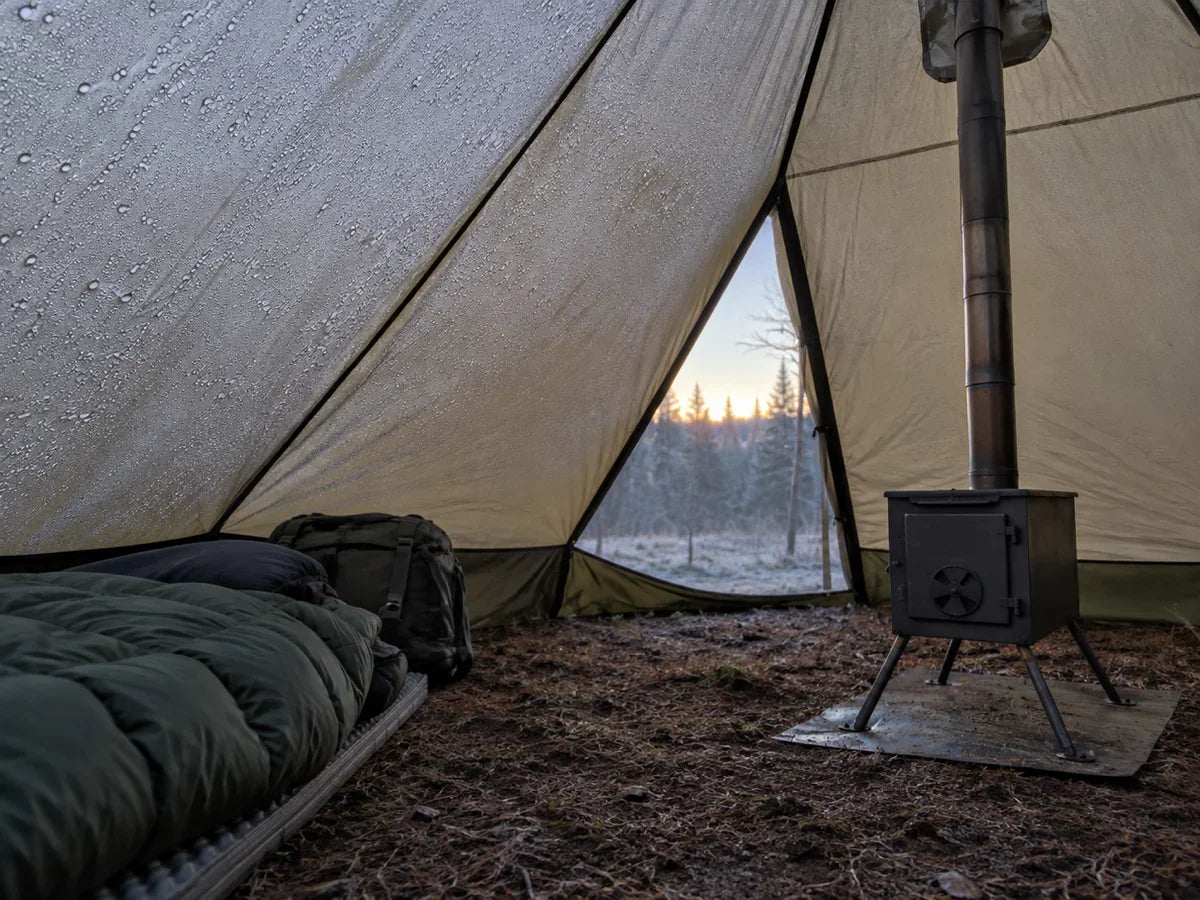
A stove jack is an interface for a flue to pass through part of a shelter, but its name alone does not specify dimensions, material limits, approved stove models, or required protection.
How to Read a Product Page With Missing Details
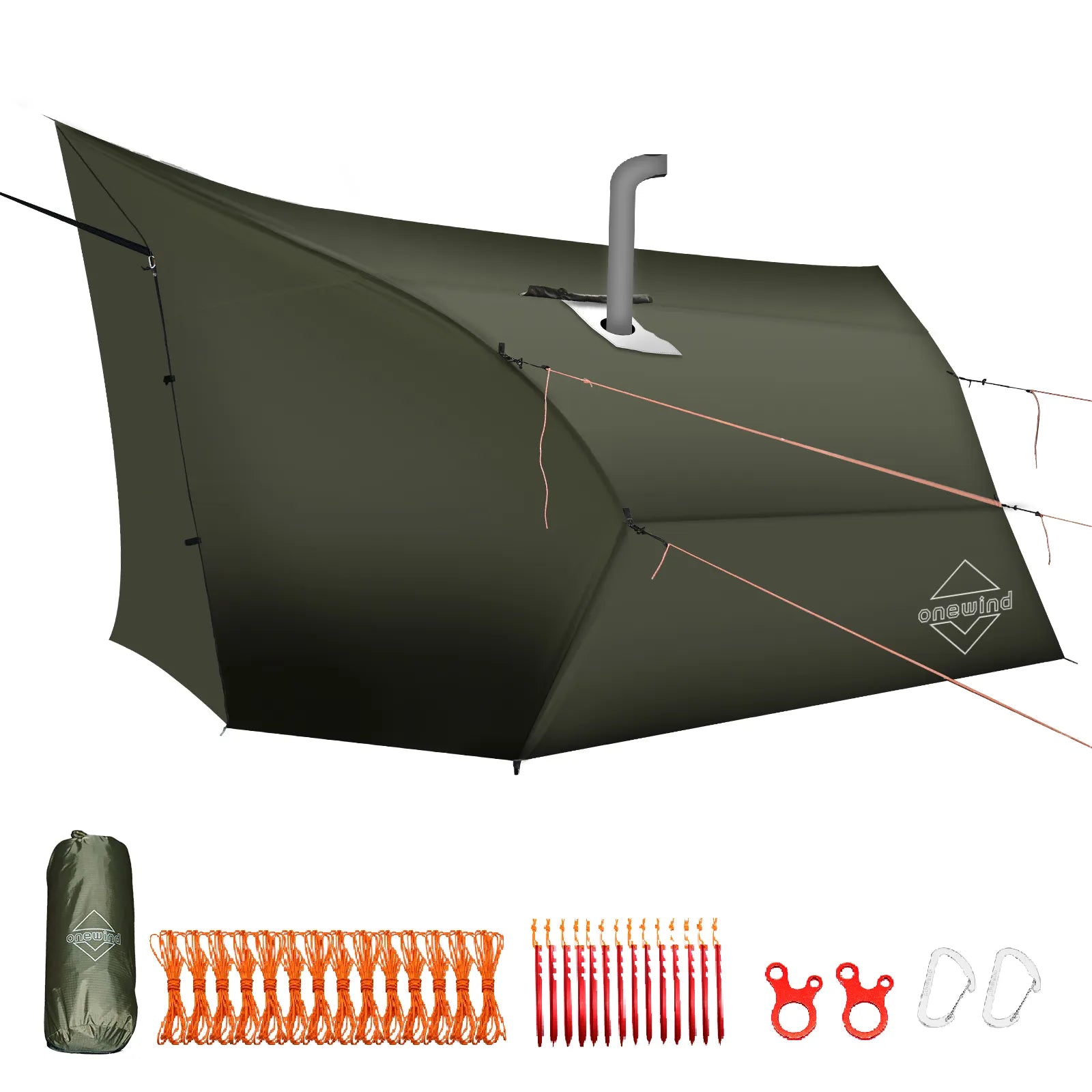
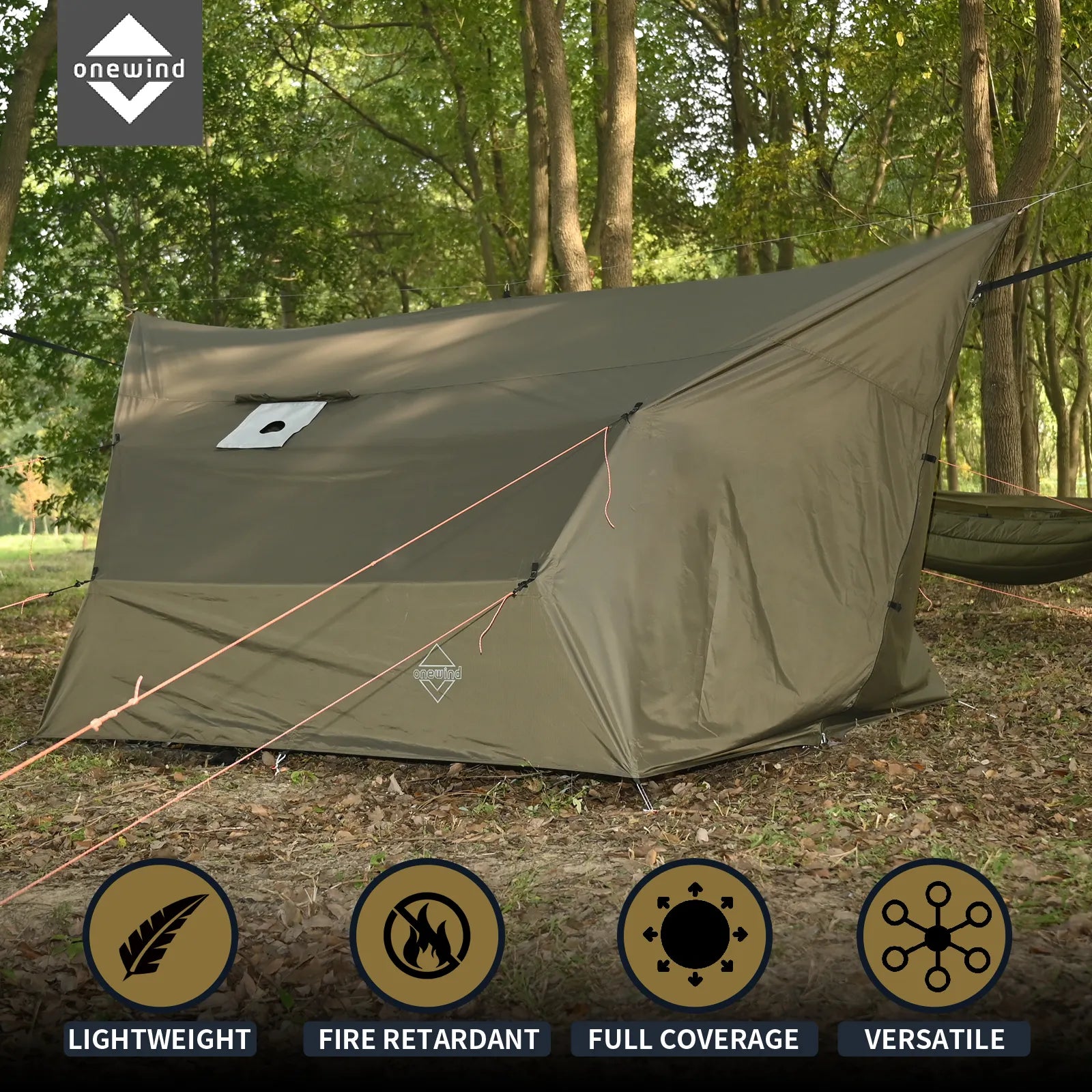
Onewind’s Penumbra page describes a pre-installed fiberglass jack, while its Summit Solo page describes a pre-cut jack; neither page in this research snapshot publishes an opening diameter, accepted flue range, matched stove, or model-specific clearance (Penumbra; Summit Solo).
That omission leaves the pairing unconfirmed, not disproven; I would ask both makers before treating “included” as “fits my stove.”
The Five-Link Compatibility Chain

Think of compatibility as a chain with five links rather than a single diameter comparison.
Any blank or model mismatch leaves the full chain unconfirmed.
For the tent link, record the exact model, version, and roof construction; do not treat similar tents from one brand as interchangeable.
Springbar names Classic Jack 140 and Skyliner in woodstove guidance tied to a Winnerwell stove and required components, while warning against modifying other tent models (Springbar compatibility and safety).
That is an example of a manufacturer defining one system, not general cross-brand approval.
For the jack, record its exact model, material, stated range, and any trimming or mounting instructions.
For the flue, identify the actual crossing section, including any joint, seam, taper, or adapter that changes its profile.
List the exit parts required by both makers; depending on the system, these may include flashing, heat protection, a specified pipe-wall section, rainfly arrangement, or support.
The Winnerwell 1G manual gives model-specific ventilation, clearance, flashing, and heat-protection requirements; it does not independently approve a tent (Winnerwell Woodlander/Nomad manual).
Keep both current instruction sets, their product links, and revision dates together.
Check the Actual Exit Pipe, Not Just the Product Label

A “2.5-inch stove pipe” label may not describe the actual section that crosses the jack.
Compare that section’s outside diameter and features with the exact jack range and both makers’ requirements; use a maker-specified dimension or measure a cold, removed part as directed, never a hot flue.
Do not add a homemade ring, wrap, packing, or spacer unless both responsible makers approve the exact part and arrangement.
No reviewed source establishes a universal gap or clearance for all fabrics, jacks, stoves, and flues, so neither a loose pass-through nor an off-center or touching fit is proof of compatibility.
CanvasCamp lists the Exit 1 Mini for flues up to 7 cm (2¾ in) and says its rubber can be trimmed; Bear Paw lists Standard Jack maxima of 2⅜ in (Small), 4 in (Medium), 6 in (Large), and 8 in (X Large) (CanvasCamp; Bear Paw).
Those limits apply to the named products, not an industry tolerance or tent/stove pairing.
Bear Paw’s 4-inch pipe-to-flammable-material warning is also specific to its product and is not a general clearance rule.
I would leave a blank in the comparison rather than import another maker’s number.
Read Both Manufacturers’ Instructions as Separate Gates

The tent maker and stove maker answer different questions, and one side cannot automatically speak for the other.
Resolve Conflicts With Both Manufacturers
Springbar’s named pairing illustrates that compatibility guidance has boundaries; do not transfer it to another tent (Springbar).
If instructions conflict, send both makers the same tent, jack, stove, flue, protective parts, and conflicting passage, then ask each to assess that exact setup.
A general answer about a stove family or tent fabric may not cover your model or adapter.
My editorial judgment is that a useful answer names the exact models and parts, not just “should fit.”
If either maker cannot confirm the combination in writing, mark it unresolved and choose a documented alternative; that status does not mean the product will definitely fail.
IF/THEN Decision Framework
Use this sequence before purchase or setup, and stop at the first unresolved answer.
IF every gate is affirmatively answered for the same named configuration, THEN follow those instructions without generalizing the result to another tent, stove, pipe, jack, or accessory.
IF any gate is unknown, mismatched, touching, or contradictory, THEN stop and request written guidance before use.
I recommend this fail-closed rule because a diameter comparison cannot answer a separate question about tent permission, required shielding, or stove operation.
A “yes” on one row does not compensate for a “no” or blank on another.
Five Scenarios: What the Evidence Says to Do
The examples below are decision situations, not endorsements or reports of personal field testing.
Scenario 1: A Factory Jack With No Published Pipe Range
Verdict: UNCONFIRMED until both makers address the exact configuration.
If you own the Penumbra and a separate stove, ask Onewind for the exact jack range, installation limits, and supported models; ask the stove maker which flue section and protective parts its manual requires.
A similar-looking product photo is not a compatibility check.
My view is that this is an information gap, not a verdict against the tent.
Until both answers cover the same configuration, mark it unconfirmed.
Scenario 2: Comparing CanvasCamp and Bear Paw Limits
How to Install a Tent Stove Jack
Verdict: COMPARE THE NAMED JACKS ONLY; neither chart proves a complete tent-and-stove match.
These ceilings compare the named jack products only; they do not establish fit in a particular tent roof or approval under a stove manual.
CanvasCamp’s trimming guide applies to its own product, not another maker’s jack or tent (CanvasCamp guide).
The CanvasCamp title shows that maker’s own procedure only; it does not approve changes to another brand’s tent. The video is embedded below.
Bear Paw’s 4-inch pipe-to-flammable-material warning is likewise specific to its product.
I would compare these listings in separate columns and leave tent and stove approval blank until each maker answers for the exact system.
Scenario 3: The Pipe Is Loose, Off-Center, or Touching Something
Verdict: STOP AND CONFIRM; do not improvise a spacer, wrap, or shield.
A gap, contact, or movement does not establish acceptable clearance or a safe repair.
Record the exact tent, jack, flue section, and required exit parts, then ask both makers whether that arrangement is allowed; do not add an improvised collar, fabric, insulation, or shield.
Two indexed Reddit snippets identify similar reader concerns: an r/HotTentCamping question about an oversized jack gap and an r/camping post about pipe contact with a built-in jack.
The full threads were not retrieved, so these user-raised questions provide no validated advice or remedy; use them only to recognize the issue, not to replace product instructions.
Scenario 4: A “Universal” or Cut-to-Fit Sales Claim
Verdict: NOT ESTABLISHED by the sales label alone.
“Universal” and “cut to fit” describe a sales claim, not approval for your complete system.
Before buying, ask for the supported pipe range at the exit, tent materials, and mounting limits; get tent-maker approval before altering a panel, rainfly, jack, seam, or reinforcement.
CanvasCamp’s guide says to measure before trimming its own rubber opening, but does not certify other brands’ tents or stove combinations (CanvasCamp guide).
I would treat “universal” as a request for a supported-size table, not as the table itself.
Scenario 5: The Tent and Stove Instructions Conflict
Verdict: STOP until both manufacturers resolve the same named setup.
For example, the tent instructions may name one jack while the stove manual requires a different flashing, or a buyer may substitute an unlisted stove.
Send each maker the complete parts list and conflicting passage; ask whether the same tent, jack, stove, flue, and exit assembly are permitted.
Springbar’s named system and Winnerwell’s model-specific manual show why an answer must stay within the models each maker covers (Springbar; Winnerwell manual).
If a manual or manufacturer answer is missing, status remains “not confirmed.”
Five Common Mistakes That Turn Fit Into Guesswork
These mistakes happen when one visible clue is asked to answer a different manufacturer’s question.
Mistake 1: Assuming “Jack Included” Means “Stove Compatible”
A “jack included” statement describes a feature, not an approved stove pairing.
Onewind’s Penumbra and Summit Solo pages describe jack features but do not publish an opening diameter, accepted flue range, or matched stove (Penumbra; Summit Solo).
Ask the tent maker for those details and the supported configuration.
Mistake 2: Comparing a Stove Outlet to the Wrong Pipe Section
The stove outlet specification may differ from the section crossing the shelter roof because a joint, adapter, seam, taper, or wall section can change the profile.
Identify the exact part and outside diameter at the exit, compare it with the jack maker’s range and both manuals, and stop if the part is unknown.
Mistake 3: Borrowing a Clearance From a Different Brand
A jack listing’s number is not an all-purpose tent-stove clearance.
Bear Paw’s 4-inch warning is for its named Standard Stove Jack, while Winnerwell’s manual gives requirements for specified 1G stove families (Bear Paw; Winnerwell).
Keep each value attached to its source product; never use one maker’s figure to fill another maker’s blank.
Mistake 4: Fixing a Gap or Contact With an Improvised Part
A wrap, spacer, collar, or homemade shield is not a documented fix for a loose or touching interface.
Ask both makers whether they approve that exact part and arrangement; without confirmation, do not install it and proceed as if documented.
Mistake 5: Treating Ventilation or an Alarm as Permission to Burn
A vent, open door, or alarm cannot approve an unspecified system or guarantee protection from carbon monoxide.
The CDC warns that carbon monoxide can accumulate in tents and that open doors or windows do not guarantee protection (CDC report).
Follow the separate response steps and appliance instructions below.
Keep Mechanical Fit Separate From Fire and Carbon-Monoxide Risk
The five-link check asks whether the named parts fit and whether the manufacturers document the configuration; it does not promise that the setup is risk-free.
Respond to CO Alarms and Symptoms Separately
The CDC reports that dangerous carbon monoxide can accumulate in tents and that opening doors or windows does not guarantee protection (CDC report).
CPSC’s narrow exception for equipment designed for enclosed spaces and used as instructed does not approve an arbitrary wood stove and tent pairing (CPSC fact sheet).
A jack is not a carbon-monoxide detector, fire certification, or substitute for the exact product instructions.
Never sleep while a stove is burning or leave it unattended.
What to Ask the Manufacturers
A precise question is more useful than “Will this stove fit my tent?” because it names the parts and the unanswered link.
Ask the tent maker: “Does the current instruction for [exact tent model/version] allow [exact stove model] with [exact jack model] and [exact flue section] at the roof exit, including these listed protective components?”
Ask the stove maker: “For [exact stove model], does the manual permit this tent and jack arrangement, and are [exact pipe segment, flashing, shield, and adapter] the required parts at the exit?”
Ask for a dated written answer naming the exact models and included or excluded parts; a general reply about “hot tents” or “2-inch pipe” may not cover your setup.
I would save the question, response, product links, and manuals together so that a later change in pipe or accessory does not silently become a new, unverified setup.
Do not fill “not published” with a guess or a competing brand’s specification.
Final Verdict
Proper Setup Of A Stove In A Snowtrekker Tent
A stove jack is one component in a tent-and-stove interface, not a universal compatibility label.
The practical rule is direct: IF every link is documented for the same tent, jack, pipe, protective assembly, and stove, THEN stay within those instructions; IF any link is missing or conflicting, THEN do not infer compatibility.
I recommend saving both manufacturers’ answers before purchase or use, especially when one product page names a jack but not its dimensions or stove pairing.
A visible opening, a product-size chart, a vent, or an alarm cannot answer every other link.
Do not sleep while a stove is burning, do not leave it unattended, and do not claim that a jack makes any tent-and-stove combination safe.
Maker-specific videos carry the same limit as maker-specific instructions.
The Snowtrekker Tents title above is a reference for that maker’s own tent system, not a cross-brand certification.
If you are choosing a tent and a stove together, start from the Onewind tent collection.
Check each candidate against the five links above before you buy, not after.

Review the Penumbra tent details before you buy
Shop Now →