
Cada guía dice "Cuélgalo a 30 grados". Ninguna te muestra cómo.
Leí las 5 mejores guías de montaje de hamacas que están posicionadas en Google en este momento.
Todos dicen lo mismo: «cuelga a 30 grados», «usa la holgura adecuada», «acuéstate en diagonal».
Buen consejo. Completamente inútil si estás de pie entre dos árboles a las 6 p. m. tratando de averiguar cómo se ven realmente 30 grados.
Después de revisar más de 200 hilos de Reddit de r/hammockcamping y r/CampingGear, el patrón quedó claro.
El 90 % de los fallos de configuración proviene de tres errores.
Ángulo de suspensión incorrecto.
Dormir recto en lugar de en diagonal.
Sin aislamiento en la parte inferior.
Todo solucionable. Todo prevenible. Pero solo si alguien te muestra cómo revisar cada uno sin herramientas especiales.
Eso es lo que hace esta guía. Siete pasos, en orden, con una prueba específica en cada paso para que sepas que lo has hecho bien antes de seguir adelante.
Lo que aprenderás en esta guía
- ✓ La secuencia exacta de configuración de 7 pasos utilizada por campistas experimentados en hamaca (con tiempos: 25 min en el primer intento, 10 min para el tercer viaje)
- ✓ Cómo verificar su ángulo de suspensión de 30° usando el atajo de la longitud del brazo (no se necesitan herramientas)
- ✓ El truco de “extremo de los pies 6 pulgadas más alto” que la mayoría de las guías de montaje omiten por completo
- ✓ Por qué dormir recto causa compresión en los hombros y cómo la posición en diagonal lo soluciona (desplazamiento de 30-45°)
- ✓ El árbol de decisiones de temperatura para el aislamiento: cuándo necesitas una almohadilla, un underquilt o ambos
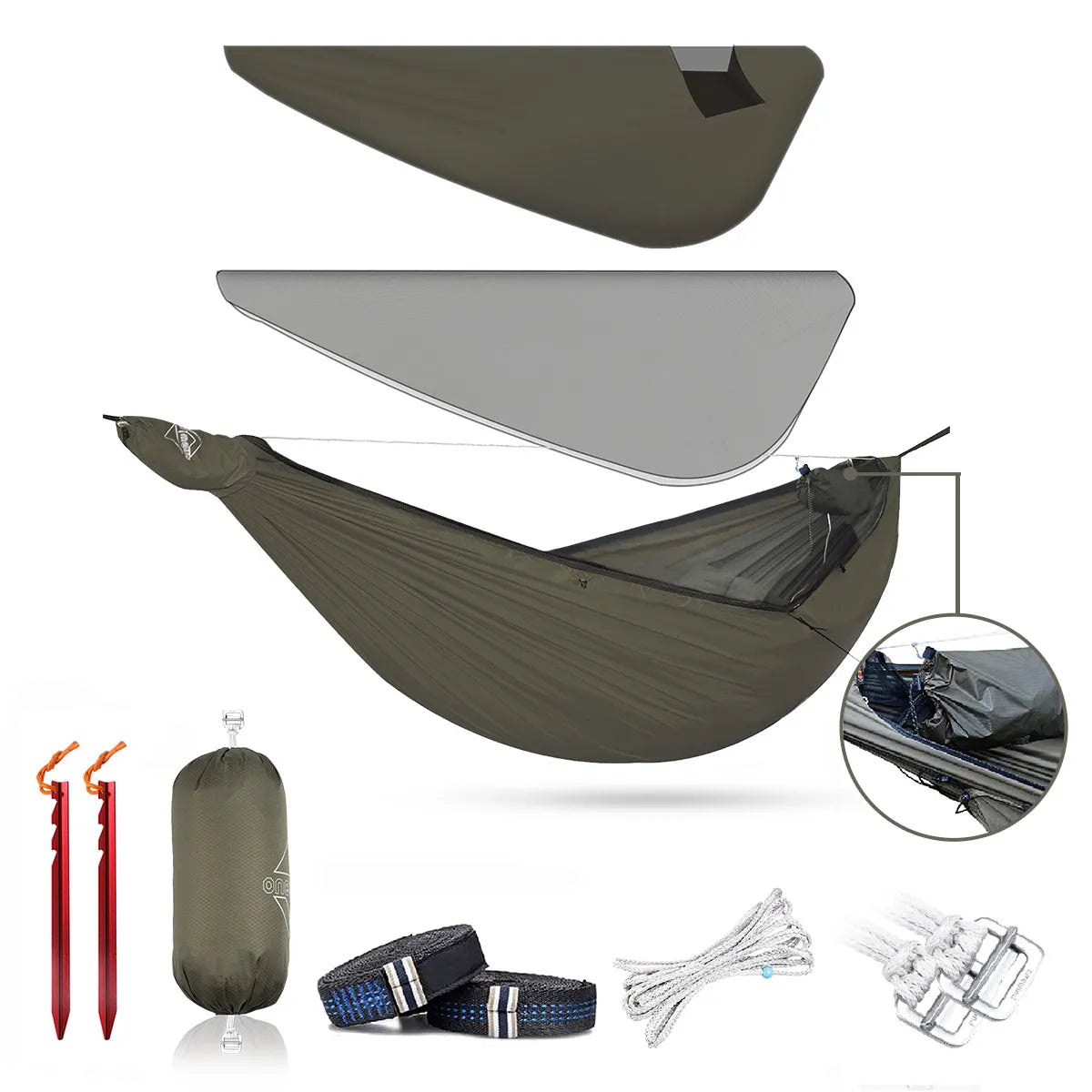
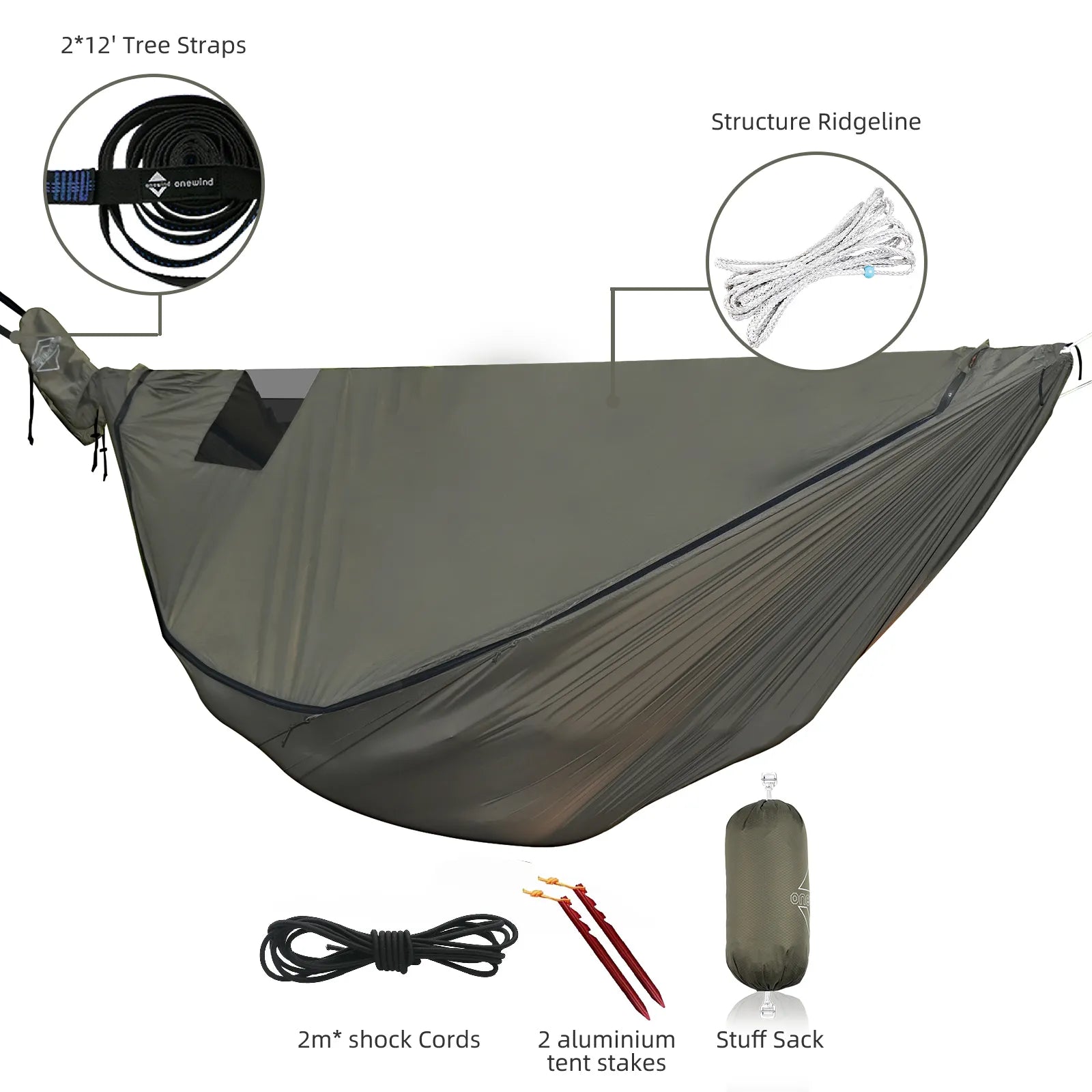
- ✓ Una lista completa de equipo con la función específica de cada componente
Respuesta rápida
Si sigues los 7 pasos en orden → estarás configurado en 25 minutos en tu primer intento, 10 minutos para el tercer uso.
Si omites pasos o los haces fuera de orden → ahí es donde ocurre el 90% de los fallos de los principiantes.
Lista completa de equipo
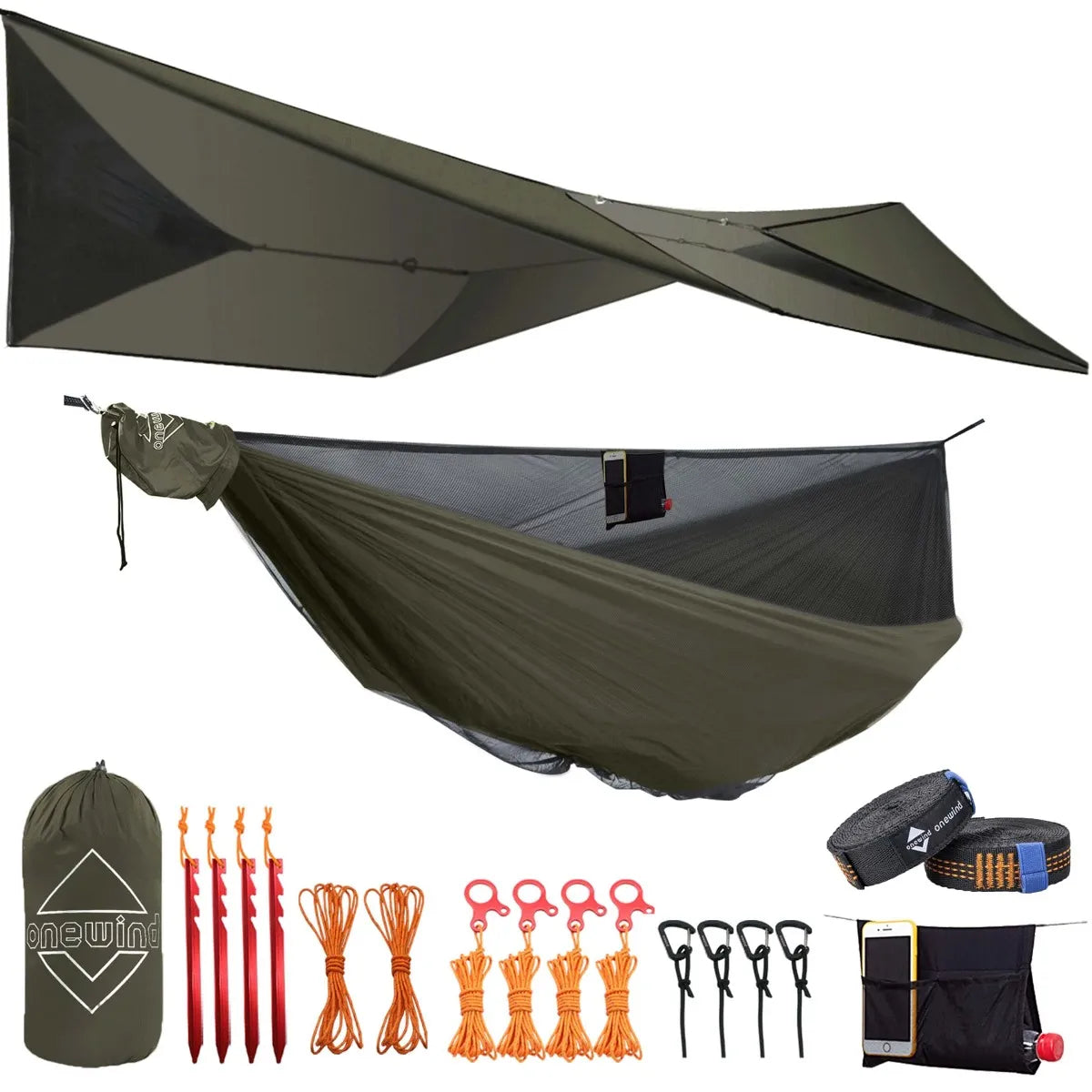
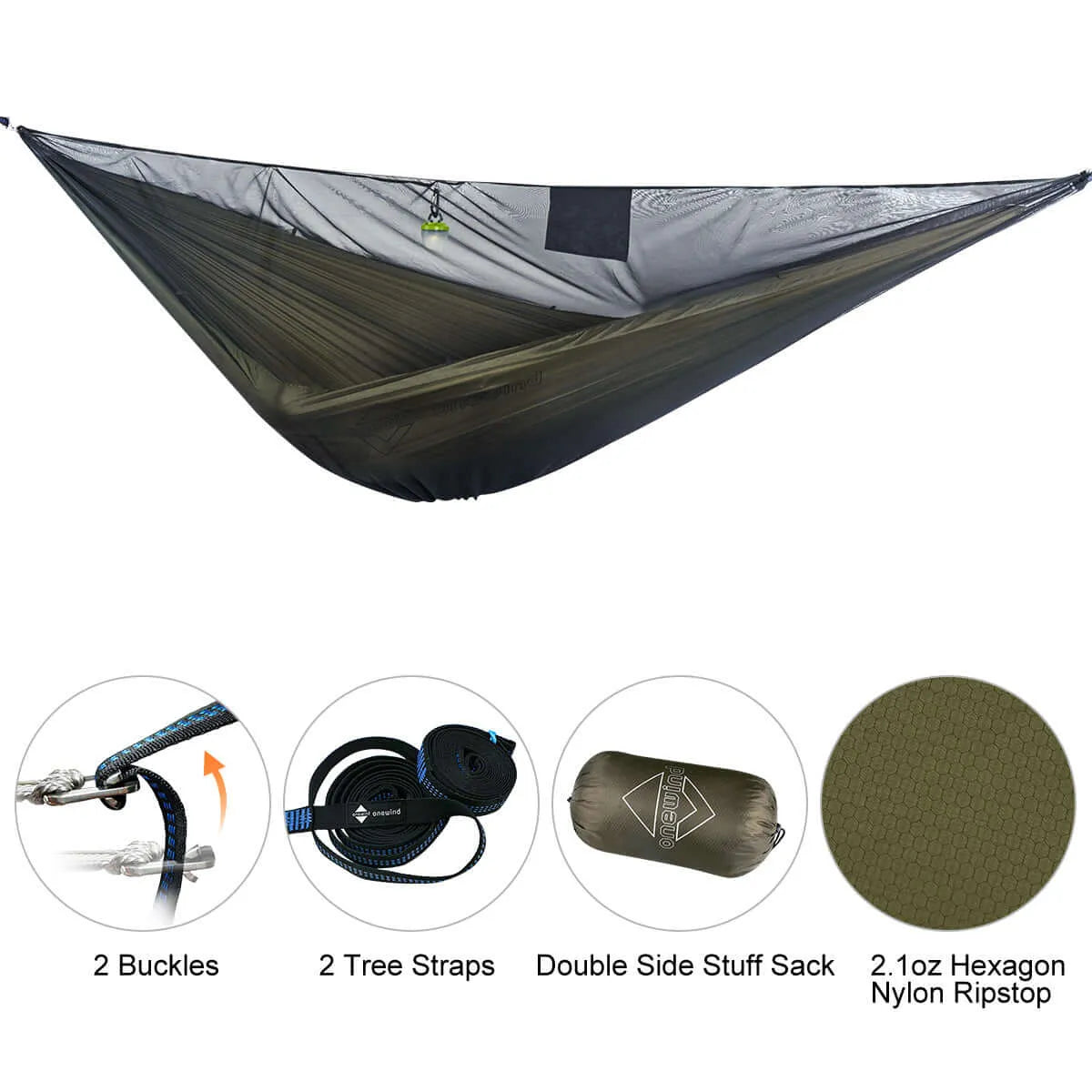
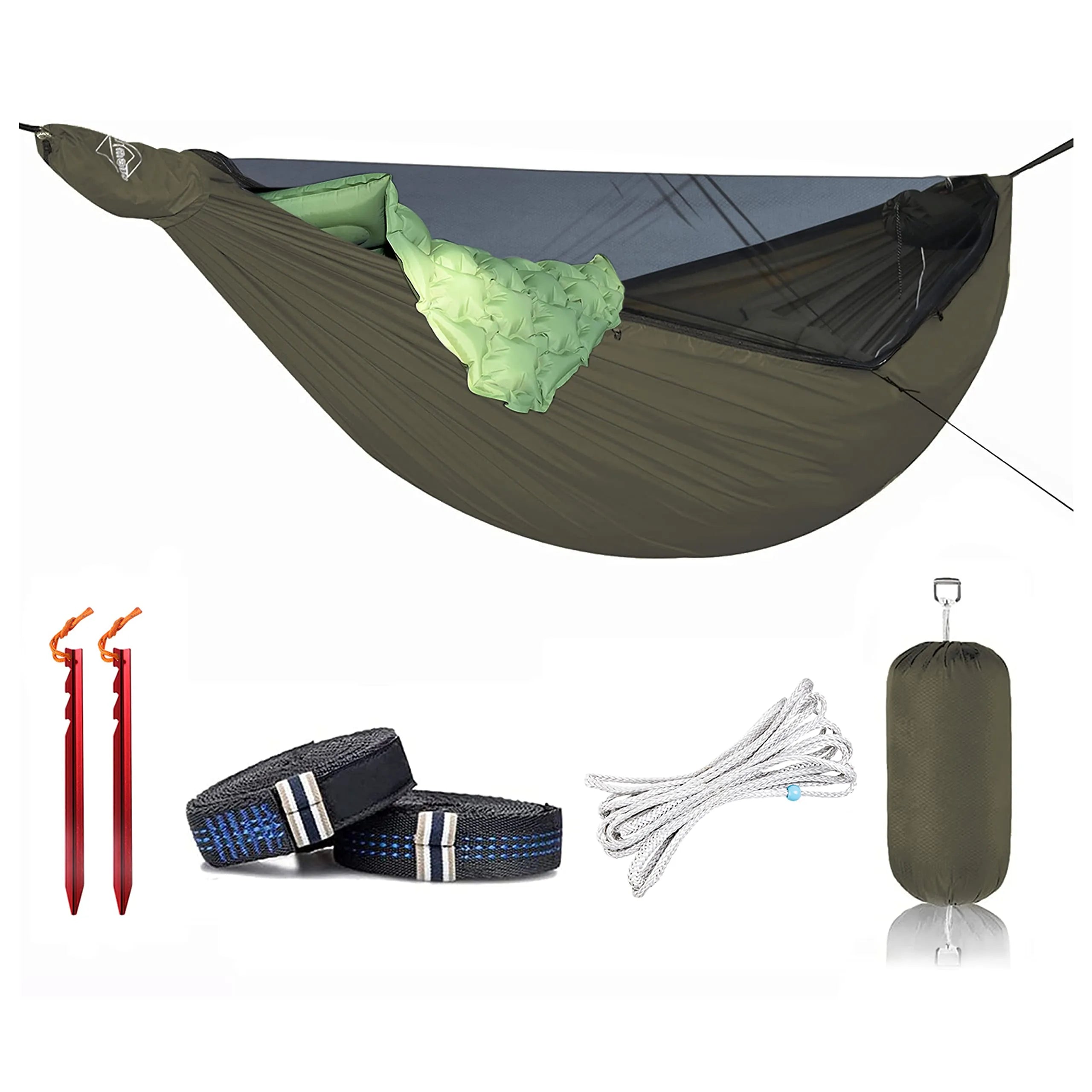
Antes de tu primera instalación, aquí tienes cada componente y por qué es importante:
¿Todavía estás eligiendo los componentes? Compara sistemas completos de hamaca por costo total de pernocta antes de elaborar la lista de verificación a continuación.
Peso total del sistema: Una configuración completa para 3 estaciones (hamaca + correas + lona + mosquitera + aislante inferior) pesa entre 57 y 80 oz, según la marca y los materiales. Como referencia, un sistema de tienda comparable pesa entre 50 y 65 oz — consulta nuestra comparación completa de peso entre hamacas y tiendas de campaña.
El método de configuración de 7 pasos
Paso 1: Seleccione su sitio
Lo que estás buscando: Dos árboles sanos y vivos, separados entre 3 y 4,5 metros, cada uno con un diámetro de al menos 15 cm.
Cómo medir el diámetro de un árbol: Envuelve el tronco con ambas manos. Si tus dedos no se tocan al otro lado, el árbol es lo suficientemente grueso (aproximadamente más de 6" de diámetro).
Cómo comprobar el espaciado: Párate con la espalda apoyada en un árbol y da 4-5 pasos normales hacia el otro. Eso es aproximadamente 12-14 pies: el punto ideal.
Lista de verificación para la selección del sitio:
- Dos árboles vivos, separados entre 3 y 4,5 m, con un diámetro de más de 15 cm
- No hay ramas muertas sobre la cabeza («hacedoras de viudas»)
- El suelo debajo está libre de rocas y objetos afilados
- Al menos a 200 pies de las fuentes de agua
- No en un sendero de animales ni en un corredor de viento
- El campamento permite acampar en hamaca (algunos parques lo restringen)
Error común: Elegir los dos primeros árboles que ves. Dedicar 5 minutos a explorar ahorra 30 minutos de volver a colgar después.
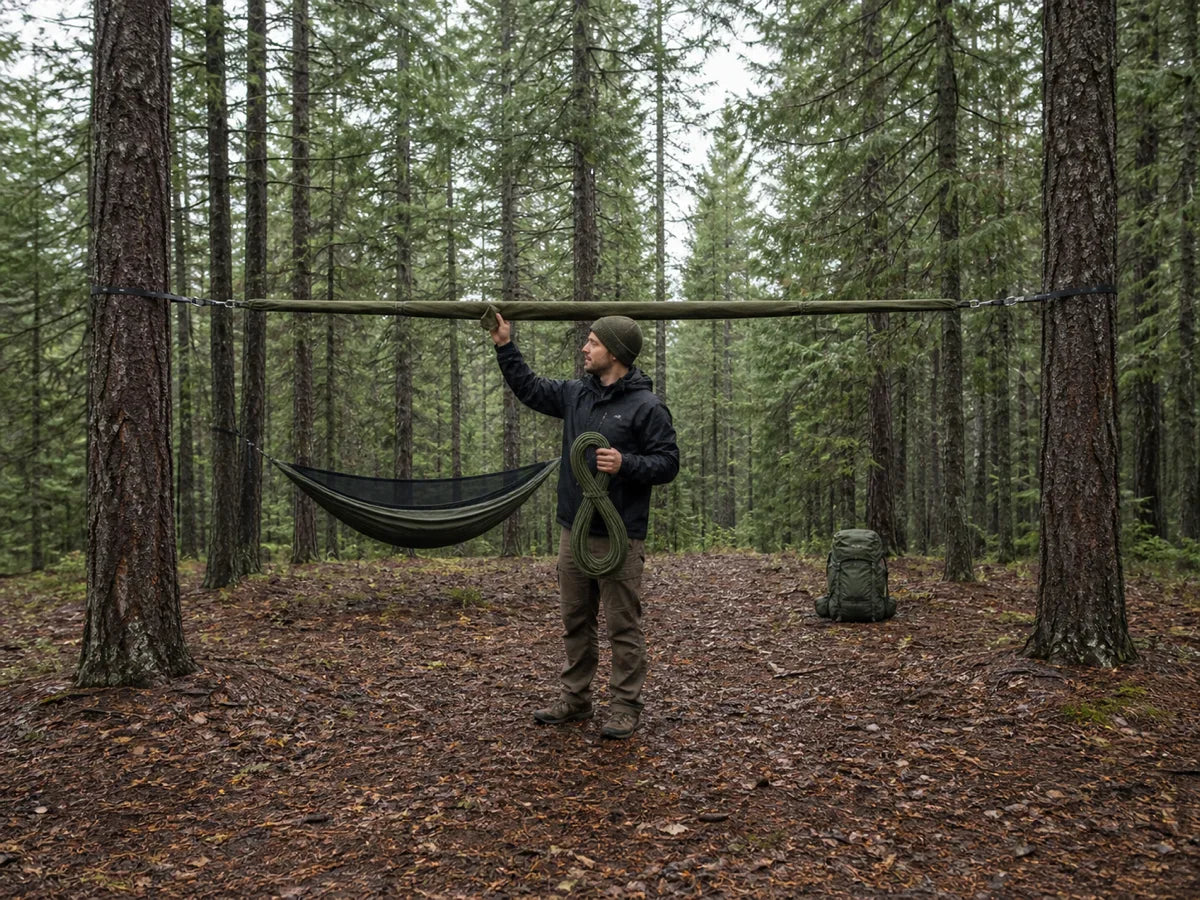
Paso 2: Coloca las correas de tu árbol
Dónde colocar las correas: Envuelva cada correa alrededor del árbol aproximadamente altura de la cabeza (5-6 pies del suelo para la mayoría de los adultos).
El truco de «elevar el extremo de los pies 6 pulgadas»: Coloca la correa del extremo de los pies unos 6 pulgadas más arriba que el extremo de la cabeza. Esto concentra el peso de tu cuerpo por debajo de la caja torácica, creando una posición notablemente más plana. La mayoría de las guías de montaje omiten este detalle. Es la diferencia entre despertar acostado en plano y despertar curvado.
Requisitos de la correa:
- Ancho: mínimo 1 pulgada, se recomiendan 1,5-2 pulgadas
- Muchos campings requieren correas de más de 1" de ancho para proteger la corteza de los árboles
- Nunca use cuerda. Se clava en la corteza, se estira durante la noche y está prohibida en muchos lugares.
Prueba de verificación: Tire de cada correa con firmeza. Debe soportar su peso sin deslizarse. La correa debe quedar plana contra la corteza, no amontonarse ni retorcerse.
Paso 3: Compruebe su ángulo de suspensión
Objetivo: Las líneas de suspensión deben colgar a una ángulo de 30° del árbol.
El atajo de la longitud del brazo (sin necesidad de transportador): Párese junto al árbol donde está sujeta la correa. Extienda el brazo recto hacia afuera en posición horizontal. Su línea de suspensión debe inclinarse hacia abajo aproximadamente hasta el punto donde estaría su codo si doblara el brazo a medio camino hacia abajo. Eso es aproximadamente 30°.
Por qué importan los 30°: Demasiado tenso (más cerca de la horizontal) aprieta tus hombros y sobrecarga la estructura. Demasiado flojo (más cerca de la vertical) te deja demasiado cerca del suelo y crea un capullo incómodo.
Ajuste: Si el ángulo parece demasiado pronunciado, suba las correas más arriba en el árbol. ¿Demasiado poco pronunciado? Baje las correas o amplíe la separación entre los árboles.
Paso 4: Cuelga y prueba tu hamaca
Enganche la hamaca a los mosquetones de cada correa. La parte inferior de la hamaca debe colgar aproximadamente 18 pulgadas sobre el suelo cuando está vacío.
La prueba de sentarse: Siéntese en la hamaca como si estuviera sentado en una silla. Los talones deben apenas tocar el suelo. Si los pies quedan colgando, la hamaca está demasiado alta: baje las correas. Si las nalgas casi tocan el suelo, está demasiado baja: suba las correas o apriételas.
Tensión de la línea de cumbrera: Si tu hamaca tiene una línea de cumbrera estructural, debería tener una ligera curvatura cuando está vacía que se endereza cuando te sientas. Piensa tensión de cuerda de tendedero, no de cuerda de guitarra. Lo suficientemente tenso para mantener la forma, lo suficientemente suelto para ceder cuando se carga.
Prueba de verificación: Siéntese completamente en la hamaca durante 30 segundos. Verifique:
- La base queda al menos a 6" del suelo con tu peso dentro de ella
- Sin crujidos del hardware ni sonidos de deslizamiento de la correa
- Puedes entrar y salir sin hacer malabares
Paso 5: Domina la posición diagonal al acostarte
Esto es la técnica más importante en el camping en hamaca. La mayoría de los principiantes se lo saltan por completo.
Acostarse recto en una hamaca (con la cabeza y los pies alineados con la línea central) crea la «forma de banana»: columna curvada, hombros comprimidos y puntos de presión incómodos.
Por eso la gente dice: «las hamacas me dañan la espalda».
La solución es simple: desplaza tu cuerpo 30-45° fuera de la línea central.
Acuéstese en diagonal para que su cabeza esté cerca de un borde y sus pies cerca del borde opuesto.
La tela de la hamaca se extiende más ancha debajo de ti, creando una superficie de descanso casi plana.
Tu columna se endereza y tus hombros se abren.
¿Esa curva de plátano?
Se fue.
Cómo encontrar el ángulo correcto: Métete en la hamaca y acuéstate recto. Ahora desplaza los pies unos 12 pulgadas hacia un lado y la cabeza unos 12 pulgadas hacia el otro. Sentirás que la superficie se aplana casi de inmediato. En mi experiencia, este es el momento en que la mayoría de las personas pasa de «las hamacas son raras» a «ah, ahora lo entiendo».
Antes y después:
Experiencia real del usuario: Los campistas experimentados de hamaca con más de 60 noches suelen afirmar de forma constante que tumbarse en diagonal es el momento en que el campamento en hamaca “encaja”. Las primeras 1-2 noches resultan incómodas. Para la noche 4, la mayoría de las personas se duerme más rápido que en una tienda de campaña.
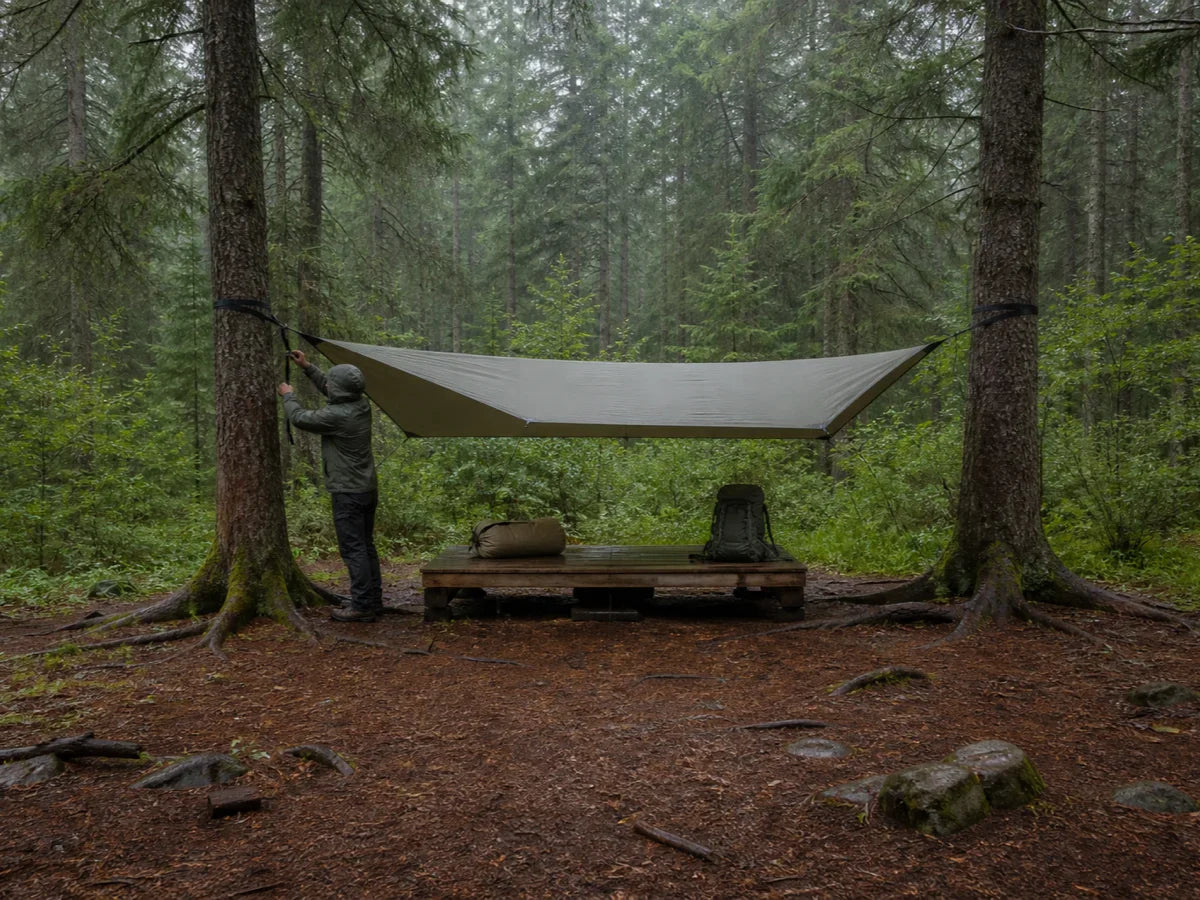
Paso 6: Despliega tu lona
Cuando: Siempre. Incluso si el pronóstico dice despejado. Pregúntale a cualquiera que se haya quedado sin uno: cielos despejados a las 8 p. m., lluvia horizontal a medianoche. Una lona tarda 5 minutos en montarse en seco, pero 30 minutos en colocarla a la fuerza bajo un aguacero.
Procedimiento de configuración:
- Tienda la línea de cumbrera de la lona entre los mismos dos árboles, colocados por encima de la línea de suspensión de tu hamaca (por encima de la cadena de margarita si usas una)
- Centra la lona sobre tu hamaca — una tarp hexagonal o lona cuadrada debería extenderse 8-12 pulgadas más allá de cada extremo de la hamaca
- Coloca la línea de cumbrera perpendicular al viento dirección, con el borde a sotavento ligeramente más bajo para desviar las ráfagas
- Marca las esquinas con estacas usando vientos y postes para lona si es necesario. La tensión debe ser lo suficientemente firme para desviar la lluvia, pero no tan apretada que rompa los puntos de sujeción
Compromiso de altura de la lona:
Prueba de verificación: Túmbate en la hamaca y extiende los brazos. Deberías poder tocar la lona, pero no debería presionarte. Echa un poco de agua sobre la lona: debería escurrirse hacia los lados, no acumularse.
Paso 7: Añadir aislamiento (según la temperatura)
Este es el paso que más dinero les cuesta a los principiantes, no por lo que compran, sino por lo que omiten.
Trae tu saco de dormir.
Te mantuvo abrigado en una tienda de campaña, así que debería funcionar en una hamaca, ¿verdad?
No.
Tu peso corporal aplasta el aislamiento que está debajo de ti.
¿Esas bolsas de aire que atrapan el calor?
Se fue.
Tu saco de dormir de 30 °F se convierte en un saco de 50 °F en la parte inferior.
A las 2 de la madrugada estás temblando y no sabes por qué.
El árbol de decisión de temperatura:
Instalación del cubrecolchón inferior: Sujete el underquilt a la línea de suspensión de su hamaca utilizando los mosquetones incluidos. Debe envolver la parte inferior de la hamaca como un capullo, centrado debajo de su torso. Sin huecos: el aire frío encuentra huecos. En condiciones de humedad o viento, añada un protector de colcha inferior para protegerlo de la humedad.
Prueba de verificación: Túmbate en la hamaca con tu aislamiento instalado. Coloca tu mano desnuda en la parte inferior de la hamaca desde el exterior. Si puedes sentir calor, el cubrecolchón está funcionando. Si la tela se siente fría, hay un hueco: ajústalo.
Para obtener un desglose completo de costos que compare los sistemas de aislamiento para hamacas frente a los sistemas de descanso para tiendas de campaña, consulte nuestra guía de hamaca frente a tienda de campaña.
Guías de escenarios: configuración según la situación
Escenario 1: Sesión de práctica en el patio trasero (por primera vez)
Veredicto: Empiece aquí antes de cualquier viaje real
Te queda bien si:
- ✓ Acabas de comprar tu primera hamaca
- ✓ Nunca has colgado una antes
- ✓ Quieres aprender sin la presión de una verdadera acampada
Por qué es importante practicar en el patio trasero: Dos campamentos de prueba antes de tu primera salida real reducen la ansiedad de montaje en aproximadamente un 70 % (según informes de foros de usuarios). Puedes cometer errores en casa — ángulo incorrecto, altura incorrecta, correas enredadas — sin consecuencias.
Lista de verificación para practicar en el patio trasero:
- Completa los pasos 1-5 (sitio → correas → ángulo → colgar → posición diagonal)
- Cronométate: el primer intento tomará aproximadamente 25 minutos; objetivo: menos de 15 minutos en el intento 3
- Duerma una noche completa en la hamaca para probar la comodidad
- Practica entrar y salir en la oscuridad (usa una linterna frontal)
- Si las temperaturas están por debajo de 55 °F, prueba también tu configuración de aislamiento.
Mejor configuración para principiantes: Hamaca de camping Onewind de 11 pies + correas para árboles — lo suficientemente ancho para tumbarse en diagonal, correas incluidas. Si desea una entrada con cremallera para un acceso más fácil, pruebe el Hamaca con cremallera de 11 pies. Para los excursionistas preocupados por el peso, el Ultraligero de 11 pies ahorra onzas sin sacrificar espacio.
Escenario 2: Campamento establecido
Veredicto: Comprueba primero las normas y luego sigue los 7 pasos
Te queda bien si:
- ✓ Acampar en un campamento designado con parcelas numeradas
- ✓ Los árboles están disponibles, pero pueden estar regulados
- ✓ Hay otros campistas cerca
Preocupaciones específicas del campamento:
- Muchos campamentos requieren correas de más de 1" de ancho (nunca cuerda)
- Algunos sitios restringen el uso de hamacas entre árboles designados.
- Algunos parques nacionales (Arches, Joshua Tree) prohíben por completo las hamacas
- Llame con anticipación o consulte el sitio web del parque antes de llegar
Modificaciones de configuración:
- El paso 1 puede estar limitado por los árboles del sitio asignados
- Utiliza correas más anchas (2") para una máxima protección de los árboles
- Monta la lona incluso con buen tiempo: la etiqueta del camping espera que dejes el mínimo rastro
Escenario 3: Configuración para clima frío (por debajo de 50 °F)
Veredicto: el aislante inferior es innegociable
Te queda bien si:
- ✓ Las temperaturas nocturnas bajan de 50 °F
- ✓ Acampar en otoño, invierno o principios de primavera
- ✓ Necesitas que tu sistema de aislamiento realmente funcione
Por qué el clima frío lo cambia todoPor debajo de 50 °F, el flujo de aire bajo su hamaca se convierte en su enemigo. Un saco de dormir por sí solo no lo salvará. Se comprime y queda aplastado bajo el peso de su cuerpo, y el aislamiento comprimido no sirve de nada.
Añadidos para clima frío a los 7 pasos:
- Después del paso 4 (colgar la hamaca): instale el saco aislante inferior antes de entrar.
- Después del paso 6 (toldo): baje la posición del toldo para protegerse del viento
- El paso 7 se vuelve crítico: colchoneta aislante inferior + colchoneta aislante superior + capas de ropa aislante
Accesorios para clima frío:
La mejor hamaca para clima frío: Hamaca puente Onewind con línea de cumbrera integrada para un ajuste uniforme del aislante inferior.
Escenario 4: Condiciones de lluvia
Veredicto: la lona se convierte en tu prioridad número 1
Te queda bien si:
- ✓ Se pronostica lluvia (o es posible)
- ✓ Acampada prolongada en la que el clima puede cambiar
- ✓ Quieres permanecer seco sin retirarte a un coche
Modificaciones específicas de la lona para la lluvia:
- Usa el tono bajo posiciona (la lona justo por encima de la altura de la hamaca) para una cobertura máxima
- Incline el lado de barlovento más bajo para desviar la lluvia lateral
- Extiende las cuerdas de sujeción más hacia afuera para crear una zona seca para el equipo debajo
- Comprueba que el agua escurra por los bordes de la lona, no que se acumule en el centro.
Detalle crítico de lluvia: Tu lona debe extenderse al menos entre 8 y 12 pulgadas más allá de cada extremo de la hamaca. A toldo hexagonal de 12 pies o toldo ultraligero de silnylon proporciona esta cobertura. En caso de lluvia intensa, considere un Toldo Zephyr con puertas de cobertura total.
Punta de línea de goteo: Donde las cuerdas guía de tu lona se unen a la línea de cumbrera, el agua viaja por la cuerda hacia tu hamaca. Ata una corta «cuerda de goteo» (6 pulgadas de cordón) en el punto de unión: el agua la seguirá hacia abajo en lugar de llegar a tu hamaca.
Errores comunes de configuración (y cómo solucionarlos)
Error 1: Colgar demasiado tenso
Qué pasa: Tus hombros quedan apretados uno contra otro. La hamaca se siente como una camisa de fuerza. Te despiertas con los brazos dormidos.
La corrección: Añade más hundimiento. La suspensión debe quedar colgando a 30° — usa el atajo de la longitud del brazo del Paso 3. En caso de duda, más hundimiento siempre es más seguro que menos.
Error 2: Dormir boca arriba
Qué pasa: Tu columna se curva en forma de «plátano». Te duele la parte baja de la espalda. Concluyes que las hamacas son incómodas.
La corrección: Tu hamaca no está rota, tu posición sí. Túmbate en diagonal a 30-45° (Paso 5). La diferencia es inmediata.
Error 3: Sin aislamiento inferior por debajo de 50 °F
Imagínate esto: las 2 de la mañana, estás tiritando y tu saco de dormir se siente como una hoja de papel debajo de ti.
Eso se debe a que el peso de tu cuerpo aplastó por completo el aislamiento.
¿Valor R en la parte inferior?
Básicamente, cero.
La respuesta es un aislante inferior.
No es una colchoneta (aunque las colchonetas funcionan por encima de 50 °F).
Una colcha inferior real que cuelga debajo de la hamaca, se mantiene esponjosa y realmente atrapa el calor.
Error 4: Usar cuerda en lugar de correas
Qué pasa: La cuerda se incrusta en la corteza del árbol (dañando el árbol), se estira de forma impredecible durante la noche (quedas más hundido) y está prohibida en muchos campamentos.
La corrección: Correas para árboles, ancho mínimo de 1". Las correas más anchas distribuyen mejor la presión y cumplen con las normas del campamento.
Error 5: Omitir la práctica previa
He visto esto repetirse decenas de veces en foros de camping.
Alguien compra el equipo, conduce tres horas hasta el campamento e intenta averiguar por primera vez las correas y los mosquetones a las 9 de la noche con una linterna frontal.
Cuarenta y cinco minutos después, están frustrados, sus compañeros están esperando y, de todos modos, la configuración está mal.
Una sesión en el patio trasero lo soluciona por completo. Cronométrate. Memoriza los 7 pasos. Tu primera salida real debería llevarte de 10 a 15 minutos, no 45.
Pónlo todo junto
La instalación de la hamaca es poco intuitivo.
Pero se puede aprender por completo en una sola tarde en el patio trasero si sigues los 7 pasos en orden.
Ángulo de suspensión incorrecto, duerme recto, omitiendo el edredón inferior.
Esos son los tres errores que arruinan a los principiantes, y cada uno de ellos tiene una solución específica en esta guía.
Resumen de la secuencia de configuración
- Sitio: Dos árboles, separados entre 3 y 4,5 m, con un diámetro de más de 15 cm
- Correas: Altura de la cabeza, extremo de los pies 6" más alto, 1"+ más ancho
- Ángulo: 30° — usa el atajo de la longitud del brazo
- Colgar: 18" de distancia al suelo, supera la prueba de sentarse
- Diagonal: Desplazamiento de 30-45° — el avance en comodidad
- Toldo: 8-12" más allá de los extremos de la hamaca, línea de sujeción perpendicular al viento
- Aislamiento: Coincide con el árbol de decisión de temperatura
Tu próximo movimiento
Si estás empezando:
→ Hamaca de camping Onewind de 11 pies — el tamaño adecuado para tumbarse en diagonal
→ Correas para árboles — 1,5" de ancho, conforme a las normas del campamento
→ Mosquitera individual — protección para primavera/verano
→ Toldo hexagonal de 12 pies — cobertura contra la lluvia con voladizo de 8-12"
→ Haz una práctica en el patio trasero este fin de semana
Si quieres ultraligero:
→ Hamaca ultraligera de 11 pies — tejido más ligero, mismo espacio
→ Tarp ultraligero de silnylon — protección contra la lluvia ultraligera
→ Acolchado inferior de una sola capa — aislamiento para temporada cálida
Si necesitas capacidad para clima frío:
→ Edredón inferior de 600 g — ajusta la clasificación a tu mínima nocturna esperada
→ Edredón superior de plumón de 800 g — combinado con un protector térmico inferior para temperaturas bajo cero
→ Hamaca puente — línea de cresta integrada para un ajuste uniforme del aislante inferior
→ Protector de aislante inferior — protege el aislamiento del viento y la humedad
Si aún estás decidiendo entre una hamaca y una tienda de campaña:
→ Lea nuestro comparación completa entre hamaca y tienda de campaña para principiantes primero

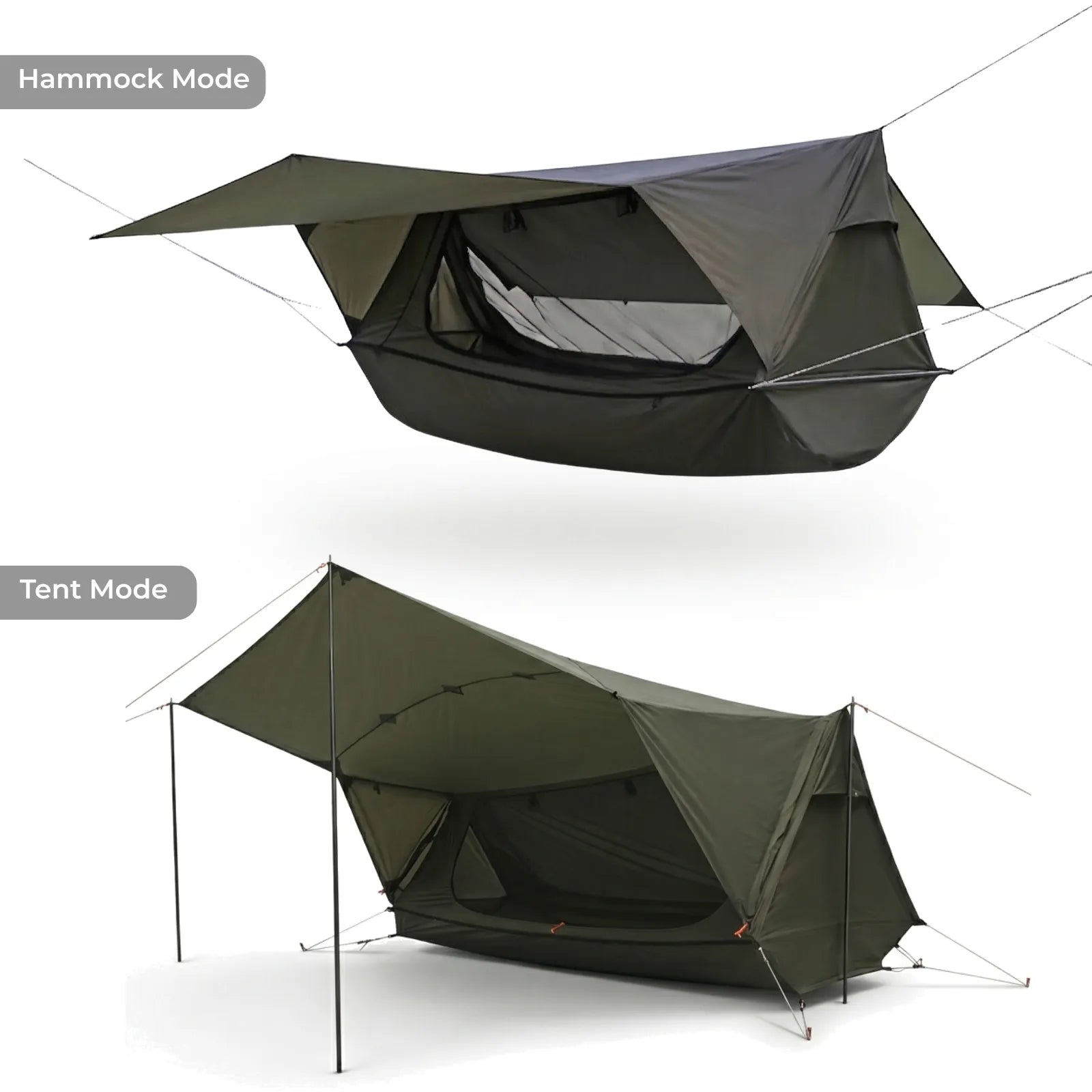
The perfect starter kit mentioned in this guide — hammock + tarp in one bundle.
Shop Now →