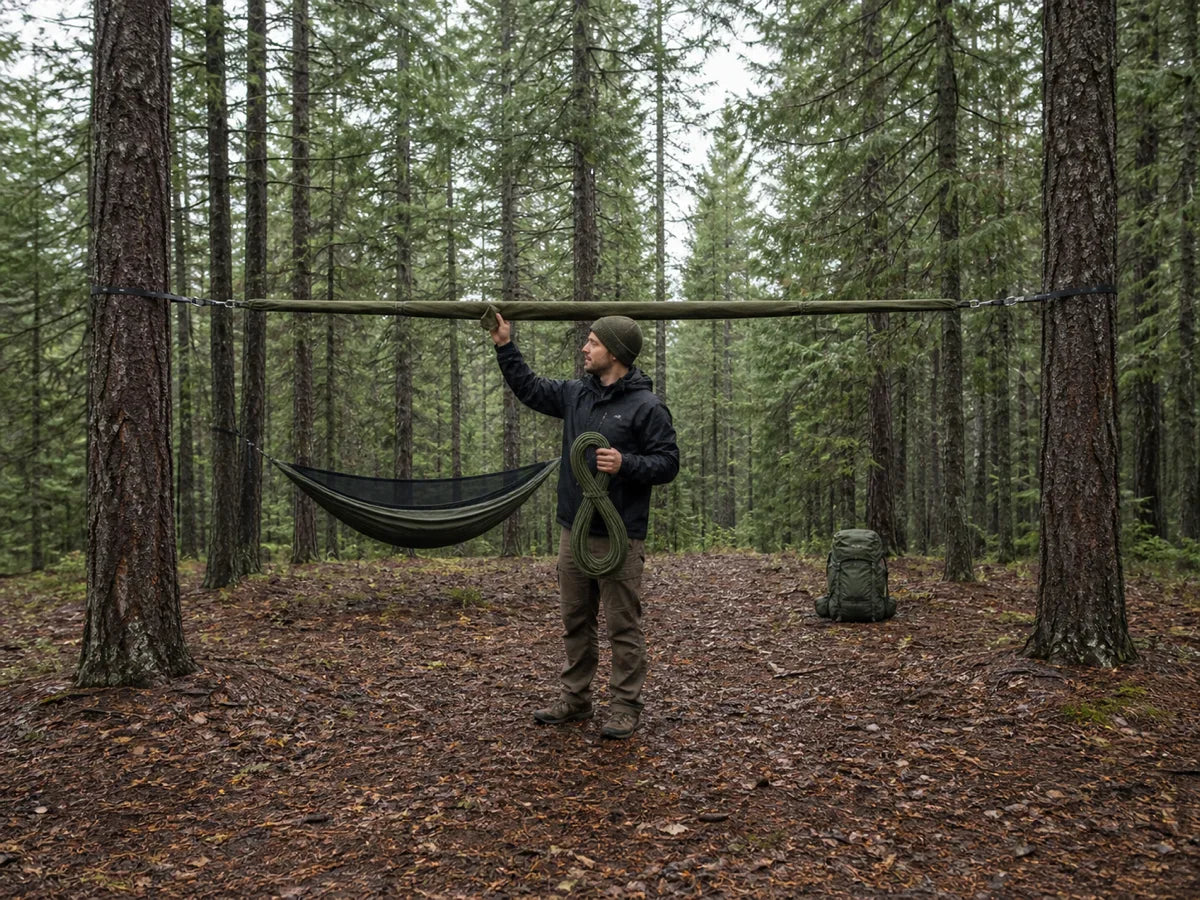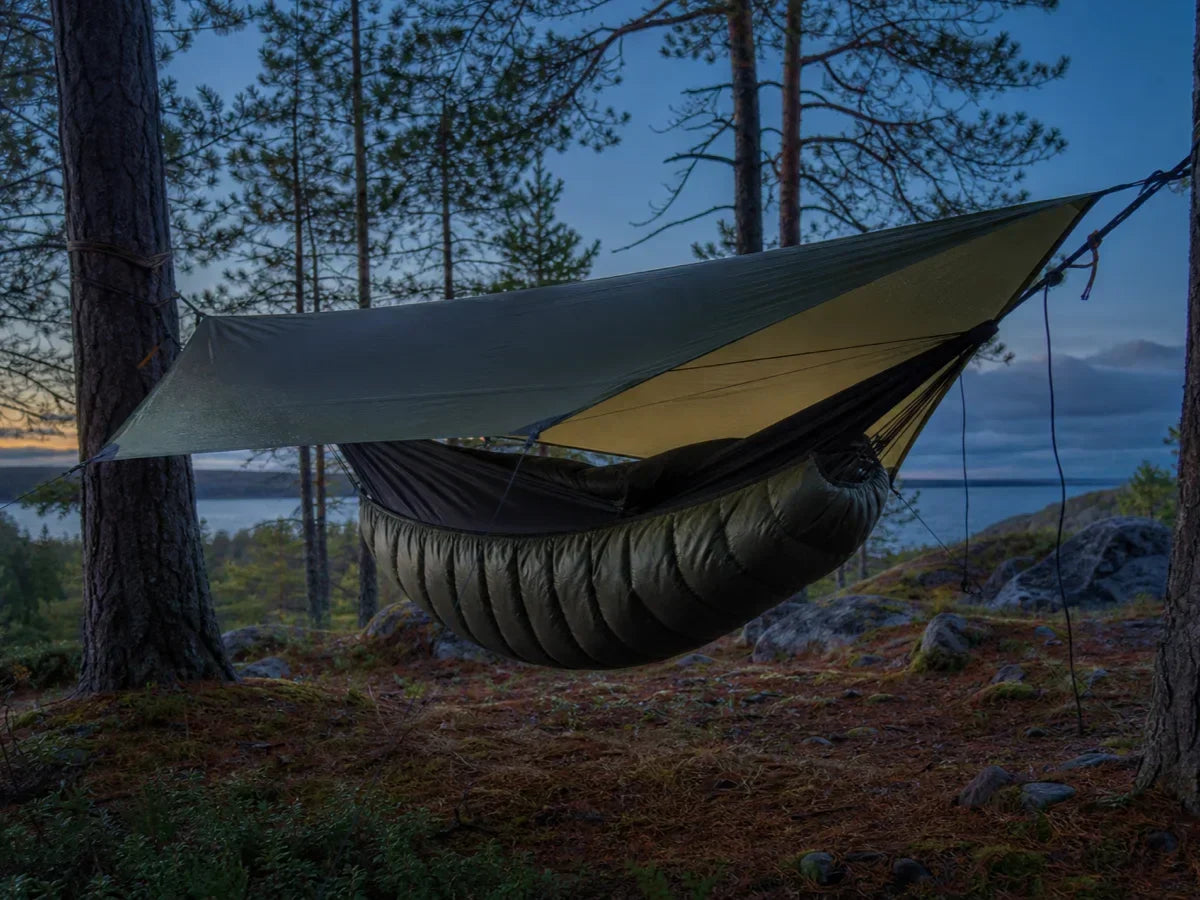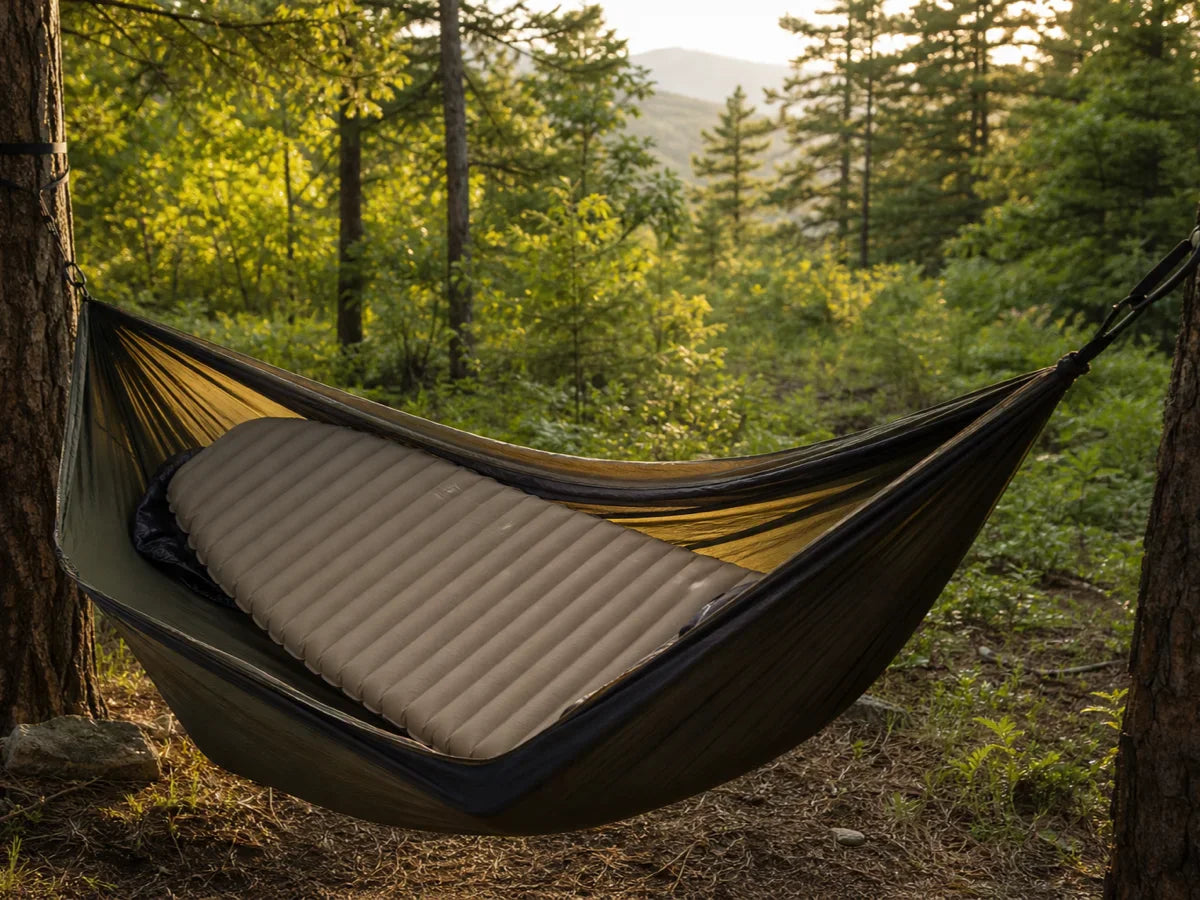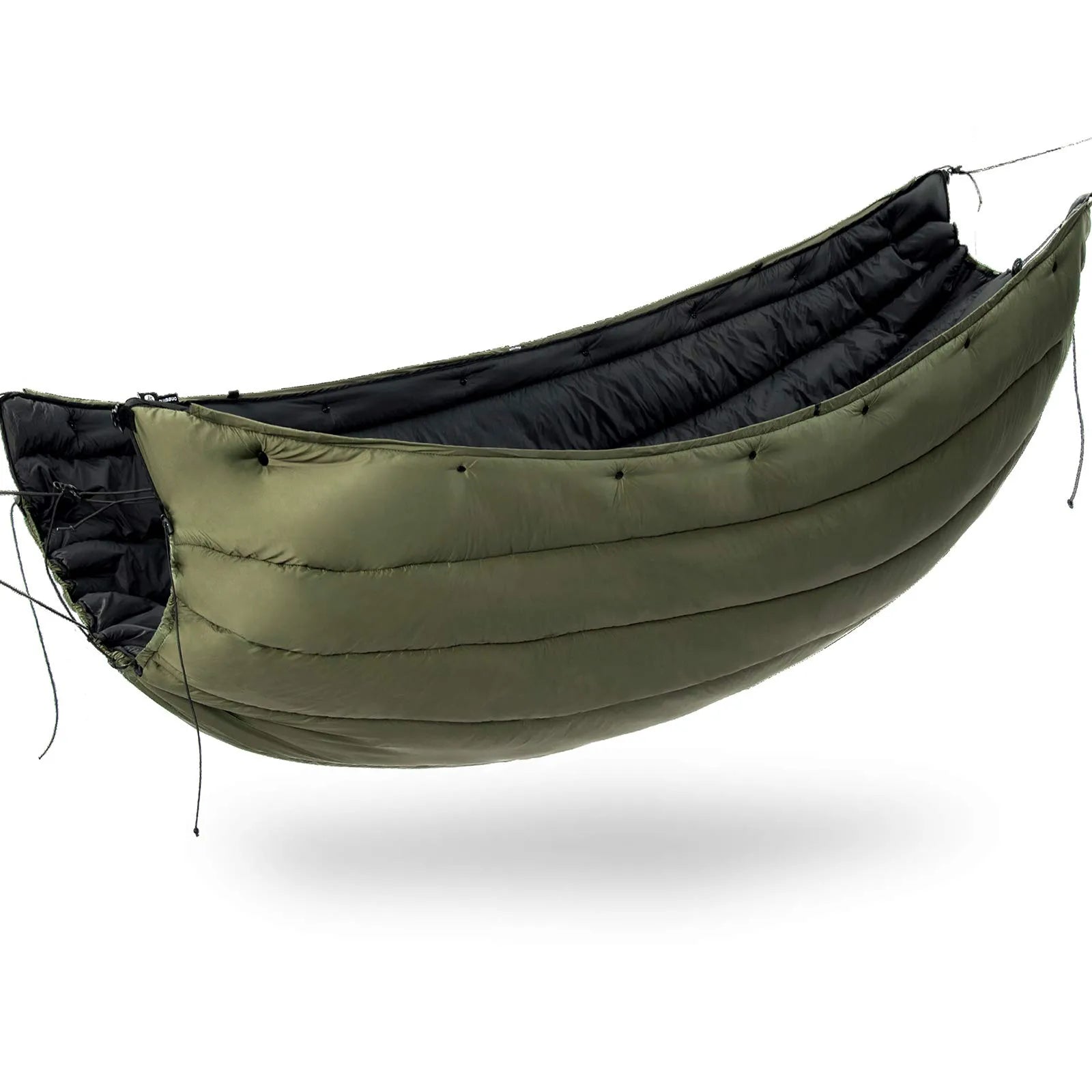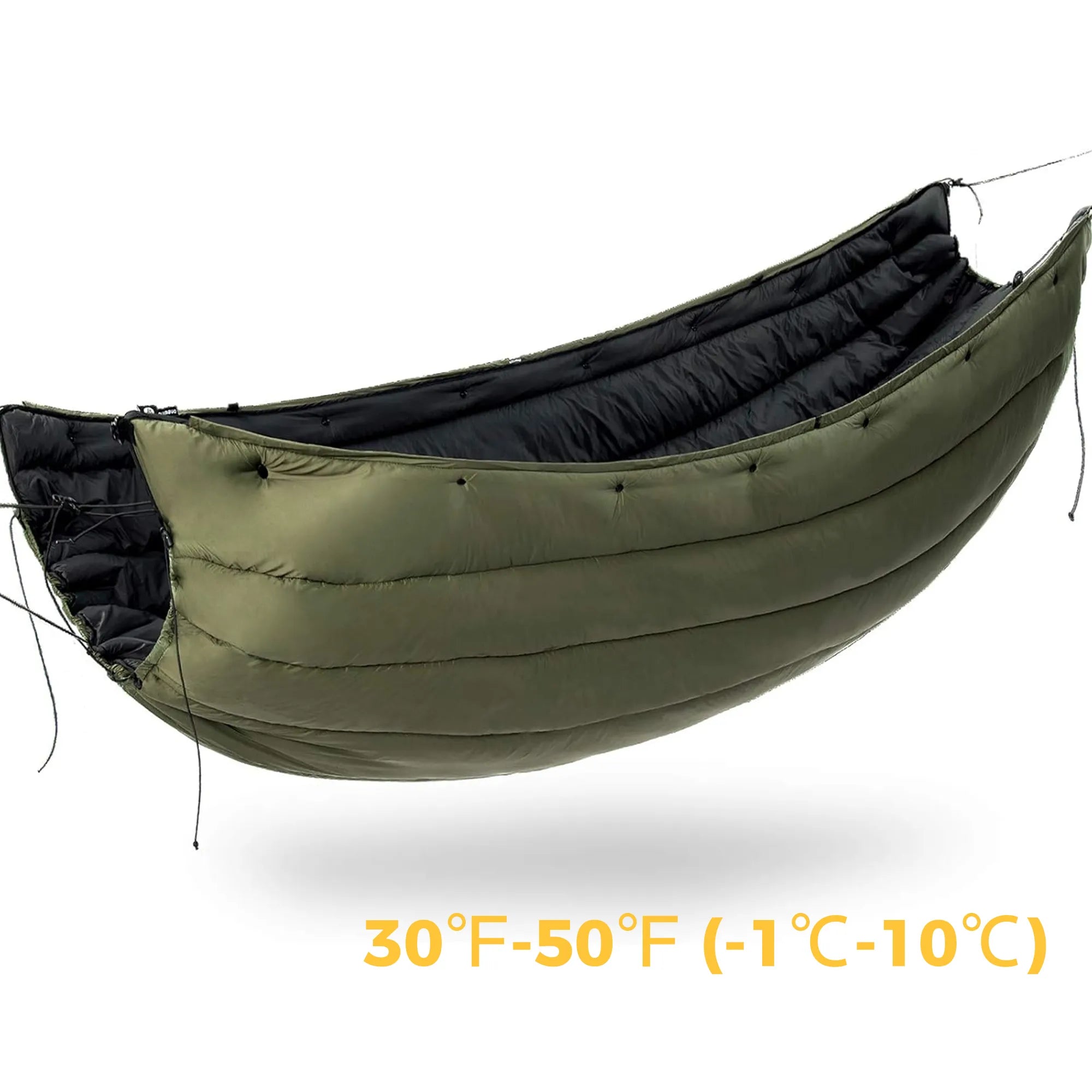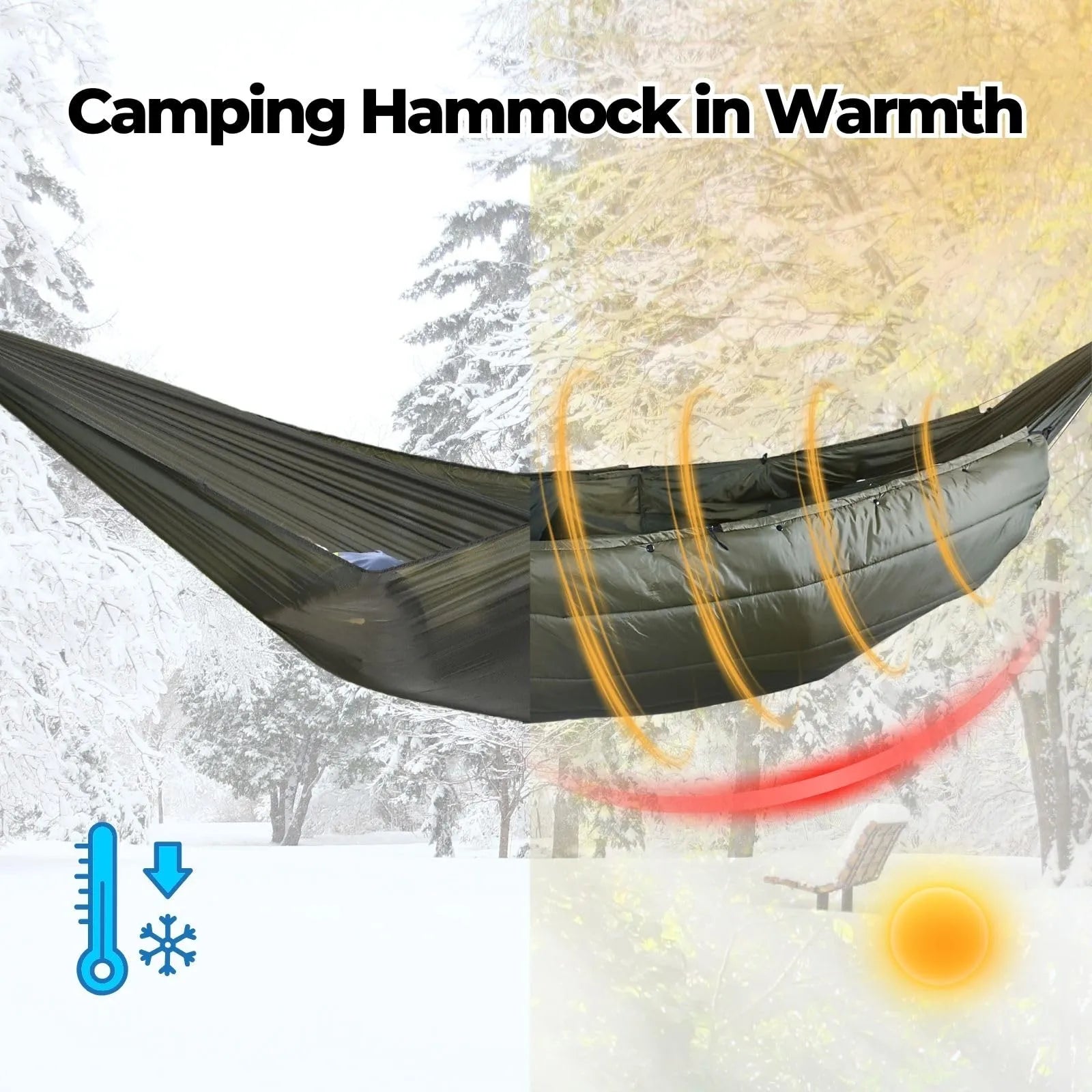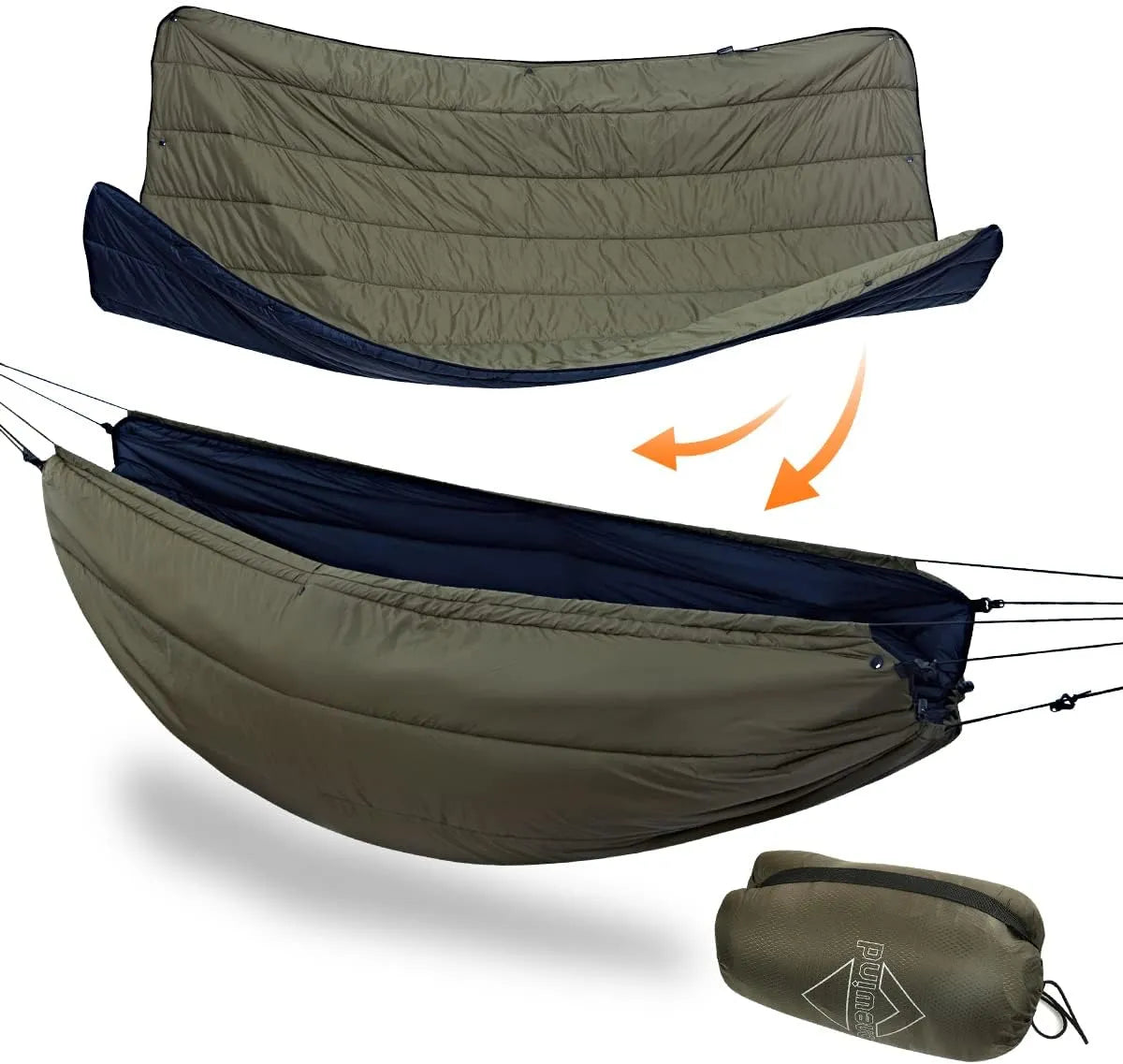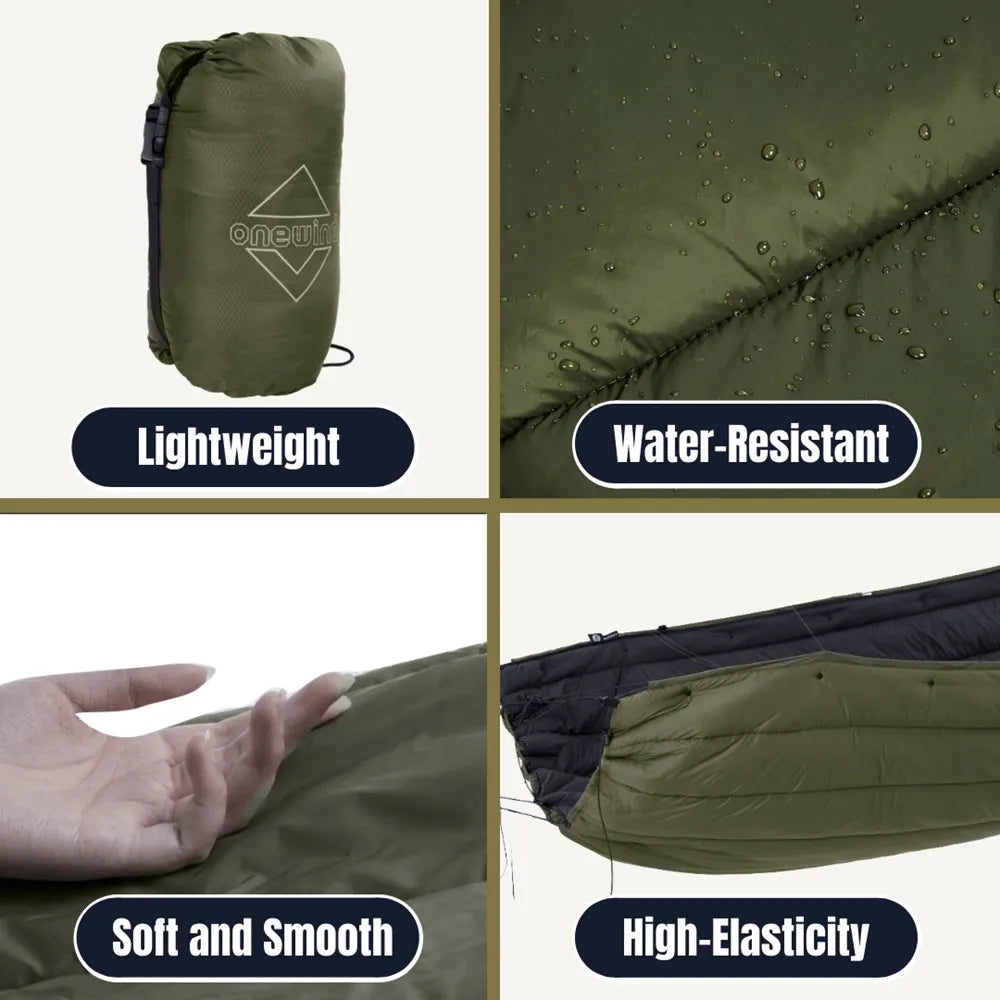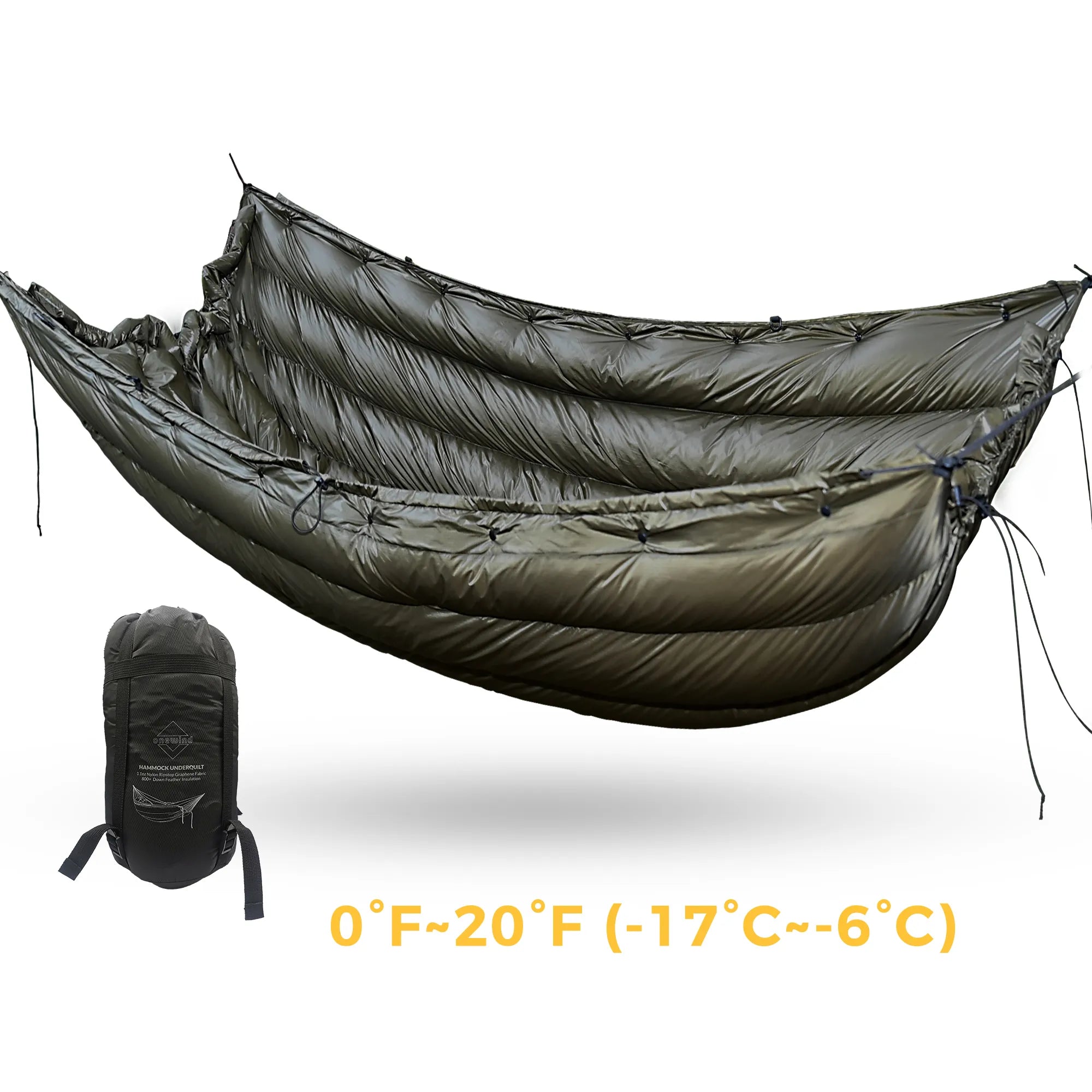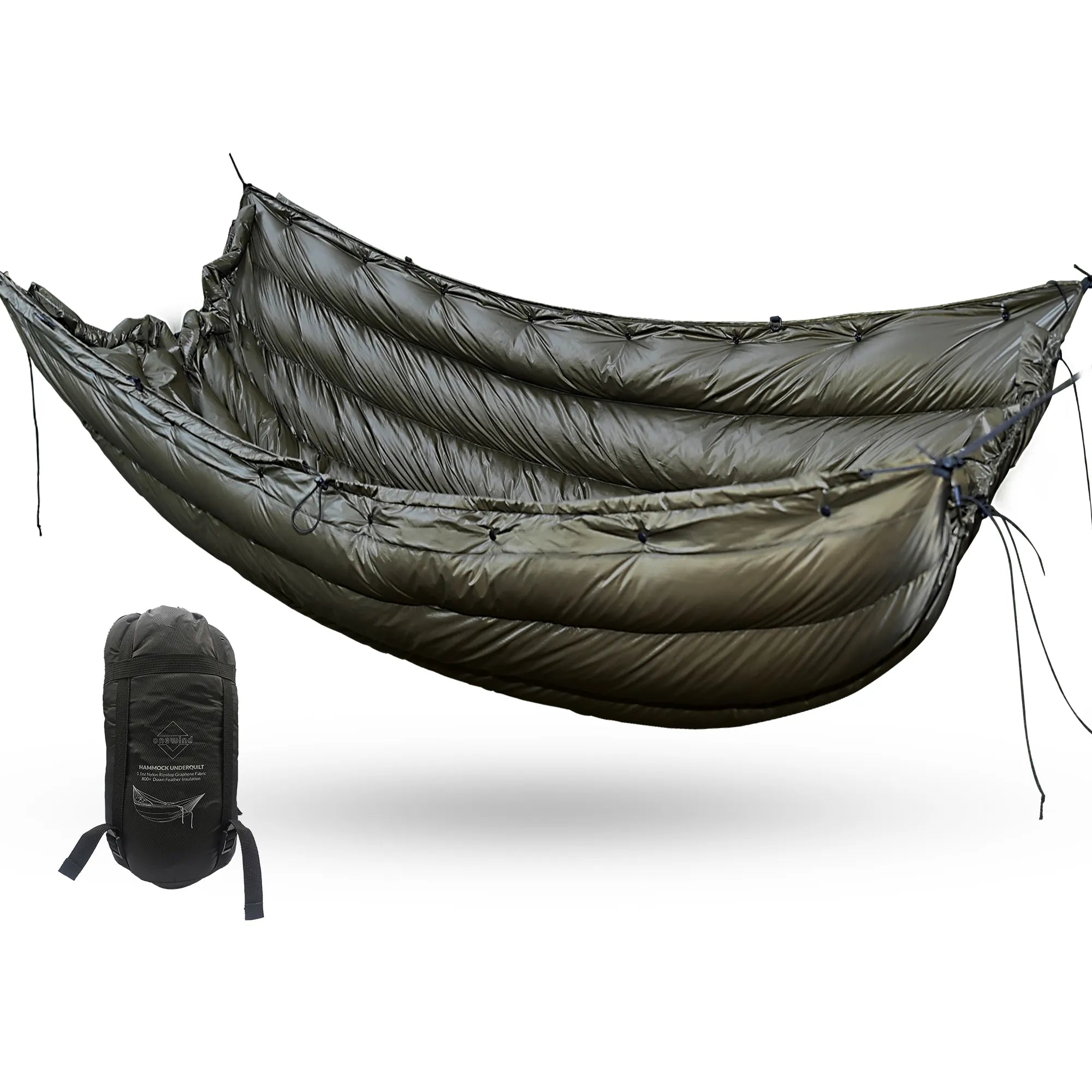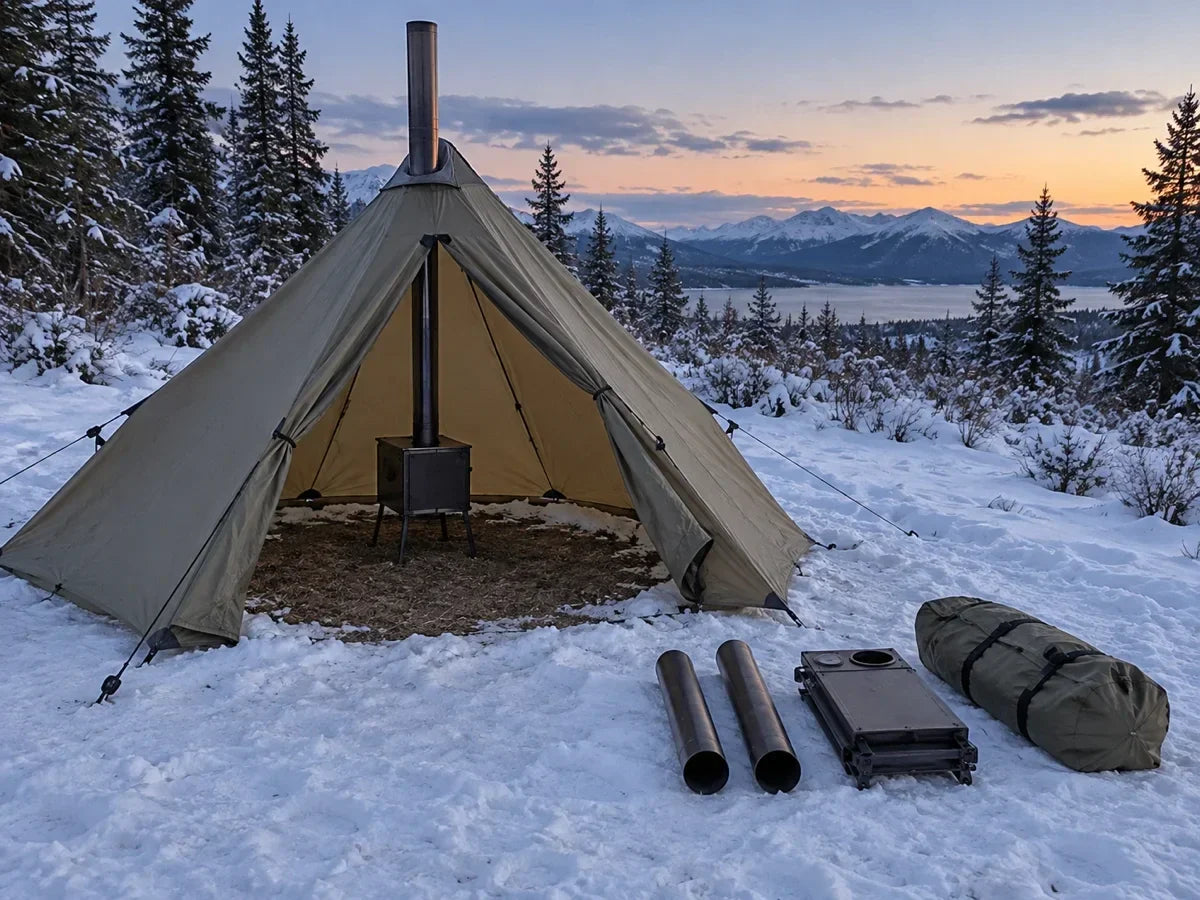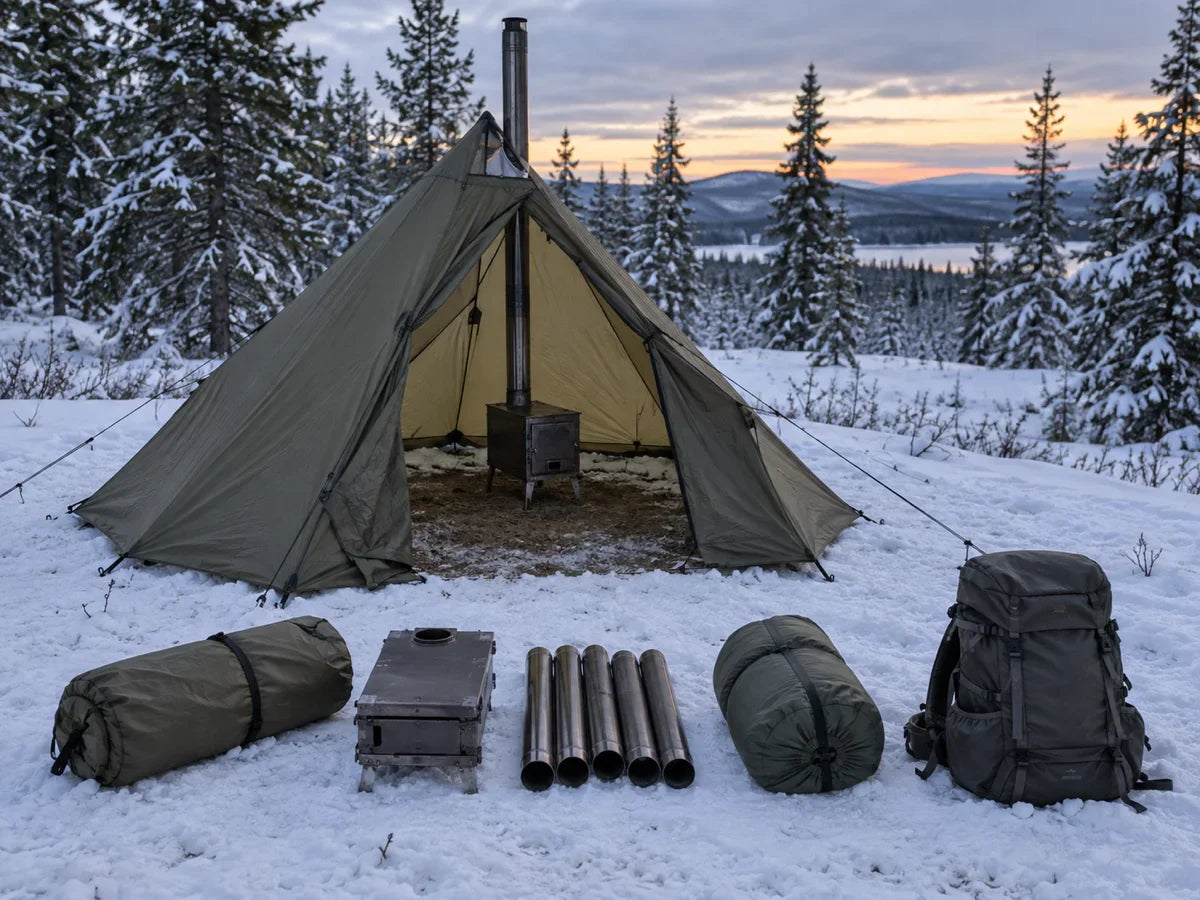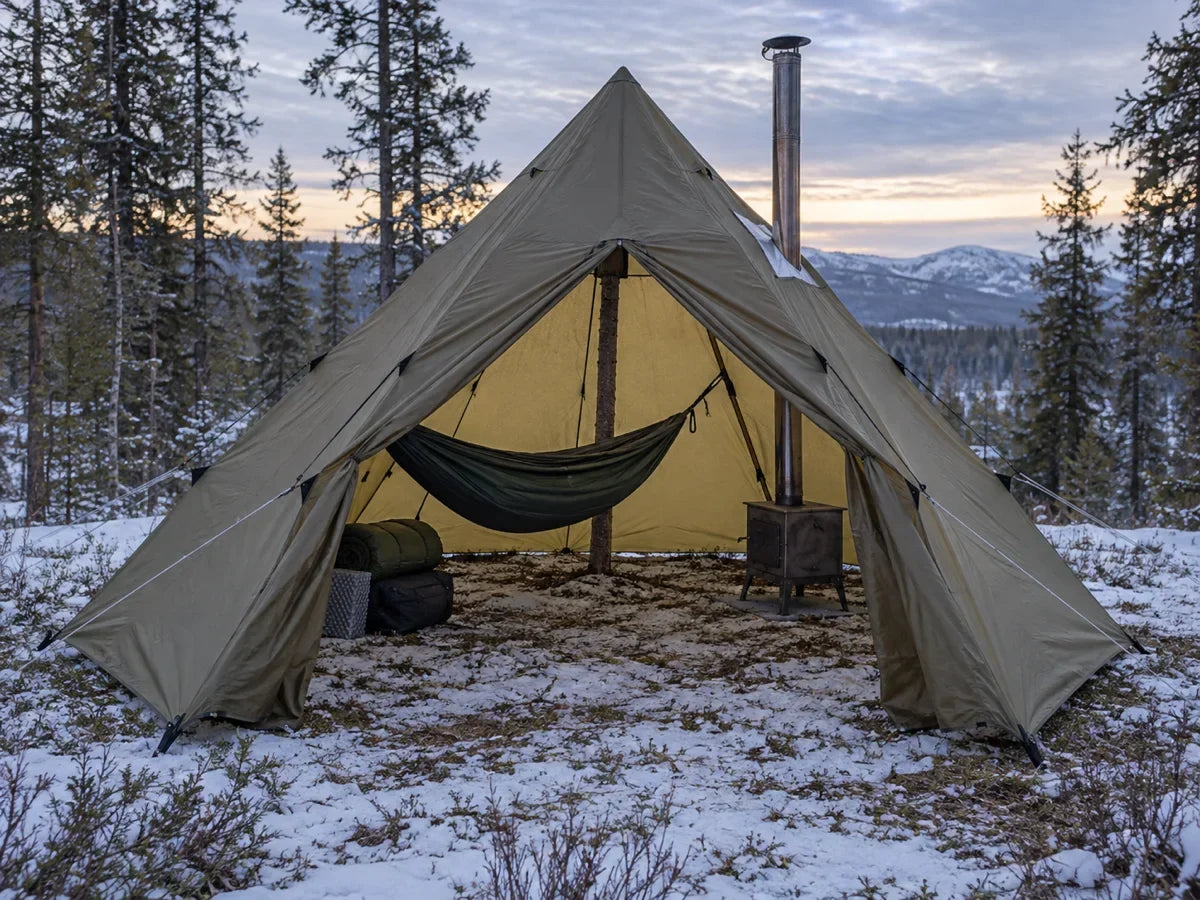

Un cubrecolchón de plumas para hamaca puede hacer que un sistema de descanso en hamaca sea más compacto, más cálido y más fácil de guardar.
También puede ser la primera mejora equivocada si el viaje es húmedo, el montaje del tarp es deficiente o la temperatura mínima nocturna no justifica la clasificación.
Esa es la decisión que la mayoría de las guías de compra omiten.
El plumón no es magia.
Funciona porque el relleno atrapa aire caliente debajo de la hamaca, y pierde esa ventaja cuando el relleno se aplasta, se empapa o queda expuesto al viento.
Uso un edredón inferior de plumas para hamaca solo después de que se cumplen tres comprobaciones: que el margen de temperatura tenga sentido, que el plan para mantener el relleno seco sea realista y que el ahorro de tamaño al empaquetarlo realmente importe para el viaje.
Si una de esas comprobaciones falla, primero soluciono el sistema de descanso.
Los datos de las páginas en directo del edredón inferior de plumón de Onewind le dan a este artículo dos anclajes concretos: un perfil de 32°F a 56°F / 850 g y un perfil de 0°F a 20°F / 1150 g.
La investigación de Textile Exchange también mantiene el punto del RDS en el carril correcto: el abastecimiento responsable es una norma ética, no una clasificación de abrigo.
Las preguntas de los usuarios de Reddit sobre los aislantes inferiores de plumón suelen girar en torno al mismo temor práctico: que sea cálido en seco no significa automáticamente que sea fácil de usar en viajes con humedad.

Lo que aprenderás
- ✓ Sabrás cuándo un underquilt de plumas para hamaca supera al aislamiento sintético.
- ✓ Sabrás cuándo un edredón sintético o un protector para edredón inferior es la opción más inteligente.
- ✓ Sabrá cómo elegir entre perfiles de underquilt de plumón para clima cálido y clima frío.
- ✓ Sabrá por qué una clasificación para temperaturas más frías no soluciona automáticamente las corrientes de aire en los hombros.
- ✓ Sabrás cómo mantener la capacidad de abrigo trabajando durante un auténtico viaje de una noche.
Esta guía no es otra lista de clasificación.
El objetivo es más simple.
Deberías poder mirar el pronóstico, un campamento y tu mochila, y decidir si el plumón pertenece a tu sistema de hamaca.
Respuesta rápida
Elige un cubrecolchón para hamaca de plumón cuando el viaje sea lo bastante seco, lo bastante frío y con limitaciones de espacio en la mochila como para que el plumón compense.
Elige un subedredón sintético, una mejor cobertura de la lona o un… protector de colcha inferior cuando la humedad y el viento son el mayor riesgo.
Si todavía estás construyendo tu sistema básico de hamaca, empieza por la compatibilidad entre la hamaca y el aislamiento inferior antes de fijarte en el tipo de relleno.
El Hamaca de camping Onewind de 11 pies Además, un edredón inferior correctamente combinado es un punto de decisión más útil que plumón frente a sintético por sí solo.
Acolchado inferior de plumón frente a acolchado inferior sintético
Edredones de plumón frente a edredones sintéticos

El plumón gana cuando el relleno se mantiene seco y sin comprimir.
Ese es todo el trato.
La razón por la que el plumón resulta eficiente es que sus agrupaciones atrapan aire con muy poco peso.
El poder de relleno es una de las formas en que las marcas describen ese potencial de volumen.
Las páginas en vivo de la colcha aislante inferior de Onewind indican plumón de pato FP800 tanto en los perfiles más cálidos como en los más fríos.
Esa especificación importa, pero solo si la colcha puede ganar volumen.
El aislamiento sintético es menos elegante en un paquete ajustado.
También es menos exigente cuando el viaje está húmedo, el usuario es novato o el equipo se manipula con brusquedad.
No considero el sintético como la versión barata del plumón.
Lo considero la versión más indulgente.
Para una ruta de senderismo con mochila en condiciones secas, el plumón puede ser la opción más limpia.
Para acampar en la temporada de hombro con humedad, cuando el edredón pueda recibir salpicaduras laterales, niebla o un embalaje descuidado, el sintético puede ser la primera opción más segura.
El marco de decisión de plumón en 3 partes

La primera comprobación es la temperatura.
No preguntes si el plumón es de primera calidad.
Pregunte si la valoración coincide con la hora más fría de la noche con margen.
La segunda comprobación es la humedad.
El plumón es un material excelente cuando está seco y un material malo si se descuida.
Si el edredón puede mojarse en la mochila, ser rociado por lluvia impulsada por el viento o almacenarse comprimido durante semanas, la ventaja del plumón se reduce.
La tercera comprobación es el volumen del paquete.
El plumón tiene más sentido cuando realmente te beneficias de la compresión.
Si acampas en coche a cinco yardas del vehículo, un equipo sintético ligeramente más voluminoso puede que no te perjudique.
Si llevas un equipo completo para hamaca, comida, agua y capas de ropa durante kilómetros, el tamaño del paquete se convierte en parte de la comodidad.
Mi regla es simple.
Si las tres comprobaciones se superan, el plumón es una opción sólida.
Si solo supera la comprobación de temperatura, revise la protección y la configuración del sistema antes de comprar.
Si ninguno supera, probablemente esté pagando por una ventaja que su viaje no utilizará.
Comprobación 1: Margen bajo durante la noche

Las clasificaciones de temperatura no son promesas.
Son puntos de partida.
Onewind Acolchado inferior de plumón para hamaca Solstice se indica a 32 °F a 56 °F, 850 g y 200 cm x 120 cm.
Ese perfil tiene sentido para viajes suaves y secos y para muchas noches de tres estaciones, donde las heladas no son la principal amenaza.
Onewind Underquilt de plumón para hamaca Equinox está clasificado de 0°F a 20°F, 1150 g y 200 cm x 120 cm.
Ese perfil tiene sentido cuando el pronóstico es más frío, menos predecible o lo bastante cercano al punto de congelación como para que merezca la pena llevar un margen extra.
La diferencia no es solo de 300 g.
Es la diferencia entre llevar un margen de seguridad más cálido y llevar un equipo más pequeño para clima templado.
Esos pesos medidos sacan a la luz el compromiso en lugar de ocultarlo detrás de la palabra premium.
Para la mayoría de los viajes, no elijo el edredón más cálido porque me parece más seguro.
Lo elijo cuando la hora más fría y realista de la noche lo exige.
Si la mínima es de 45 °F, el perfil de 0 °F a 20 °F puede proporcionar más calor del que el viaje necesita.
Si la temperatura mínima es de 25 °F con viento, el perfil de 32 °F a 56 °F no es el lugar adecuado para ahorrar peso.
Comprobación 2: Control Dry-Loft

El plumón requiere un diseño de volumen seco.
Ese plan empieza antes de que salgas de casa.
La colcha aislante inferior no debe ir suelta en una mochila donde una botella con fugas, una lona mojada o un bolsillo empapado por la tormenta puedan alcanzarla.
En el campamento, la lona debe proteger más que tu cabeza.
Una colcha aislante para hamaca cuelga debajo y alrededor de la hamaca, por lo que el viento puede empujar la humedad hacia el aislamiento exacto por el que pagaste para mantenerlo esponjado.
Por eso importan el montaje de la lona y la elección del lugar.
Si el viaje está mojado, observo las salpicaduras laterales, la dirección de la escorrentía y qué tan bajo puede quedar el toldo sin presionar la hamaca.
Si la colcha estará expuesta a salpicaduras, añado protección o elijo una configuración más tolerante.
Uno protector de colcha inferior No es un trofeo de calidez.
Es una capa de control de riesgo contra el viento, las salpicaduras y la suciedad.
El Estándar de Plumón Responsable es importante para el contexto de abastecimiento, y Onewind enumera plumón certificado por RDS en sus páginas activas de colchonetas aislantes inferiores de plumón.
RDS no hace que el plumón mojado sea más cálido.
Te dice algo diferente: dónde se sitúa éticamente el estándar de abastecimiento del plumón.
Mantén esas afirmaciones separadas.
Comprobación 3: ahorro de volumen del paquete

El tamaño plegado es donde un bajoquilt de plumón para hamaca empieza a sentirse diferente.
Un kit completo de hamaca puede crecer rápidamente.
Puede llevar hamaca, correas, lona, estacas, mosquitera, aislamiento superior, aislamiento inferior, ropa, comida, agua y artículos de reparación.
Si el cubrecolchón se comprime a un tamaño más pequeño, todo el equipo para dormir se vuelve más fácil de gestionar.
Eso no importa por igual para todos los campistas.
Me importa mucho más en una ruta de varios días que en una noche en un parque estatal.
Entonces, la pregunta no es simplemente «¿Es mejor el plumón?»
La mejor pregunta es: "¿Este viaje recompensará lo suficiente una colcha más pequeña y cálida como para justificar el cuidado?"
Si la respuesta es sí, Down merece estar en la lista de finalistas.
Si la respuesta es no, no dejes que un lenguaje premium te empuje a tomar una decisión frágil.
Solstice frente a Equinox: elige según el perfil del viaje
Onewind Equinox Hamaca Acolchado Inferior de Plumón | Prueba Real y Reseña Honesta

Estos dos perfiles resuelven problemas diferentes.
El perfil Solstice es la opción más limpia cuando el pronóstico se mantiene templado y te importa un kit de hamaca más pequeño y ligero.
El perfil Equinox es la opción más segura cuando el pronóstico es más frío, el lugar está expuesto o un mínimo no previsto podría convertirse en una noche larga.
No lo plantearía como principiante frente a experto.
Lo formularía como temperatura de activación frente a control en seco.
Si la temperatura mínima es suave pero el riesgo de lluvia es alto, el perfil Solstice todavía necesita un plan seco.
Si el nivel bajo es frío, pero el montaje de la lona es deficiente, el perfil Equinox aún necesita control del viento.
El plumón no sustituye la artesanía de campamento.
Lo recompensa.
El colección de mantas aislantes inferiores es útil aquí porque te recuerda que el plumón es una vía de aislamiento, no todo el sistema de la hamaca.
Escenario 1: Excursionismo con mochila en tres estaciones secas

Este es el escenario en el que abajo tiene más sentido evidente.
La ruta está seca.
El pronóstico es estable.
El paquete es ajustado.
El campamento tiene una buena separación entre árboles y suficiente cobertura de lona.
El campista ya entiende cómo mantener el aislante inferior centrado debajo de la hamaca cargada.
En esa configuración, las ventajas del plumón no son teóricas.
Aparecen en el paquete y debajo de la hamaca.
Si la mínima prevista se mantiene dentro del rango de clima templado, yo me fijaría primero en un perfil de plumón más ligero en lugar de llevar aislamiento para frío extremo solo porque suena más seguro.
Eso es especialmente cierto cuando el resto del sistema de descanso está bien ajustado: saco quilt superior o saco de dormir arriba, aislamiento inferior abajo, tarp preparado para el clima y almacenamiento seco resuelto.
Veredicto: Elige un bajoquilt de plumón para hamaca cuando la ruta esté seca, el pronóstico sea fiable y el volumen de la mochila importe.
Escenario 2: Acampada en temporada intermedia cerca del punto de congelación

La temporada intermedia castiga el optimismo.
Un pronóstico que parece suave a la hora de la cena puede sentirse muy diferente a las 4 a. m.
En ese momento, el perfil más frío empieza a tener sentido.
Si la temperatura mínima está cerca de la congelación, si el lugar está expuesto o si sabes que duermes con frío, no elegiría una colcha para clima templado solo para ahorrar peso.
Una colchoneta aislante inferior de hamaca de plumón sigue necesitando control de la humedad, pero aquí el margen de clasificación importa más.
El perfil Equinox de 0 °F a 20 °F ofrece más espacio para las noches frías que el perfil Solstice de 32 °F a 56 °F.
Eso no significa que sea adecuado para cada viaje.
Significa que los 300 g adicionales cumplen una función cuando el riesgo de temperatura es real.
Comprueba también la parte superior.
Una colcha inferior cálida bajo una capa superior débil todavía puede dejarte con frío.
Tu sistema de hamaca funciona como un sistema, no como un solo artículo estrella.
Si desea un contexto de compra más amplio después de esta decisión, compárelo con el mejor guía de subcolcha para hamaca.
Veredicto: Elige el perfil de colcha inferior de plumón más cálido cuando la temperatura mínima nocturna pueda acercarse al punto de congelación o estar por debajo y el plan de loft seco sea sólido.
Escenario 3: Viajes húmedos, con alta humedad o propensos a salpicaduras

La lluvia me hace ir más despacio.
Los viajes húmedos no prohíben automáticamente el plumón.
Exigen un plan mejor.
Pregunta cómo se mantendrá seco el subquilt en la mochila.
Pregunte si la lona puede bloquear la lluvia lateral.
Pregunte si la hamaca colgará por encima de las salpicaduras y la escorrentía.
Pregunte si puede airear el edredón antes de guardarlo por la mañana.
Si esas respuestas son débiles, el plumón puede no ser la primera mejora adecuada.
Un aislante inferior sintético, una mejor configuración de lona o un protector de aislante inferior pueden ser más racionales que pagar por plumón y luego exponerlo.
Para regiones húmedas, también pienso en la duración del viaje.
Una noche húmeda es más fácil de gestionar que varias mañanas húmedas con tiempo de secado limitado.
El plumón sigue siendo útil para campistas experimentados que manejan la humedad con cuidado.
Es menos tolerante con los principiantes que empacan rápido, cuelgan tarde y se despiertan dentro de la condensación.
Veredicto: Utiliza plumón en viajes propensos a la humedad solo cuando puedas proteger el relleno del contacto con la humedad del equipaje, la lluvia lateral, las salpicaduras y las mañanas húmedas repetidas.
Escenario 4: Durmiente frío con corrientes de aire

Los durmientes frioleros suelen culpar primero a la clasificación.
A veces tienen razón.
A menudo no lo están.
Un edredón aislante inferior con una clasificación para temperaturas más frías no solucionará un hueco de cinco centímetros en los hombros.
No reparará un canal de extremo que tenga fugas de aire.
No evitará que el viento golpee el edredón porque la lona está montada demasiado alta.
Antes de comprar la opción de plumón para clima más frío, realiza la misma revisión de configuración del artículo anterior sobre el aislante inferior: longitud, envoltura lateral, sellado de los extremos, tensión de la suspensión y protección contra el viento.
Si necesita una comparación más amplia antes de esta decisión de calificación, use el mejor guía de subcolcha para hamaca.
Solo después de que el ajuste sea adecuado debes decidir si la calificación es demasiado adecuada para clima cálido para el viaje.
Esto evita un error costoso.
No quieres comprar más plumón cuando el verdadero problema es una suspensión floja o una ruta expuesta al viento.
Veredicto: Ajusta el calce y el viento primero, luego mejora la valoración si el pronóstico sigue superando el saco de dormir.
Escenario 5: Principiante con un saco de dormir

Un saco de dormir no es inútil en una hamaca.
Simplemente está haciendo un trabajo diferente.
Encima de ti, puede ser una capa superior.
Debajo de ti, su aislamiento se comprime entre tu cuerpo y la tela de la hamaca.
Por eso los principiantes se despiertan con la espalda fría incluso al usar un saco que se sentía cálido en una tienda de campaña.
Un edredón inferior de plumón para hamaca soluciona el calor de la parte inferior solo si el resto del montaje está listo.
Si no has aprendido la curvatura de la hamaca, la posición diagonal, el montaje de la lona y la colocación del aislante inferior, comprar primero plumón puede ocultar la verdadera lección.
Comience con una base de hamaca consistente.
Luego añade aislamiento inferior.
Luego, decide si el tamaño de empaquetado y la relación calor-peso del plumón valen la pena.
Onewind Hamaca de camping de 11 pies es un ancla lógica del sistema porque puedes probar la misma forma de hamaca cargada cada vez.
Veredicto: Los principiantes deben resolver la función del aislamiento inferior y el ajuste antes de pagar extra por el plumón.
Errores comunes con un aislante inferior para hamaca de plumón

Todos los errores comparten un patrón.
Tratan el edredón inferior como una solución independiente.
No lo es.
Es un componente de un sistema de descanso colgante.
El sistema debe proteger el aislamiento, mantener el sellado, bloquear el viento y ajustarse a la temperatura mínima real durante la noche.
Cuando eso sucede, el plumón pierde rendimiento.
Cuando no lo hace, el plumón se convierte en una forma cara de aprender los conceptos básicos del aislamiento para hamacas.
Error 1: Comprar la colcha más cálida para cada viaje

La clasificación más fría no es automáticamente la mejor clasificación.
Puede ser más voluminoso, pesado y demasiado cálido para noches templadas.
Si el pronóstico es de 50 °F, un sobrecolchón para frío intenso puede resolver un problema que no tienes.
Usa el perfil para clima frío cuando el riesgo de temperatura lo justifique.
Utiliza el perfil de clima templado cuando el viaje se mantenga de forma segura dentro de ese rango.
La pregunta más inteligente no es "¿Qué edredón es más cálido?"
¿Cuál edredón ofrece suficiente margen sin llevar aislamiento innecesario?
Esa pregunta mantiene el artículo honesto.
También mantiene tu mochila auténtica.
Error 2: Olvidar que el relleno necesita un plan de almacenamiento

El plumón no debe permanecer comprimido después del viaje.
Debe volver a casa seco, airearse y guardarse suelto.
Ese hábito importa porque el aislamiento es el valor por el que pagaste.
Si la colcha permanece rellena durante semanas, el sistema empieza a perder la ventaja exacta que hacía atractivo el plumón.
Lo mismo se aplica durante el viaje.
Utilice un método de empaquetado en seco.
Separe la lona mojada de la colcha seca.
No metas una colcha aislante de plumón húmeda en una mochila y esperes que se comporte como una manta sintética.
Esto no es difícil.
Solo necesita ser deliberado.
Error 3: Ignorar el viento debajo de la hamaca

El viento puede hacer que un buen underquilt se sienta insuficiente.
Elimina el aire cálido del área del edredón y deja al descubierto huecos que no habías notado en casa.
Una clasificación más baja de temperatura puede ayudar, pero la inclinación de la lona y la protección de la colcha suelen ayudar primero.
Baje el toldo cuando se espere viento.
Comprueba la cobertura lateral.
Considere un protector de colcha inferior si la colcha queda expuesta.
Esto es especialmente importante para el plumón, porque el poder de relleno solo es útil cuando el aire cálido que lo rodea no se reemplaza constantemente por aire frío en movimiento.
Si solo sientes frío cuando empieza la brisa, no culpes inmediatamente al relleno.
Encuentra el flujo de aire.
Error 4: Usar RDS como una afirmación de calidez

RDS es el contexto de origen.
No es una clasificación de temperatura.
Onewind enumera plumón certificado por el Estándar de Pluma Responsable en las páginas en vivo de los underquilts de plumón, y eso es información útil para los compradores que se preocupan por el origen de los materiales.
No significa que el edredón será más cálido cuando esté mojado.
No significa que puedas ignorar la cobertura de la lona.
No sustituye el poder de relleno, el tamaño, la construcción, el ajuste ni la planificación del viaje.
Mantén las afirmaciones sobre abastecimiento ético en su justo lugar.
Mantén las afirmaciones de rendimiento en su justo lugar.
Esa separación hace que la decisión de compra sea más clara.
Lista final de embalaje

Usa plumón cuando se ajuste al viaje.
Utiliza otra cosa cuando el viaje se ponga duro.
Esa es toda la decisión.
Para mochilear en seco, un edredón inferior de plumón para hamaca puede ser una de las mejoras más elegantes en un sistema de descanso en hamaca.
Para excursiones húmedas para principiantes, puede ser un atajo frágil.
La respuesta correcta no es el relleno más premium.
La respuesta correcta es el edredón que se mantiene esponjoso, sellado y adaptado a la noche que realmente estás durmiendo.
Si quieres la ruta más ligera para clima cálido, compara el perfil de 32 °F a 56 °F de Solstice.
Si desea la ruta con un margen de seguridad más frío, compare el perfil Equinox de 0 °F con el de 20 °F.
Si no está seguro de que el sistema esté listo, ajuste primero el ajuste de la hamaca, la lona y el aislante inferior.

Compare the cold-weather down underquilt
Shop Now →