
The most-shared hammock-knot guides list nine knots and let you guess which one to learn, and not one of them tells you the fact that decides whether your knot holds: the cord.
A taut-line hitch that grips perfectly on cheap nylon will quietly slip on slick Amsteel, and you find out at 2 a.m.
I read through the knot listicles, the manufacturer guides, and a stack of threads on Reddit's r/hammockcamping, and the same two gaps showed up every time.
Nobody groups the knots by what they actually do, and nobody warns you that the cord under the knot changes the answer.
So this guide does both.
You get a three-question decision instead of nine knots to memorize, and by the end you will know the one or two knots your setup needs, when your cord rules a knot out, and when you should stop tying knots altogether.
What You'll Learn
I built this around a decision, not a knot gallery, because you do not need nine knots, you need the right one for your job and your cord.
Here is what each part settles.
Quick Answer
You do not need to learn nine knots.
You need to match one knot to the job in front of you and the cord in your hand, and know when to stop tying.
The rest of this guide explains why each call is what it is.
The Anchor Knot Decision

I stopped trying to memorize knots the day I realized the choice is three questions, not a list.
Ask them in order and the nine-knot list collapses to the one or two you actually need.
Everything below is these three questions worked out in detail, plus two safety rules you do not break.
Question 1: What Is the Job

Knots sort cleanly by what they do, and most people only ever need one or two.
Group them by job and the choice gets obvious.
The bowline is the one knot to learn first if you learn only one.
According to The Bear Essentials' knot guide it does not slip when loaded and unties easily when you dress it neatly, which is exactly what you want holding your body weight.
On Reddit, a beginner in r/hammockcamping posted that the only thing between them and their first trip was learning to tie actual knots, and the top replies did not send them to a nine-knot chart.
They found that the fix was smaller than the fear.
They said two knots cover everything, a bowline and a taut-line hitch, from the tarp to strapping a kayak to a roof rack.
That is the reframe the listicles miss.
One knot in that table earns a warning before you rely on it.
The double fisherman's joins cord into a loop and holds superbly, but My Open Country notes it jams so hard after a loaded night that you may not get it undone in the morning.
A water knot on webbing is the friendlier way to join two lines, and for the loop on your hammock end you rarely tie either yourself because it comes pre-spliced.
Verdict: if you learn only two knots, make them the bowline and the taut-line hitch, and add the marlin spike hitch when you move to a toggle-and-whoopie setup.
Question 2: What Is the Cord
Hammock Becket Hitch (Derek Hansen)

This is the fact the ranking guides leave out, and it is the one that drops people.
A friction knot only works on grippy cord.
The taut-line hitch and the becket hitch hold beautifully on nylon and polyester, because the fibers grab.
On slick Amsteel, Dyneema, or Spectra those same knots creep and slip under load, because there is nothing for the wraps to bite.
Derek Hansen, who writes The Ultimate Hang and is the closest thing hammock camping has to an authority, is blunt about it.
He warns that thin smooth cordage like Amsteel, Spectra, or Dyneema is prone to slipping, and that you must not run a becket hitch with Dyneema on both sides.
The Bear Essentials guide says the same about the taut-line hitch creeping on UHMWPE and Amsteel.
The reason is the fiber itself.
UHMWPE, the material behind Amsteel and Dyneema, has a very low coefficient of friction by design, which is what lets it be slick and strong at once, and that same slickness is what a friction knot cannot grip.
The Ultimate Hang's advice is to test any suspension for slippage before you trust it with body weight, loading it a few inches off the ground and watching whether the knot moves.
If it creeps at ankle height in the yard, it will creep at hang height in the dark.
So the rule is simple.
Grippy cord, tie the knot.
Slick cord, stop tying friction knots and use a spliced loop or hardware instead.
Verdict: match the knot to the cord before you trust it, and on any slick Dyneema or Amsteel line you should default to a splice or a buckle rather than a friction knot.
Question 3: Should You Be Tying at All

Knots are the lightest and cheapest way to hang, and for a minimalist they are the right answer.
They are not always the smart answer.
The knotless hammock suspension systems exist for exactly the situations where a knot is the wrong tool.
The Reddit consensus in r/hammockcamping is blunter than any product page: a lot of folks work way too hard on suspension.
One veteran described cycling through hardware, whoopie slings, adjustable ropes, and every kind of toggle before settling, three seasons deep, on a plain becket hitch to the continuous loops because it just works.
Here is how the real options compare, with weights and capacities as ranges because sources measure them differently.
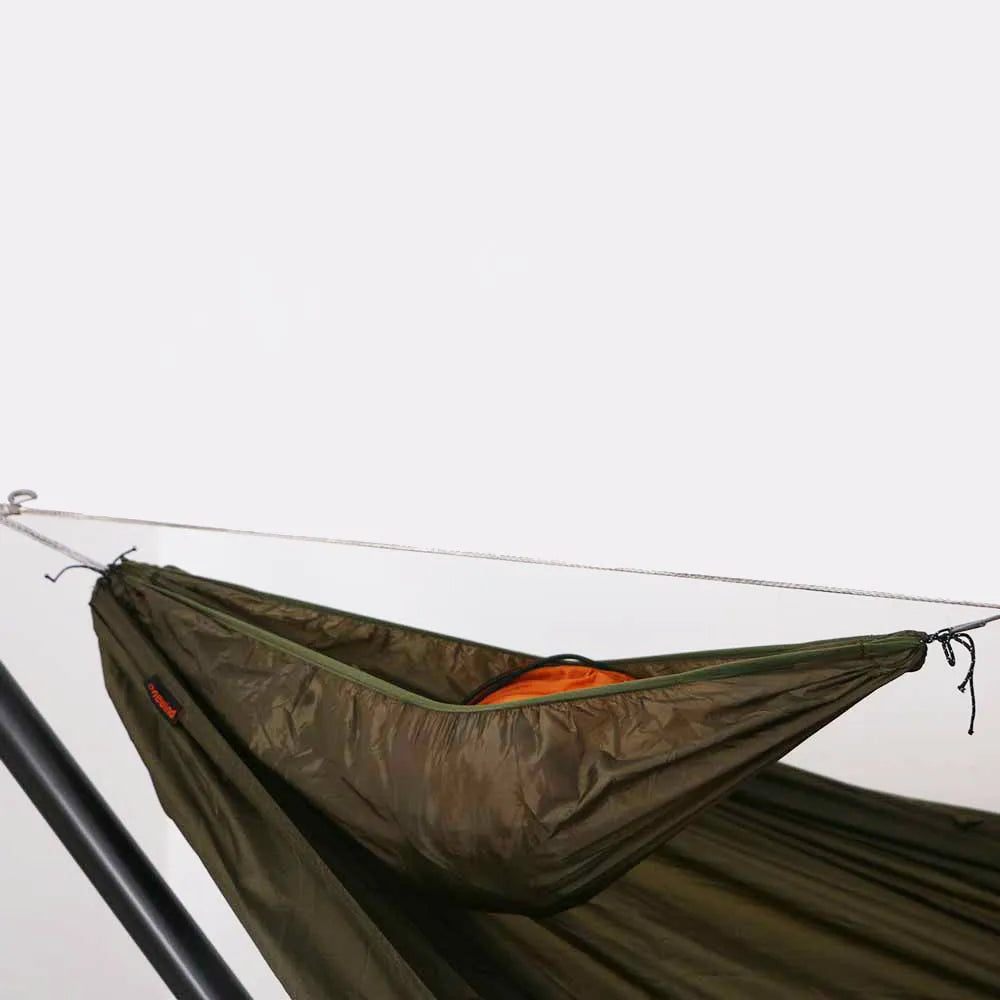
The hinge of this whole decision is the continuous loop, the short spliced loop most gathered-end hammocks already carry on each end.
You do not tie it, you tie or clip to it.
Lark's-head a ring, seat a whoopie sling, or clip a carabiner to it, and your body-weight knot count drops to zero or one.
Nearly every modern gathered-end hammock ships with continuous loops for exactly this reason, according to both Greenbelly and The Ultimate Hang.
They turn the hardest step, learning a knot you trust with your weight, into a clip-and-go, which is why the veterans who tried everything keep coming back to them.
If you want the lightest adjustable knotless hang, a whoopie sling to that loop is about four ounces and dials in infinitely.
If you camp in cold and wet or wear gloves, a cinch buckle is the honest pick even though it is heavier, because you can work it without bare hands.
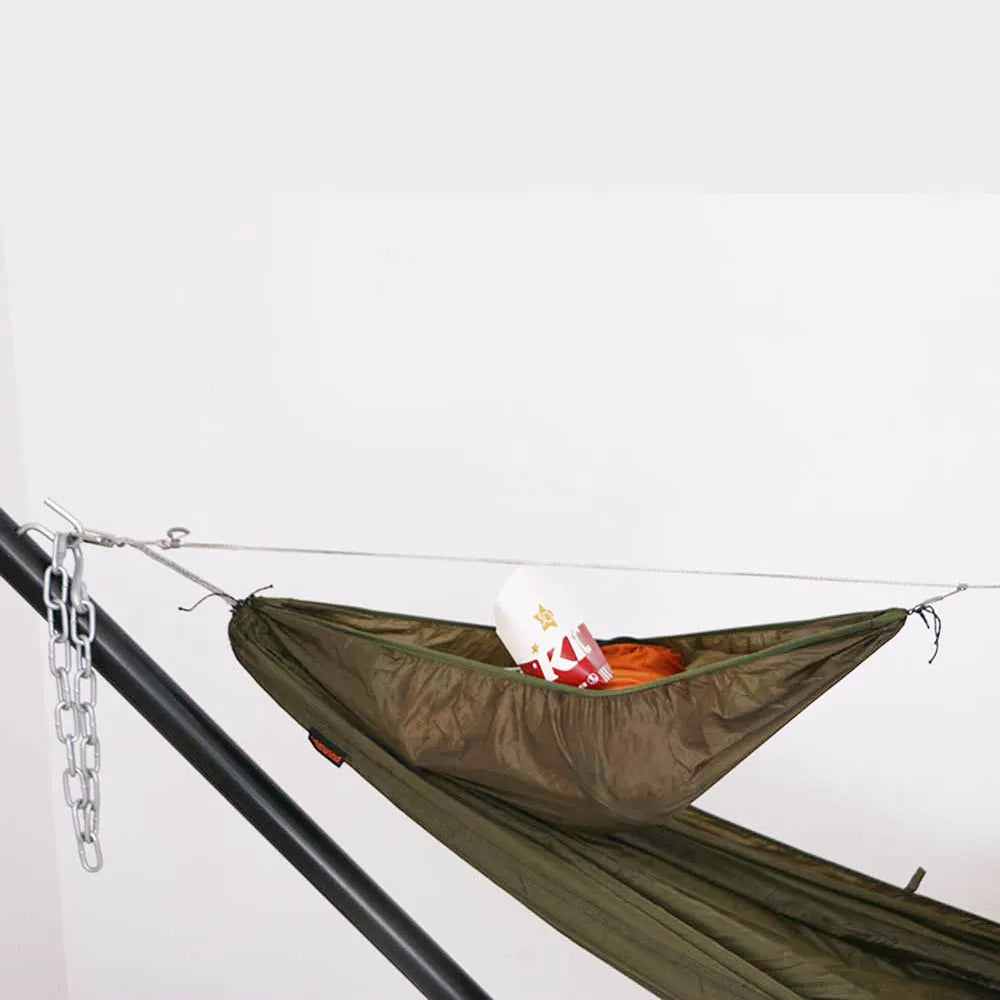
If you have never hung before or you are setting up for a group, a daisy chain is the fastest thing with zero learning curve.
Verdict: buy the buckle when weather and gloves win, choose the whoopie when weight wins, and use the daisy chain when a zero learning curve wins; tie direct knots only when saving every ounce and dollar matters most.
Two Rules You Don't Break
Tree Hugger, Marlin Spike, Toggle for Hammock Suspension

Most knot mistakes just cost you a saggy hang.
Two of them drop you on the ground, so they get their own section.
The first is the square knot.
My Open Country's guide states it can come undone even when tied correctly and should never be used in any load-bearing situation, and that is the clearest never-do-this in all the research.
A square knot looks secure because it sits flat and neat, which is exactly why it fools people.
Under the shifting, uneven load of a body rolling in a hammock it can work itself loose, and My Open Country's data puts it firmly in the never-load column.
Do not trust a square knot, also called a reef knot, with your body weight, ever.
The second is the toggle.
The marlin spike hitch plus a toggle is the most common real-world hammock attachment, and it is genuinely good, but its physics are counterintuitive.
Per the Wikipedia entry on the marlinspike hitch, the knot is not stable unless it is loaded, must be loaded only from the standing side, and will capsize into an overhand noose if you load it the wrong way.
The rule every source repeats is that you hang on the knot, not the toggle.
The load should squeeze the toggle against the knot, not try to snap the toggle in half.
On Reddit, one hanger hung from a found stick pushed through the loop, and the top reply was blunt: it is all fun and games until that twig breaks and your tailbone too.
A titanium or hardwood toggle costs a few dollars and removes that failure mode entirely.
Use a proper metal or hardwood toggle, seat it against the knot, and the marlin spike falls apart the instant you unload it, which is exactly why teardown is so fast.
Whatever you tie or clip, a wide webbing strap goes against the bark first, because bare rope and knots against a trunk damage the tree.
Scenario 1: The Absolute Beginner

You want to hang tonight and you do not want a project.
Learn two knots and stop there.
Tie a wide tree strap around the trunk, clip a carabiner, and tie a bowline in your suspension line to that carabiner for the fixed end.
Use a taut-line hitch on the other end if your cord is grippy nylon, so you can slide it to adjust.
If tying knots at all sounds like too much, skip straight to a cinch buckle or a daisy chain and clip in.
Verdict: for most beginners, a bowline plus a taut-line hitch is the whole skill set, and if you would rather not tie, a buckle or daisy chain gets you hanging with zero knots.
Scenario 2: Dialing In an Adjustable Hang

Cord stretches overnight and a hang that felt right at dusk sags by midnight, so you want to re-tension without retying.
On grippy nylon, a taut-line hitch slides and holds, and a becket hitch gives you a quick adjustable strap-to-loop connection.
On slick Amsteel or Dyneema, both of those creep, so the adjustable answer is a whoopie sling, whose Amsteel bury tightens like a Chinese finger trap as your weight pulls it.
Verdict: choose a taut-line or becket hitch for adjustability only on grippy cord; on slick line, use a whoopie sling instead of fighting a knot that will slip.
Scenario 3: Slick Amsteel or Dyneema Line

You bought thin high-strength line because it is light and strong, and now your knots will not hold.
This is not your technique, it is physics.
Slick UHMWPE fibers give a friction knot nothing to bite, so the taut-line and becket hitches creep under load.
The answer is to stop asking the knot to grip and let a splice or hardware do the holding.
A spliced continuous loop, a whoopie sling, or a buckle all work with slick line because they trap it rather than pinch it.
Verdict: on slick Amsteel or Dyneema you should not rely on a friction knot at all; switch to a spliced loop or a buckle and keep the one knot you do tie, like a bowline, to a spot where it is dressed and backed up.
Scenario 4: The Structural Ridgeline or Tarp

Here the knot holds a ridgeline or a tarp, not your body, so the stakes and the rules change.
Adjustability matters more than raw strength, and a slip is an annoyance, not an injury.
A taut-line hitch, a clove hitch, or a becket hitch all work for a ridgeline, and a marlin spike can seat toggles for a tarp.
On Reddit, hangers reach for a prusik here, and that is the right context for it.
One user described using a prusik on the rainfly specifically because it is an easily adjustable, non-weight-bearing knot, and that is the honest limit: the prusik is a ridgeline and tarp knot, not a suspension knot you trust with your body.
For a fixed-length structural ridgeline, an adjustable structural ridgeline takes the knot out of the equation entirely.
Verdict: for a ridgeline or tarp, use a taut-line, clove, or becket hitch, or a prusik for adjustable non-load tension, but never carry the prusik over to body-weight suspension.
Scenario 5: Cold, Wet, or Gloved Hands

At 20 degrees with wet gloves, fine knot work is miserable and slow, and that is when mistakes happen.
This is the scenario where knots are simply the wrong tool.
A cinch buckle or a daisy chain lets you set up without taking your gloves off, which is why the winter and group crowd swears by them.
On Reddit, a hanger reported they run hardware specifically so they can set up without removing their gloves when it is cold, and called it a genuine comfort upgrade.
Verdict: for cold, wet, or gloved hands, choose a cinch buckle or daisy chain over any knot, and accept the extra few ounces as the price of setting up with numb fingers.
Scenario 6: Fast One-Handed Teardown

You break camp in the rain and you want the hang to drop in seconds without picking at a loaded knot.
Quick-release ties are built for exactly this.
A marlin spike hitch with a toggle collapses the instant you lift your weight off, a falconer's knot releases with one pull of the free end, and a shoelace-style bow around the tree unties just as fast.
Because the marlin spike is only stable while loaded, teardown is nearly instant, which is its whole appeal.
Verdict: for fast teardown, prefer a marlin spike toggle or a falconer's knot, and avoid knots like the double fisherman's that jam after a loaded night.
Scenario 7: You Already Have Continuous Loops

Most gathered-end hammocks ship with a short spliced loop on each end, and a lot of owners never realize what it is for.
That loop is your shortcut to knotless.
You do not tie the continuous loop, you tie or clip to it, so you are one lark's head away from a whoopie sling, a ring, or a carabiner.
For the lightest possible hang, a becket hitch straight to the continuous loops is what several Reddit veterans settled on after trying everything else.
Verdict: if your hammock already has continuous loops, use them; lark's-head a whoopie sling or clip a carabiner and your body-weight knot count drops to zero or one.
Scenario 8: The Ultralight Minimalist

You count grams and you want the fewest, lightest parts that still hold.
Direct knots win on weight at around two ounces, less than any hardware.
A becket hitch from the suspension line straight to the continuous loops, with a wide strap at the tree, is about as light as a safe hang gets.
The catch is that this only works on cord the becket hitch can grip, so a minimalist running slick Amsteel still needs a splice rather than a knot on both sides.
Pair a light hammock like the 11-foot ultralight single with a continuous loop and a becket hitch and you are carrying almost nothing.
Verdict: for the ultralight minimalist, a becket hitch to continuous loops is the lightest safe hang, as long as your cord is grippy enough to hold it.
Common Mistakes

The first mistake is memorizing knots you will never use, when the job-based answer is one or two.
The second is ignoring the cord, tying a taut-line on slick Amsteel and wondering why it creeps.
The third is trusting a square knot with body weight, the one knot the sources agree you must never load.
The fourth is hanging on the toggle instead of the knot, which snaps sticks and bruises tailbones.
The fifth is skipping the tree strap and putting bare rope or a knot against the bark, which damages the tree and, on many public lands, breaks the rules.
The sixth is fighting knots in cold and wet when a buckle would have you hung in seconds.
The Quick Decision Checklist
Run this before you trust any hang with your weight.
Match the knot to the job, check it against the cord, and know when to stop tying.
Do that and you never again stand under a tree at dusk wondering which of nine knots is the one that holds.

Shop Hammock Continuous Loops
Shop Now →