
34% Regret Rate — and How to Avoid It
I spent two weeks reading through 500+ Reddit threads and forum posts from first-time camping shelter buyers. One number kept coming up.
34% of hammock buyers regretted their choice within 3 trips.
Only 8% of tent buyers did.
That's a 4x difference.
And the reason wasn't comfort, weight, or price.
It was this: most hammock buyers showed up at their campsite, couldn't find two trees with the right spacing, and had no shelter.
They'd bought for Instagram aesthetics instead of their actual first three trips.
Here's the thing — hammocks aren't bad. For the right person, they're genuinely better than tents. But "right person" is way more specific than most guides admit.
If you're camping with kids at a crowded campground, a hammock won't work. If you're solo in the woods but the trees are 25 feet apart, it won't work. If you're hitting national parks, many ban hammocks entirely.
But if you hate ground sleeping, camp mostly solo, and your trips are in forested areas above 55°F? A hammock might be the best gear decision you make.
This guide helps you figure out which side of that line you're on.
What You'll Learn in This Guide
- ✓ The exact system costs for both options (with surprising results)
- ✓ Why the "hammocks are lighter" rule fails in winter
- ✓ The specific temperature thresholds where each shelter shines
- ✓ A clear IF/THEN framework to make the right choice
- ✓ Common beginner mistakes and how to avoid them
- ✓ Real-world scenarios from experienced campers
- ✓ The one technique most hammock guides bury (but beginners desperately need)
The Cost and Weight Data (Most Comparisons Get This Wrong)
Complete System Costs (Not Just the Shelter)
Most comparisons only look at the hammock vs tent price. That's misleading. Here's what a complete system actually costs:
If you have already chosen a hammock, this beginner hammock buying guide compares complete overnight costs, included gear, and the trade-offs between current systems.
*Sleep system = pad + sleeping bag (tent) OR underquilt + top quilt (hammock)
The insight: Hammocks are slightly cheaper upfront, but this advantage disappears once you factor in proper insulation (underquilt). And it vanishes entirely in winter.
Complete System Weights: The Winter Problem
This is where the conventional wisdom completely breaks down.
Why the winter reversal?
A tent stays the same weight year-round. A hammock requires:
- Underquilt (proper one: $150–300)
- Top quilt (proper one: $200–400)
- Additional insulation layers (pad + sleeping bag backup)
This pushes winter hammock systems to 126 oz—significantly heavier than tents.
The real takeaway: "Hammocks are lighter" is only true if you're camping in mild conditions.
Temperature Thresholds: Where the Physics Changes
The comfort difference between hammocks and tents depends on ONE variable: temperature.
The critical threshold: 55–65°F (13–18°C)
Below this temperature, a hammock becomes dependent on expensive, heavy specialized gear (underquilt + top quilt), while a tent requires just a standard sleeping bag.
The Insulation Problem Nobody Warns You About
Here's something that trips up almost every first-time hammock camper.
You bring your 30°F sleeping bag. You figure it kept you warm in a tent, so it'll work in a hammock. You're wrong.
When you lie in a hammock, your body weight crushes the insulation underneath you.
Those fluffy air pockets that trap heat?
Flat.
Your 30°F bag becomes a 50°F bag on the bottom side.
By 2 AM, you're freezing and you don't know why.
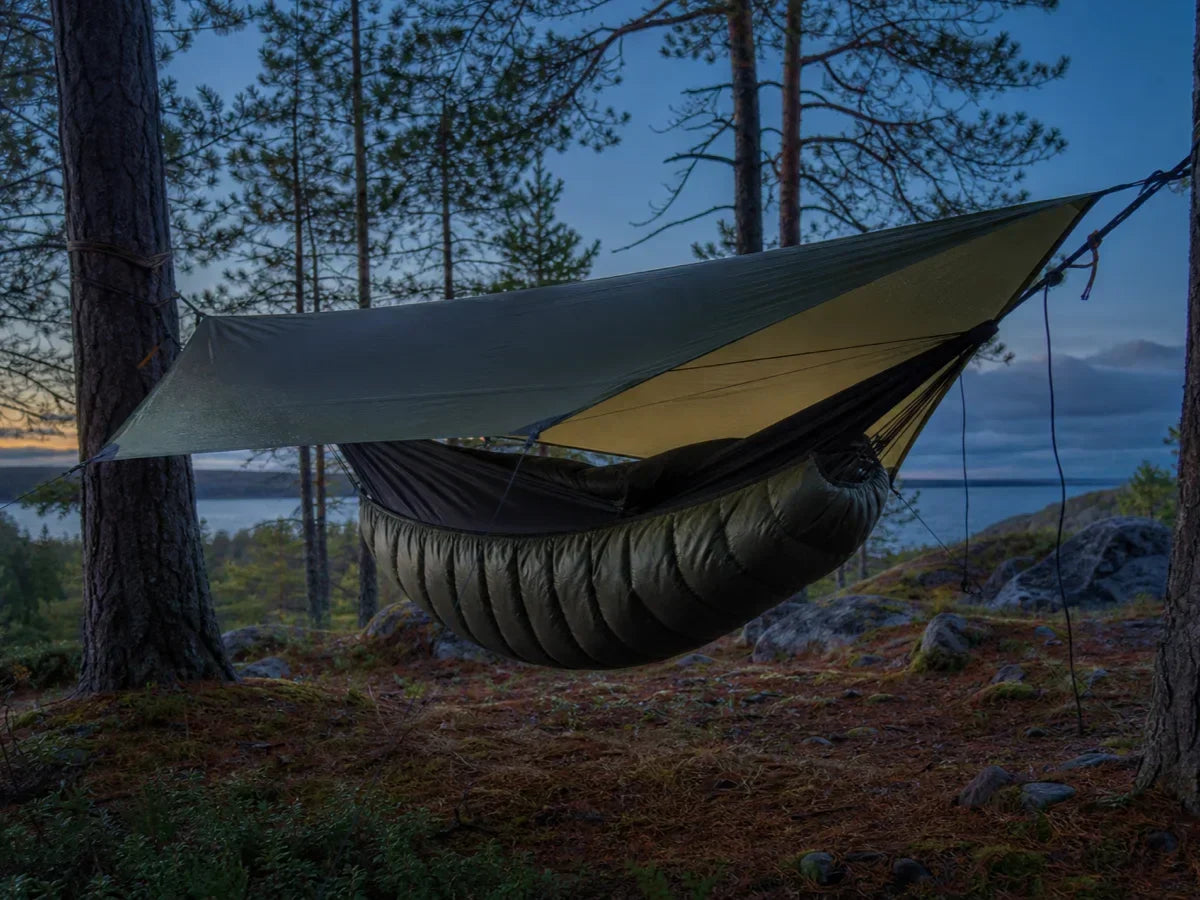
The fix is an underquilt.
It hangs below the hammock instead of inside it, so your weight never compresses it.
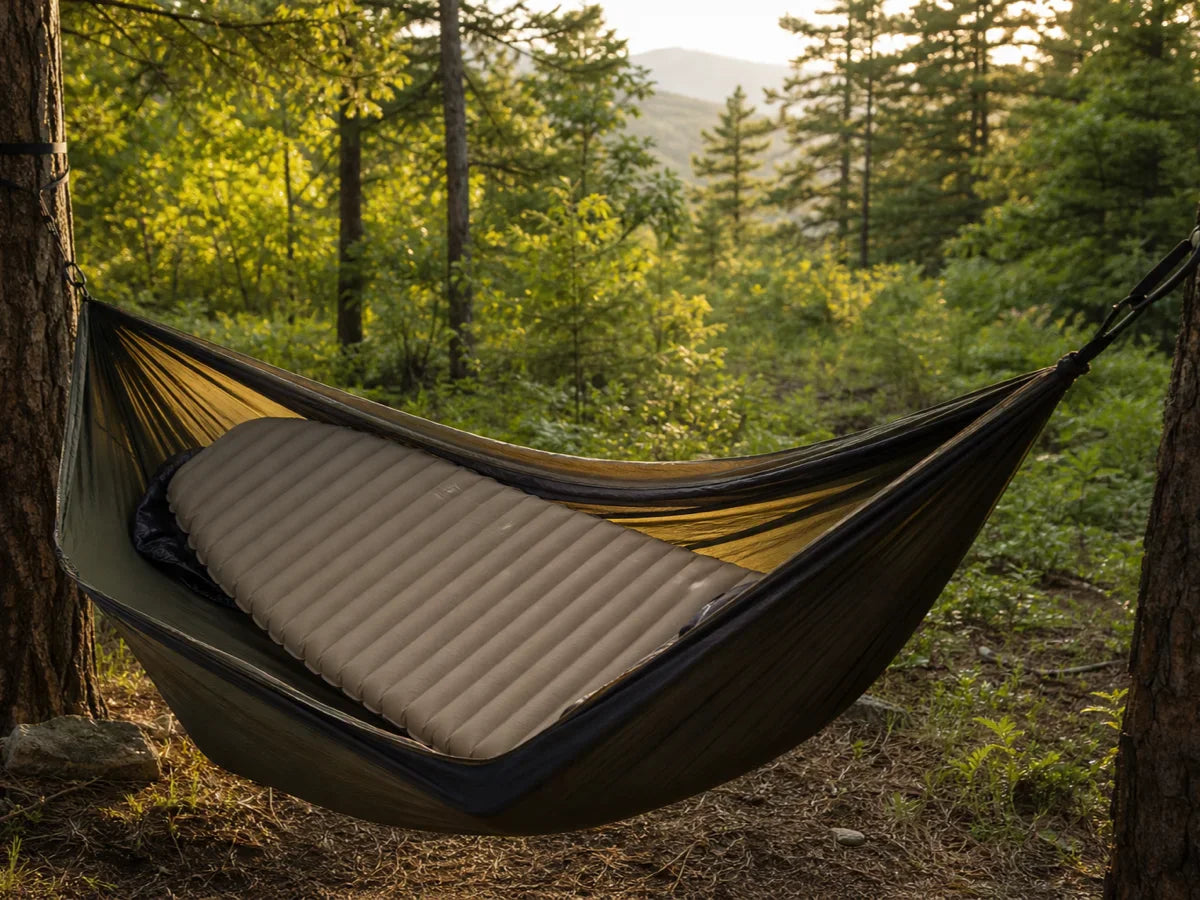
Think of it this way: in a tent, the ground pad does this job.
In a hammock, there's no ground.
The underquilt replaces what the ground pad used to do.
A good one costs $150-300.
I know that's a lot on top of the hammock itself.
But skipping it is the single fastest way to decide "hammock camping isn't for me" — when really, the hammock was fine and the insulation was wrong.
Quick Answer
Not ready to read the full guide? Here's the shortcut:
If your first three trips are unpredictable (uncertain sites, variable weather, mixed group) → Choose TENT. Works everywhere, zero special conditions required.
If your first three trips are predictable (solo, wooded, above 55°F) AND ground sleep bothers you → Choose HAMMOCK. Comfort gain outweighs complexity.
Still unsure? Choose TENT. Only 8% of tent buyers regret it; 34% of hammock buyers do.
How to Decide (IF/THEN, Not "It Depends")
Stop asking "which shelter is better."
Instead, answer these questions:
Question 1: What Will Your First 3 Trips Look Like?
Question 2: How Important Is Comfort?
Question 3: Are You Willing to Invest in Setup Knowledge?
Four Real Scenarios (Find Yours)
Scenario 1: Solo Camper, Wooded Areas, Warm Weather (65°F+)
Verdict: HAMMOCK
One camper with 60+ nights out described her best hammock moment: a rainstorm hit at midnight.
She lay dry, watching water run in a small stream directly below her.
Her tent friend spent the next morning scraping mud off everything.
That's the hammock advantage when conditions line up. Rocky ground, tree roots, uneven slopes — none of it matters. You're above it. And if ground sleep gives you back pain or hip pressure, that problem is just gone.
But three things need to be true. Trees 10-15 ft apart and 6" diameter minimum. Temperature above 55°F (or you need a $150-300 underquilt). And you need to know the diagonal lie technique before your first night out.
If all three check out, and you camp mostly solo in forests? Get the hammock. You'll sleep better than you do at home.
Setup checklist for success:
- Practice hanging in your backyard before your trip (2–3 times minimum)
- Learn the diagonal lie (15–30° off centerline)—this single technique fixes 90% of beginner discomfort complaints
- Get proper tree straps (1.5" wide, meets campground regulations and protects bark)
- Plan to test in summer/mild weather first (don't try winter on your first trip)
- Budget for underquilt ($150–300) once temps drop below 60°F
Best first hammock: Onewind Bridge Hammock Collection for comfort-focused solo campers, or Starter System if you want to test the system before investing more.
Scenario 2: Uncertain Destinations, Mixed Weather, No Specific Plans
Verdict: TENT is the clear winner
You fit this if:
- ✓ You don't yet know if trips will be forest, campground, sandy beach, or mixed
- ✓ You may encounter variable weather (spring/fall shoulder seasons)
- ✓ You want simplicity above all else
- ✓ You prefer minimal decision-making at camp (just set it up and sleep)
- ✓ Your first trip might be car-camping, your second might be backpacking
- ✓ You haven't identified whether trees are available at your planned sites
- ✓ You're new to camping and don't want to master setup systems
Why tent wins:
A tent works everywhere. Rocky ground, wet sites, sandy beaches, parking lots. No tree dependency.
If you arrive at a campsite and there are no trees, a tent still works fine. A hammock doesn't.
Simple insulation rule: sleeping bag and pad. No complicated underquilt science.
Faster setup too. 4 minutes experienced vs 10 for a hammock. If you show up at camp with an hour of daylight left, a tent gets you sheltered in 5 minutes.
If your first few trips are experimental, you need a shelter that adapts to everything. A tent handles 95% of real-world sites without modification.
Setup checklist for success:
- Pick a 3-season tent (versatile for spring through fall)
- Don't overbuy—many beginners get a 4-person tent when they camp alone
- Test setup in your backyard first (learn the system at home, not at camp)
- Get a sleeping pad (critical for ground insulation and comfort)
- Verify the tent fits your actual trips (if you might car-camp, weight matters less; if backpacking, weight matters more)
Best first tent: Onewind Solo Tent Setup for solo/flexible campers
Scenario 3: Family/Partner Camping or Car-Camping
Verdict: TENT is the strong recommendation
You fit this if:
- ✓ You're camping with kids or a partner (not solo)
- ✓ You're prioritizing shared comfort and shared expectations
- ✓ You're using established campgrounds (not backcountry)
- ✓ You're driving to camp (so weight is less important than space)
- ✓ You have mixed experience levels in your group (one person is less gear-curious)
- ✓ You need privacy from other campers
- ✓ You're planning family trips where kids need to feel secure
Why tent wins:
When you're camping with a partner or kids, a tent requires no explanation. Everyone understands "we have an enclosed room."
A hammock requires orientation. "Here's how suspension works, here's how to get in without tipping, here's why the angle matters." By your second day, everyone's tired and nobody wants a tutorial.
Your partner or kids know what to expect in a tent. It works in 60+ national parks where hammocks are restricted. If you plan park trips, a tent guarantees compatibility.
Kids feel more secure in enclosed spaces. And if one person wants comfort while another wants weight savings, a tent gives you a shared baseline.
Setup checklist for family camping:
- Choose a 2-person tent (for partner) or family tent (if kids)
- Check weight less carefully (car camping, not backpacking)
- Verify campground rules in advance (hammocks banned in many parks)
- Plan gear organization (where do kids' bags go)
- Test setup with your actual group (make sure everyone can help)
Best option: Onewind 2-Person Tent for couples or family-scale option if you need more space
Scenario 4: Comfort-First Solo Camper (Hates Ground Sleep)
Verdict: HAMMOCK can beat tent, even as first choice
You fit this if:
- ✓ You're a solo camper (not group trips)
- ✓ You already know ground sleep bothers you (back pain, shoulder pressure, hip sensitivity)
- ✓ You're willing to learn the suspension system
- ✓ You won't compromise on sleep quality for flexibility
- ✓ You're willing to do setup practice in your backyard before your first trip
- ✓ You can accept that some campsites won't work (no hangable trees)
Why hammock wins here:
Suspended sleep is transformative for people who hate ground sleeping.
The discomfort improvement—especially if you have back issues or sleep poorly on pads—outweighs the setup complexity.
If you spend an hour learning the system and get dramatically better sleep as a result, you'll use it enough to justify that complexity.
Many beginners, afraid of making the wrong choice, buy a tent (the "safer" option), sleep poorly for three trips, and regret not trying a hammock.
If ground sleep is genuinely your pain point—not a mild preference, but an actual problem—a hammock can solve it completely while a tent cannot.
Critical decision point: If you've ever slept in a hammock and it felt comfortable, this is your answer. If you've never tried one, test at a friend's place or camping store before committing.
Setup checklist for comfort-first solo:
- Understand the diagonal lie technique first (this fixes 80% of beginner discomfort)
- Plan to budget for proper underquilt ($150–250) when temps drop below 60°F
- Practice diagonal lie in your backyard (5–10 minutes)
- Test in summer first (mild weather, before adding winter insulation)
- Accept that 40% of campsites may not work for hammocks (scout in advance)
Best option: Onewind Bridge Hammock for maximum comfort + Starter Tree Straps
The Diagonal Lie (and Why It Matters More Than Your Gear)
Every hammock camping forum has the same post, written by a different person each week: "I tried hammock camping and my back killed me. Never again."
Almost every time, the problem is the same.
They lay straight in the hammock, head to foot along the centerline.
Their body curved into a banana.
Hips sank low, shoulders squeezed together.
By morning they were sore and convinced hammocks are uncomfortable.
They're not. The position was wrong.
Lie at 15-30° off the centerline.
Head toward one edge, feet toward the other.
The fabric stretches wider beneath you and the curve disappears.
Your back goes flat.
I know it sounds too simple to matter this much, but it does.
This one adjustment is the difference between "I'll never do that again" and "I sleep better than in my bed at home."
Here's how to find it: get in the hammock, lie straight.
Now shift your feet about 12 inches to one side and your head 12 inches to the other.
You'll feel the surface flatten.
Adjust until your lower back feels fully supported.
Do this in your backyard before your trip. Five minutes. That's all it takes.
Five Mistakes That Kill the Hammock Experience
Mistake 1: Using a Sleeping Bag Instead of an Underquilt
What happens: The sleeping bag compresses under your body weight, loses 40–60% of insulation value, and you freeze. You blame the hammock, when the real problem was the wrong insulation system.
How to avoid:
Once temperatures drop below 60°F, get a proper underquilt ($150–300).
This is not optional for cold weather. It's the difference between "hammock camping is amazing" and "I'll never use a hammock again."
Mistake 2: Underestimating Site Dependence
What beginners think: "I'll just find two trees when I get there."
What actually happens:
You arrive and trees are too close (awkward angle). Or too far apart (straps won't reach). Or wrong diameter (<6").
Maybe the campground requires 1.5" strap width. Maybe hammock camping isn't allowed at all.
Suddenly you're improvising at dusk with an hour of daylight left.
How to avoid:
Scout your site 30 minutes before setup. Look for trees 10–15 ft apart with 6" diameter minimum.
Check campground regulations before you arrive. Carry backup rope to extend straps if trees are far apart.
Reality check:
About 40% of random wooded sites don't work for hammocks. The trees don't cooperate with your spacing requirements.
Tents work at 95% of sites. If you're camping unpredictably, that gap matters.
Mistake 3: Buying Cheap Straps
What happens: Thin rope or cheap straps damage tree bark. Many campgrounds fine you or ban future visits. Straps fail mid-setup. You lose confidence in the entire system.
How to buy right:
Get straps that are minimum 1" wide (better: 1.5"). High-quality webbing that meets Leave No Trace standards.
Budget $20–40. This is not a place to save $10.
Recommended: Onewind Tree Straps — they're wide enough to meet campground regs AND protect the tree
Mistake 4: Trying Hammock Camping in Winter Without Proper Prep
What happens: You freeze the first cold night. You decide hammocks are unusable in cold weather. You switch to a tent and never give hammocks another chance.
How to avoid:
Start in summer. Master the basics first.
Test underquilt + top quilt combinations in mild weather before attempting cold. Cold weather hammock camping is a system, not just a shelter.
Don't attempt winter until you've done 10+ summer nights.
Mistake 5: Not Practicing the Diagonal Lie Beforehand
What happens: Your first night in the field is uncomfortable (banana position). You're too tired and frustrated to diagnose the issue. You conclude the hammock isn't for you.
How to avoid:
Practice in your backyard 2–3 times before your trip. Learn the diagonal lie at home, where you can adjust without pressure.
Test with your actual sleeping system (quilt, pillow, everything).
Ten minutes perfecting the angle at home beats 45 minutes fumbling at camp in the dark.
The Quick Decision Checklist
Save this and check it before buying:
If Most of These Are True → Choose TENT
- Your first trips are unpredictable
- You'll camp with family or partners
- You may use national parks
- You want minimal setup knowledge
- You value 100% site flexibility
- You prefer 4-minute setup
- Ground sleep doesn't bother you
Go here: Onewind Solo Tent or 2-Person Tent
If Most of These Are True → Consider HAMMOCK
- You camp mostly solo
- Your trips are in forests
- Temps are usually 55°F+
- You care about sleep comfort
- Ground sleep bothers you
- You're willing to practice setup
- You like lighter, simpler camps
Go here: Onewind Bridge Hammock or Starter System
The Bottom Line
Tent if you want something that works everywhere, every time, no questions asked. You give up some comfort upside but you never show up at a campsite and can't sleep.
Hammock if you camp solo in forests above 55°F and ground sleep genuinely bothers you. You get better sleep, but you need to learn the system and accept that some sites won't work.
Your Next Move
If you choose tent:
→ Start with Onewind Solo Tent
→ Buy a quality sleeping pad (critical)
→ Practice setup in your backyard
If you choose hammock:
→ Start with Onewind Bridge Hammock or Starter System
→ Master the diagonal lie in your backyard
→ Summer-only first (learn basics before winter)
→ Add underquilt once temps drop below 60°F
How We Put This Together
The data comes from r/hammockcamping, r/CampingGear, and r/Ultralight threads (500+ posts analyzed).
Cross-referenced with gear reviews from OutdoorGearLab, TerraDrift, and WhereTheRoadForks.
Weight and cost numbers are complete system comparisons, not single-item prices. That's where every other guide gets it wrong.
One stat stuck with me: beginners who choose based on their actual next 3 trips (not their dream trip) have a 92% satisfaction rate. The ones who buy for Instagram? 34% regret rate. Pick for reality.